

Your team burns hours each week chasing bad phone numbers and bounced emails. Cognism and Lusha both promise to fix that problem, but they’re built for very different buyers. One optimizes for EMEA market accuracy and compliance, the other for US-focused volume and fast setup. Here’s how to choose the right platform for your use case in 2026.
What Cognism and Lusha actually do
Both platforms sell access to B2B contact databases with phone numbers, emails, and firmographic data. You use them to build prospect lists, enrich your CRM, and find decision-makers at companies you want to target.
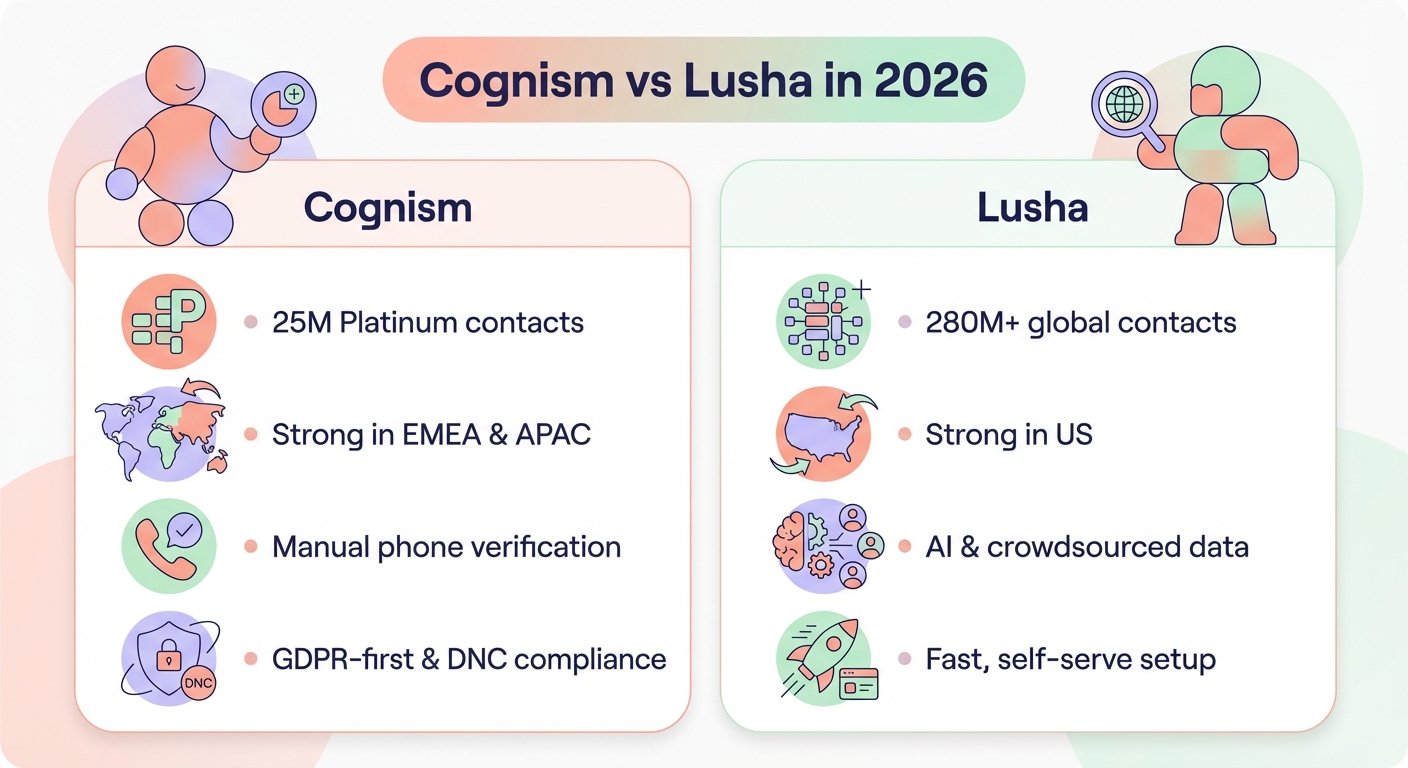
The core difference is in approach. Cognism focuses on approximately 25 million high-quality Platinum contacts with extensive manual verification, especially in EMEA and APAC markets. Lusha offers a larger database of 280 million contacts globally, but accuracy is hit-or-miss outside North America.
If you’re selling into European markets or need verified phone numbers, that distinction matters. If you’re a US-focused team running high-volume prospecting, your priorities differ.
Data quality: where your list actually matters
Bad data costs more than the subscription fee. It costs your reps hours of dead-end calls and damages your sender reputation when emails bounce.
Cognism uses manual verification for what they call Diamond Data® with phone-verified contacts and extensive DNC (do not call) compliance, aiming for fewer wrong numbers. Promon, a client in Southern Europe, reported that 33% of meetings booked in that region came from Cognism-generated leads, directly contributing to closed revenue and ROI.
Lusha uses AI and crowdsourced verification. Independent reviews on G2, Capterra, and Trustpilot indicate users face data quality issues including outdated contact information and limited coverage in international markets. The platform performs well in the United States and parts of Europe, but becomes less reliable beyond English-speaking markets.
If you’re expanding into EMEA or APAC, Cognism’s GDPR-compliant and manually verified data in Europe, EMEA, and APAC makes it the stronger choice for B2B teams expanding into new markets in those regions. If you’re a small US team doing mostly domestic outreach, Lusha’s larger database and lower entry price might fit.
Cognism has a G2 rating of 8.6 compared to Lusha’s 8.5, with users indicating Cognism slightly outperforms on performance and reliability. Cognism’s manual verification process results in fewer wrong numbers and dead ends compared to Lusha’s AI and crowdsourced verification approach.
Features: what’s actually included
Both platforms offer CRM enrichment, list building, and integrations, but the tier where those features unlock varies significantly.
Cognism includes CRM enrichment and DNC filtering on all packages. You’re not paying extra to avoid calling people on do-not-call lists. All tiers also have access to the full contact database with no artificial credit ceiling.
Lusha reserves CRM enrichment for its most expensive Scale package. The lower tiers give you database access, but core prospecting capabilities like APIs and custom workflows are locked behind higher plans. Lusha also offers Bombora intent signals and email sequences automation, but only on the top tier.
On the integration side, Lusha offers published documentation and native CRM connections. Cognism lacks public integration documentation, requiring sales calls to determine compatibility. If plug-and-play setup matters to you, that’s a real consideration.
For teams evaluating how these tools fit into broader workflows, our sales workflow automation tools comparison explores how native integrations save setup time and reduce friction.
Pricing: what you’ll actually pay
Neither platform publishes full pricing, but here’s what buyers report in 2026.
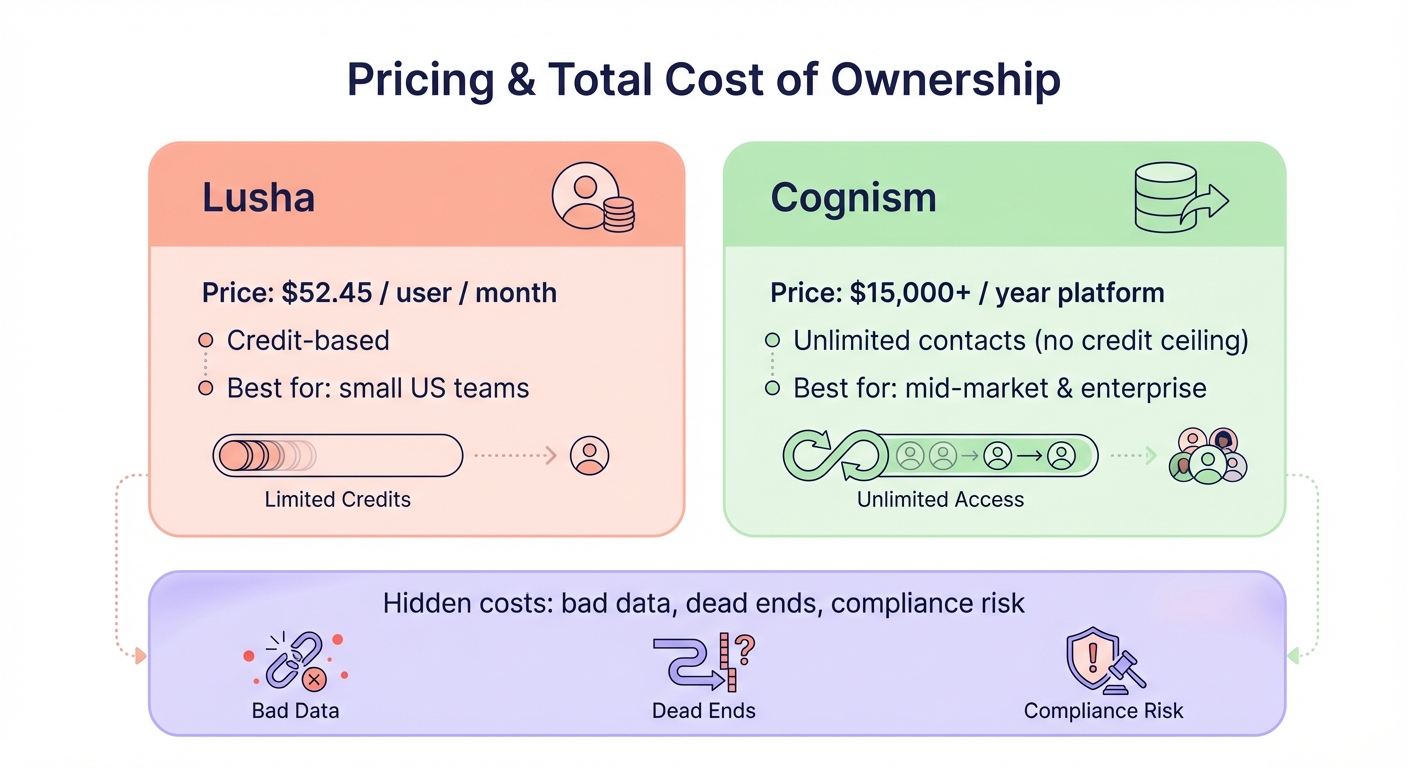
Lusha’s pricing starts at $52.45 per user per month billed annually. That sounds reasonable until you hit the credit limits. Lusha has maximum credits per user, requiring additional users for more credits and creating a scarcity mindset. If you’re doing serious prospecting volume, you end up paying for extra seats just to get more data. Lusha’s credit-based pricing only works well for low prospecting volume.
Cognism uses opaque enterprise pricing with platform fees around $15,000 or more and annual commitments. You won’t see a price until you talk to sales. But once you’re in, there’s no credit ceiling. You pay for seats, not artificial usage caps.
For a small team doing occasional prospecting, Lusha’s credit model can work. For a mid-market or enterprise team running consistent outbound campaigns, Cognism’s unlimited structure often ends up cheaper per qualified contact.
Total cost of ownership: the hidden expenses
Your data provider subscription is just the start. Factor in the time your reps spend validating bad data, the cost of bounced emails hurting your domain reputation, and the opportunity cost of chasing dead-end leads.
With Cognism, the higher data accuracy from manual verification means fewer wrong numbers and dead ends. That’s time saved on your end. The trade-off is the higher upfront price and the need for a sales call to even see pricing. Cognism is noted for transparent practices, reliable accuracy, and commitment to compliance. The platform is considered the reference for large enterprises with high compliance requirements.
With Lusha, you get faster onboarding and transparent pricing tiers, but users report unsolicited contact and concerns about how personal data is handled. If compliance is a concern – especially under GDPR – this matters.
For UK and European teams, GDPR compliance isn’t optional. Cognism’s data in Europe, EMEA, and APAC is GDPR-compliant and manually verified, while Lusha’s global database may require extra diligence to ensure compliance in non-US markets.
Looking at the total cost picture requires thinking beyond subscriptions. Our guide to metrics for evaluating AI-driven lead quality explains how to measure the true ROI of your data investments by tracking conversion rates, time savings, and cost per qualified lead.
When each platform makes sense
Choose Cognism if:
You’re expanding into EMEA, APAC, or other international markets where data quality drops off for US-centric providers. You need phone-verified mobile numbers and DNC compliance built in. Your team runs high-volume prospecting and credit limits would slow you down. Compliance and data transparency are non-negotiable for your industry.
Cognism is the stronger choice for B2B teams expanding into new markets in EMEA and works best for established mid-market and enterprise teams with consistent outbound motion. Cognism claims three times better connect rates in European markets with phone-verified Diamond Data and extensive DNC compliance.
Choose Lusha if:
You’re a small team prospecting primarily in the US or English-speaking markets. You want published pricing and fast onboarding without a sales call. Your prospecting volume is low to moderate and credit limits won’t be a bottleneck. You value plug-and-play CRM integrations and self-service setup.
Lusha is a good tool for smaller teams looking to prospect in the US and suits startups or small sales teams that need quick access to contacts without enterprise-level complexity.
The 2026 reality: data access isn’t the bottleneck anymore
Here’s the bigger question facing GTM leaders in 2026: why are you spending budget on data platforms when the real bottleneck is execution?
Both Cognism and Lusha give you access to contact records. But you still need someone to build the list, research each account, write personalized messages, handle deliverability, and follow up at the right time. That’s either your rep’s time or another stack of tool subscriptions.
The market has moved beyond simple data lookup. AI automation for B2B lead generation now handles the entire workflow: list building, enrichment, research, decision-maker identification, outreach writing, and deliverability monitoring. Modern AI lead generation tools for sales teams deliver booked meetings, not just contact records.
Sera’s Autopilot is powered by six specialist AI agents working together. A List Building Agent creates ultra-targeted lead lists from 300 million companies and one billion professional profiles. An Enrichment Engine adds firmographics and tech stack data. A Research Analyst finds timing and relevance signals. A Decision Maker Identifier confirms the right buyer. A Deliverability Guard protects your sender reputation and keeps emails landing in inboxes at 99% deliverability. An Outreach Writer crafts human-sounding, multilingual emails across 100 languages.
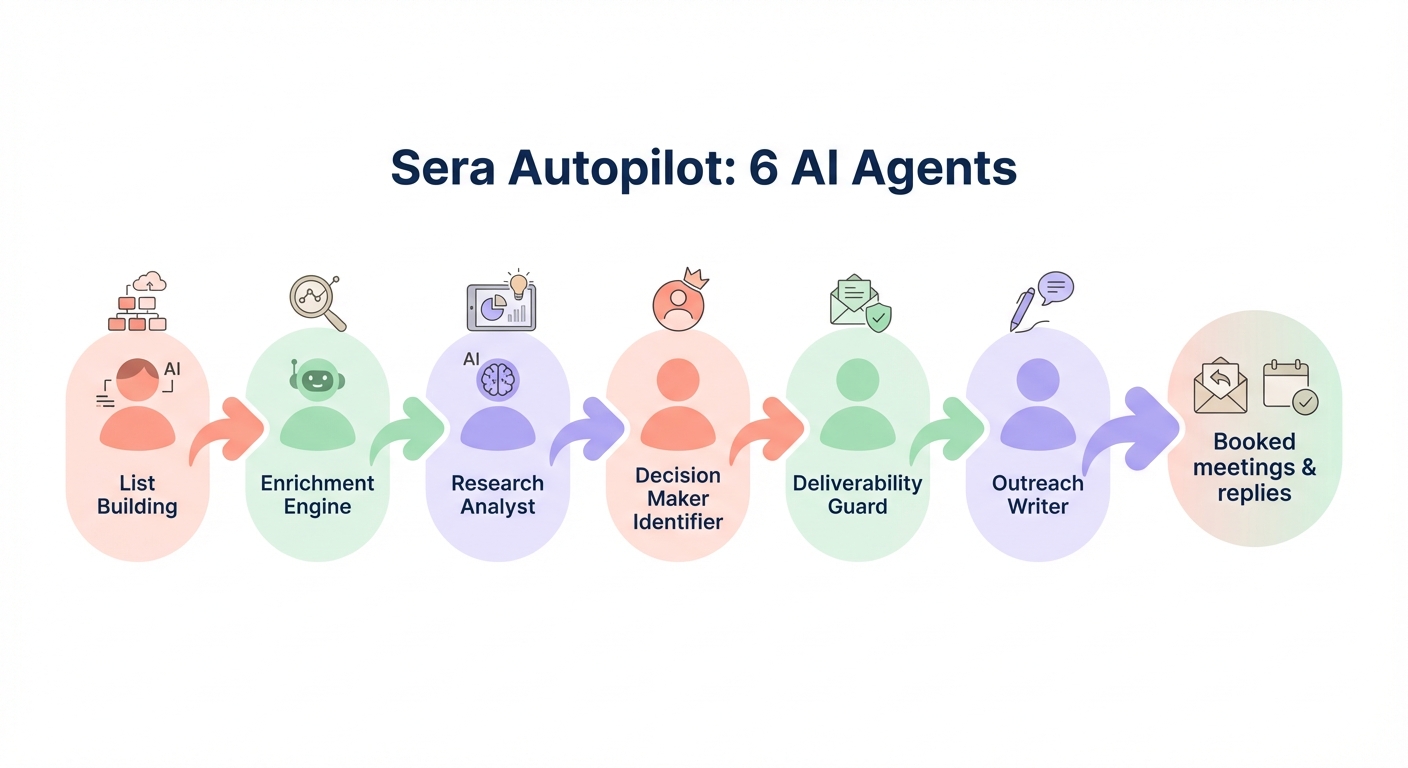
Instead of buying data and then figuring out what to do with it, you get an end-to-end outreach service. The AI agents handle approximately 93% of the work while humans supervise for quality. You don’t export CSVs, you don’t write sequences, you don’t warm domains. You get qualified leads, booked meetings, and replies in your inbox.
Using AI sales agents to book more sales meetings means your reps focus on closing deals, not managing data providers. For teams expanding into new markets – especially across Europe where Sera has connected 1,000 companies – this approach delivers faster validation and higher ROI than data subscriptions alone.
For manufacturing companies in particular, Sera works with Viking Window and 39 other manufacturers to open deals across Ireland, Germany, Poland, Finland, the Netherlands and beyond. The approach turns outbound into a structured feedback loop for go-to-market validation, helping teams test value propositions by segment and language without hiring multilingual SDRs.
What to do next
If you’re committed to a data provider, the choice depends on your market and team size. Cognism for international expansion and high compliance needs. Lusha for US-focused, smaller teams that want self-service setup.
But if you’re evaluating tools in 2026, ask yourself: do you want to buy data, or do you want booked meetings?
Sera’s AI-driven Autopilot replaces the entire prospecting stack – data provider, enrichment tool, sequencing platform, and junior SDR – with a human-supervised AI service. You get research-driven, low-volume outreach that lands in inboxes, not spam folders. Setup takes 15 minutes, and clients typically see replies within the first week.
Book a free consultation at seraleads.com to see how Sera’s six AI agents can handle your outbound motion while you focus on closing deals.