

Are your sales reps actually selling, or are they just expensive data entry clerks? In 2026, clicking through manual cadences in Outreach or Salesloft is a costly relic that drains your manufacturing firm’s resources.
The state of sales engagement in 2026
Both Outreach.io and Salesloft have long been the gold standards for managing multi-channel outreach. They provide a central hub for email, LinkedIn, and phone calls, ensuring that no prospect falls through the cracks. However, for a B2B manufacturing executive, the challenge is no longer just “sending more emails.” It is about reaching the right decision-makers at industrial firms with high-precision technical relevance.
Outreach has evolved into a comprehensive revenue execution platform. It unifies prospecting with deal management and forecasting, making it a heavy-duty option for large enterprises. Its agentic AI, known as Kaia, provides real-time coaching during calls and can even flag at-risk deals by analyzing prospect activity. This level of sophistication is excellent for teams with dedicated sales operations managers, but it often comes with a steep learning curve that can frustrate seasoned industrial sales veterans.
Salesloft remains focused on the user experience and high-velocity execution. It consistently earns high marks for its intuitive interface, which allows reps to start running sequences with minimal training. While it lacks the deep forecasting depth of Outreach, its Rhythm engine does a great job of prioritizing daily tasks so your team knows exactly who to call next. If you are evaluating Salesloft alternatives for manufacturers, the choice usually comes down to whether you want a sophisticated platform to manage or a simpler tool that your team will actually use.
Comparing core features and automation
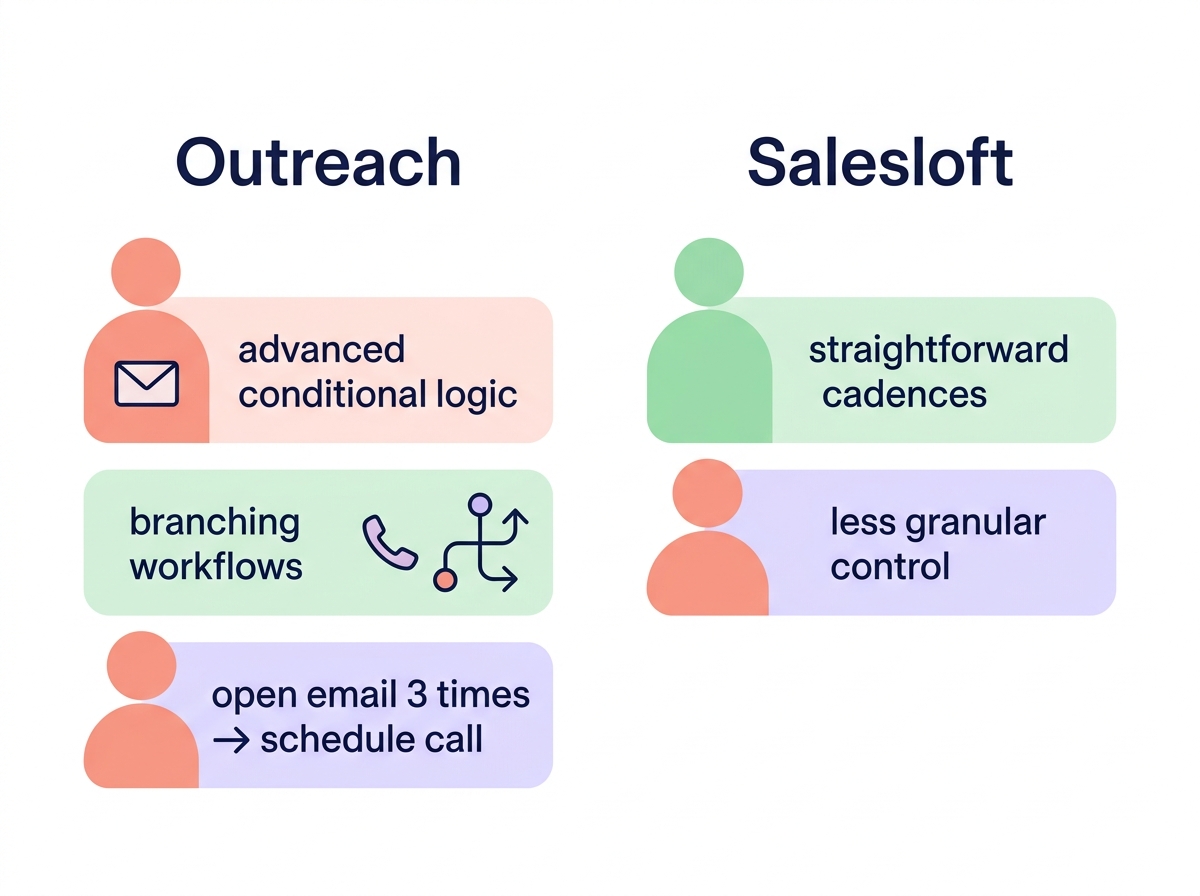
When it comes to sequencing, Outreach offers advanced conditional logic and branching. You can build complex workflows where the system automatically schedules a call if a prospect opens an email three times. This is particularly useful for long manufacturing sales cycles where timing is everything. Salesloft provides reliable automation for straightforward cadences, but it offers less granular control for multi-path journeys.
The role of artificial intelligence has also diverged. Outreach’s AI focuses on executing actions within a deal, such as summarizing meetings or updating CRM fields. Salesloft uses an Analytics Interpreter to give you insights into what is happening across your pipeline, though it often requires a human to take the next step. Despite these advancements, both platforms still operate on a “tool” model. Your reps are still the ones doing the research, building the lists, and clicking the “send” buttons on every manual task.
CRM integration is another critical factor for industrial firms using Salesforce or HubSpot. Outreach provides a deeper bidirectional sync with custom mapping, which is vital if your CRM is the single source of truth for complex engineering projects. Salesloft offers solid connectivity but may require third-party tools like Zapier if you need to automate highly specific manufacturing workflows.
The hidden cost of manual sales software
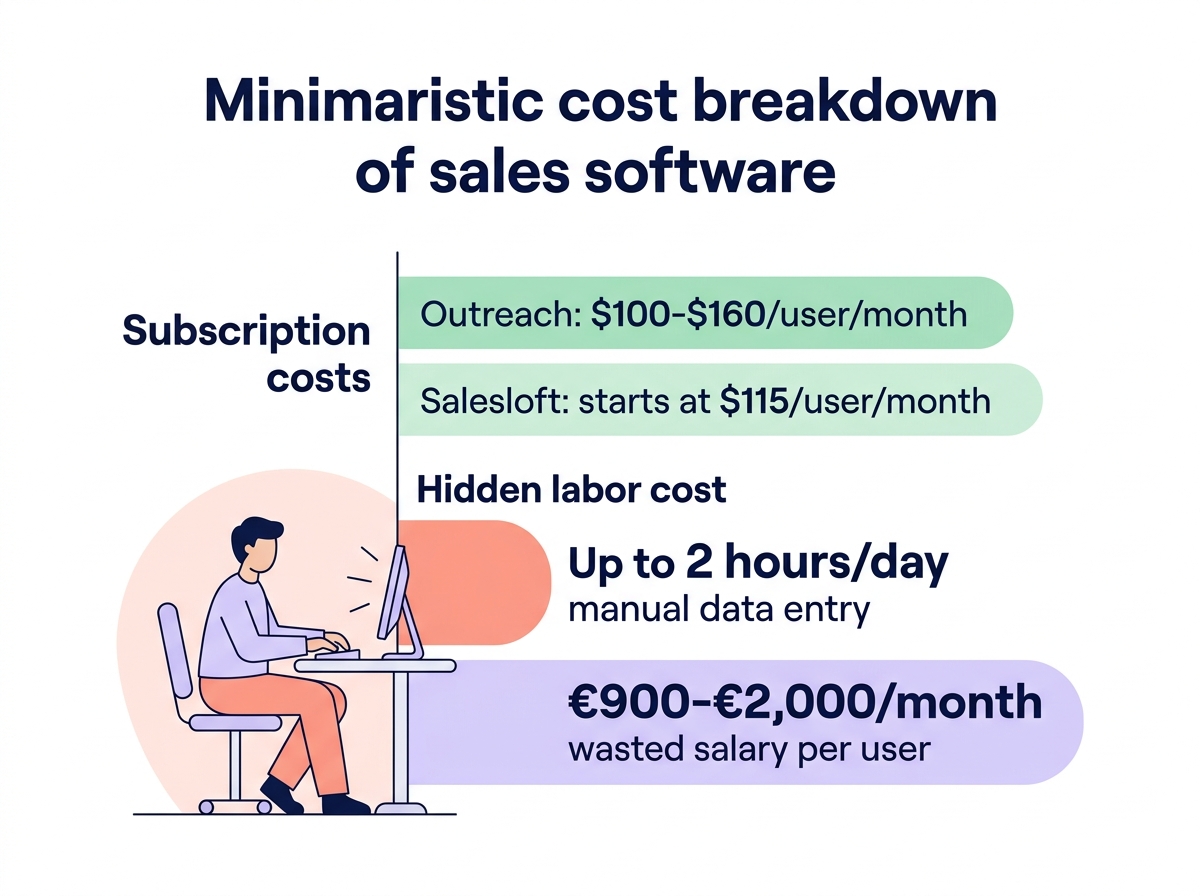
The true cost of these platforms is rarely found in the subscription fee. While Outreach can cost between $100 and $160 per user monthly, and Salesloft starts around $115, the real drain is human labor. Research indicates that reps still spend up to two hours every day on manual data entry and list cleanup. When you factor in the time spent on AiSDR pricing and budgeting, you realize that your “automated” tool is actually costing you an additional €900 to €2,000 per month in wasted salary for every user.
Manufacturing teams also face the massive burden of list building and deliverability. Neither Outreach nor Salesloft finds or qualifies your leads for you. You still need to pay for data providers like ZoomInfo or Cognism and spend hours confirming that a plant manager is still at the same company. Furthermore, because these tools send from your domain, your team is responsible for technical setup and reputation monitoring. If your volume is too high or your targeting is off, you risk damaging your domain reputation, a common pitfall mentioned in this AISDR review.
Why autonomous AI agents are the 2026 alternative
For manufacturing companies selling high-value deals of €10,000 or more, the bottleneck is no longer execution – it is intelligence. You do not need a faster way for your reps to send generic emails. You need a way to identify the exact moment a buyer needs your equipment and reach them with a technical, research-backed message. This is where an AI-driven outreach autopilot replaces the manual work of traditional platforms.
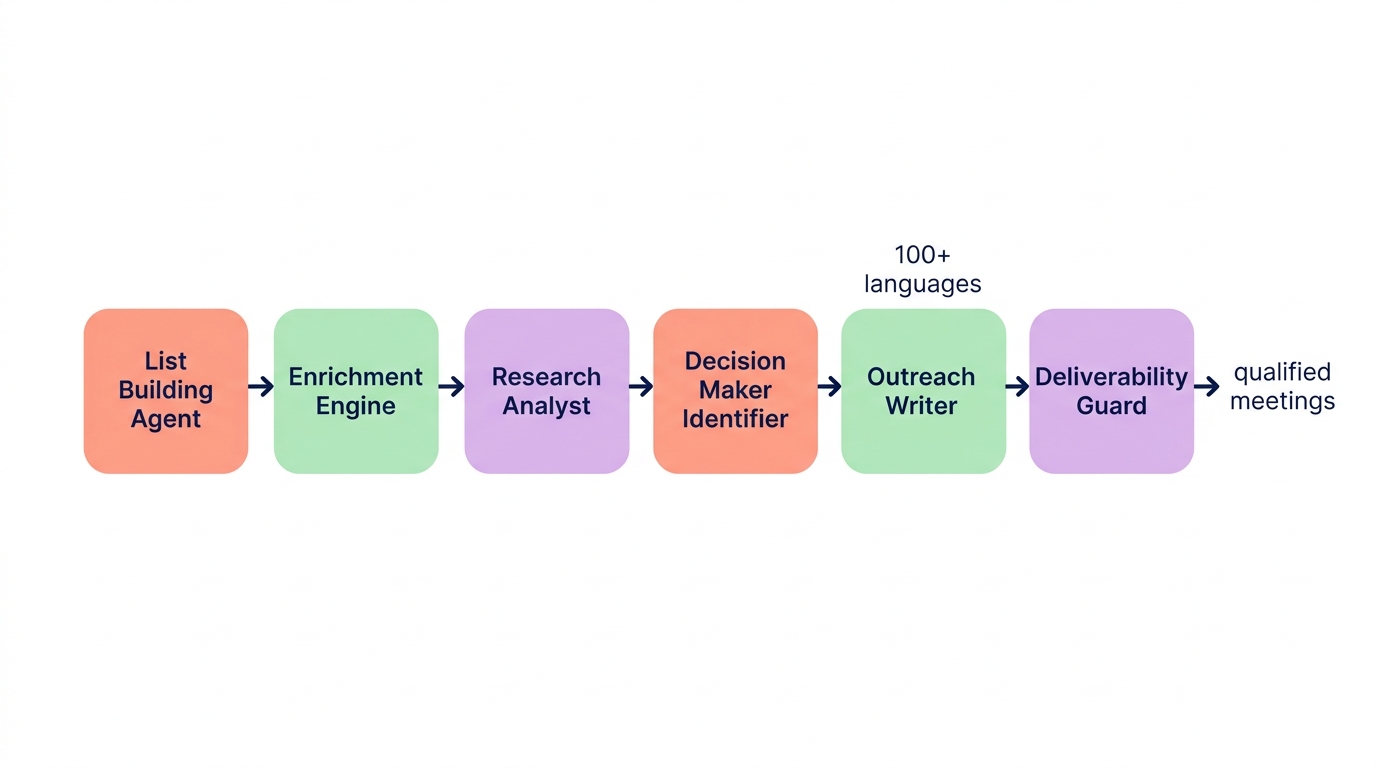
Instead of a tool that your reps must operate, an agentic system like Sera uses six specialized AI agents to handle the entire process. A List Building Agent and an Enrichment Engine find the right companies and deep firmographic insights. A Research Analyst and a Decision Maker Identifier then confirm the buyer’s identity and find a relevant “hook” for the outreach. Finally, an Outreach Writer crafts a human-sounding message in any of 100+ languages, while a Deliverability Guard ensures the email actually lands in the inbox.
- Sera agents handle roughly 93% of the manual labor, allowing your technical experts to focus on closing deals.
- The system operates with low-volume, high-precision outreach to protect your brand reputation.
- Native-level multilingual support allows you to expand into new European markets without hiring local SDRs.
- The service includes everything from domain warmup to verified lead lists, eliminating the need for a fragmented tech stack.
Choosing the right path for your manufacturing firm
If you have a large, established team of SDRs who enjoy the craft of manual prospecting and need a robust system to manage their activity, Outreach or Salesloft are solid choices. Outreach is the “SUV” of the category – powerful and complex – while Salesloft is the “sedan” – efficient and easy to drive. Both will help you organize your team, but neither will do the work for you.
However, if you want your sales engineers and account managers to stop clicking buttons and start having conversations, an autonomous system is the better investment. For manufacturers, the goal is often to find real-world evidence of success in specific niches. While platforms like Artisan offer autonomous features, many manufacturers find that a human-supervised AI service provides the necessary guardrails to ensure technical accuracy and brand safety.
In 2026, the winning companies will be those that treat their sales team as closers, not operators. By moving the burden of research and initial contact to Sera’s AI agents, you reclaim over 120 hours per rep annually. This time is better spent on site visits, technical consultations, and building the relationships that actually drive revenue.
To see how an autonomous AI autopilot can fill your calendar with qualified meetings without the manual overhead of traditional software, book a free 30-minute consultation with Sera.