


Did you know that small and mid-sized firms drive a massive portion of international trade, yet many hesitate to expand due to regulatory fear? Entering a new export market does not have to be a high-stakes gamble. With a structured strategy, you can protect your margins and scale overseas sales.
Phase 1: Strategic market selection
The first step in reducing expansion risk is narrowing your focus. Rather than trying to target an entire continent, select three to five high-potential regions to analyze.
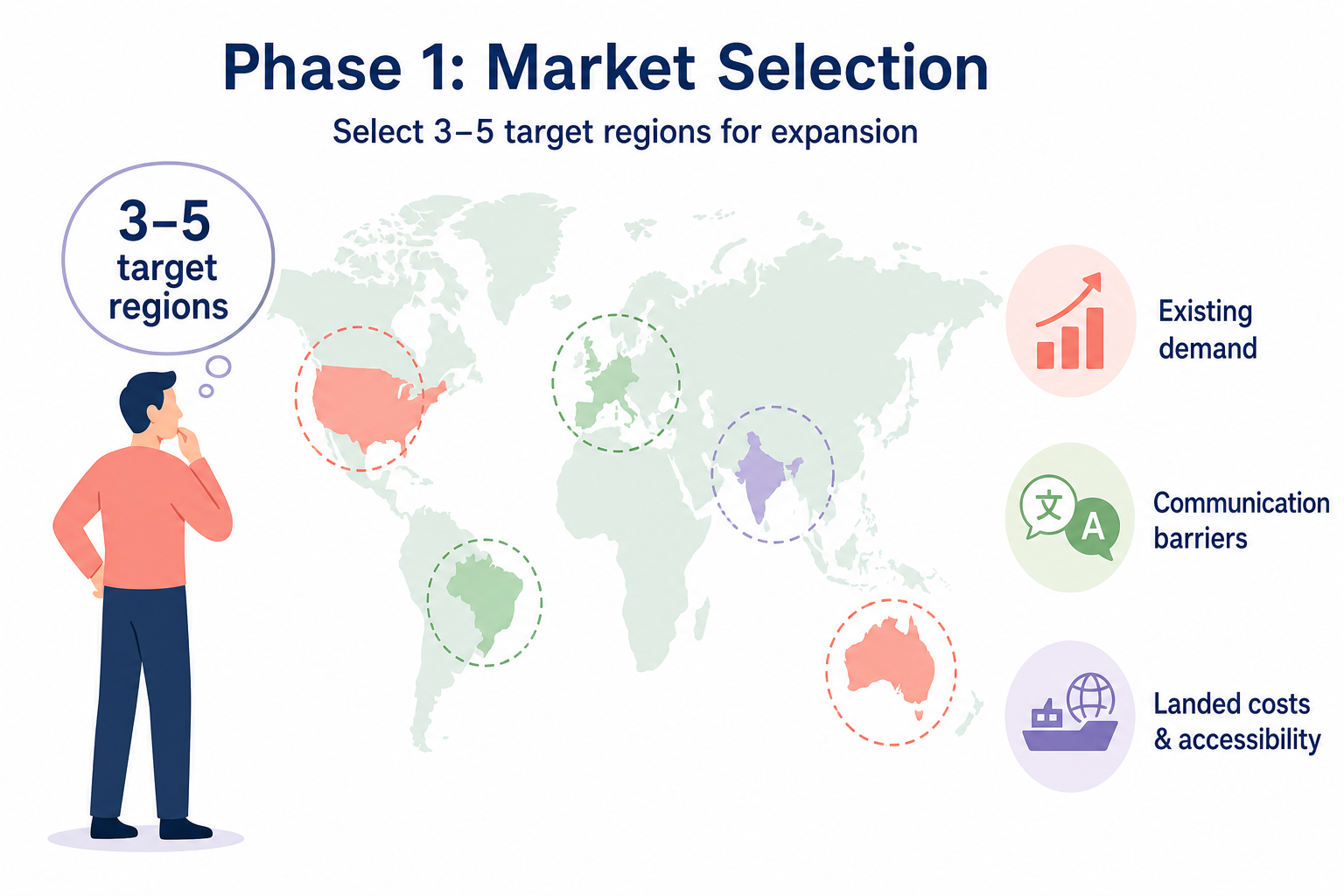
When evaluating potential target markets, look closely at:
- Existing demand: Research whether similar products already sell well in those markets. If they do, you have a validated commercial opportunity.
- Communication barriers: Consider how you will handle language differences. If your target buyers do not speak English, you must plan for translation or partner with intermediaries who can close the communication gap.
- Landed costs and accessibility: Calculate shipping costs, geographic accessibility, and local taxes to ensure your margins remain healthy.
To ensure your sales team focuses their energy where it yields the highest return, you need a robust framework to balance regional opportunities, average deal sizes, and market workloads. Implementing strategic territory and account planning for export helps you distribute resources efficiently and keep reps focused on high-value accounts.
Phase 2: Navigating regulatory and compliance risks
Compliance mistakes can result in impounded shipments, heavy fines, or damaged brand reputations. In fact, research shows that 42% of UK small and medium-sized enterprises (SMEs) report needing six to twelve months to break even on new export ventures. This delay is largely due to compliance costs, market adaptation, and unexpected payment cycles.
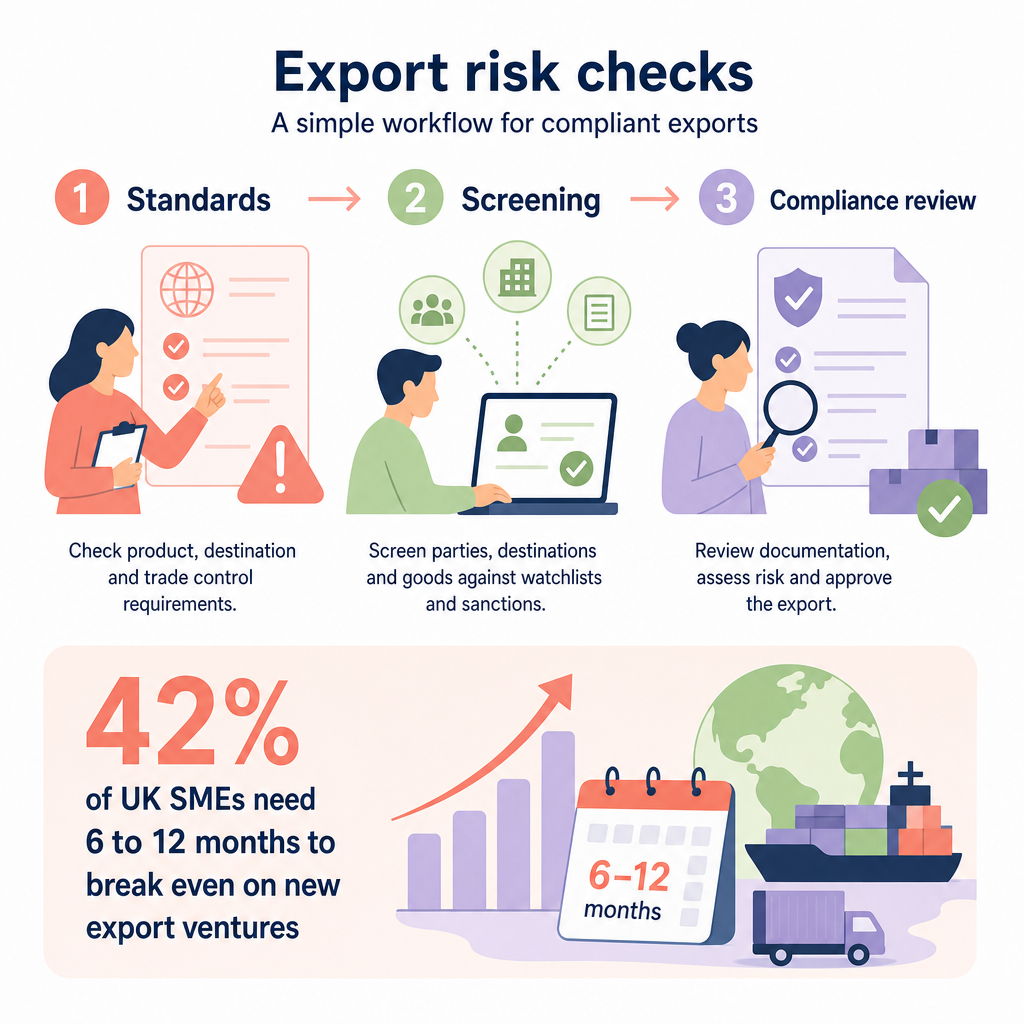
To protect your business, build a strict compliance workflow covering several critical areas.
Product standards and licensing
Almost all manufactured exports require some form of local registration, testing, labeling, or licensing prior to release. Determine early on if your products require specific certifications, such as CE, FDA, UL, or VDE. If your products have civilian and military dual-use applications, you must check the Export Administration Regulations (EAR) and identify your Export Control Classification Number (ECCN) to see if you require a specialized export license.
Party screening
Before shipping goods or signing contracts, verify that you are not doing business with restricted individuals or entities. The fastest way to do this is to check the Consolidated Screening List (CSL), which aggregates various government restrictions on exports, reexports, or transfers of items.
Export Compliance Programs (ECPs)
Establish a clear internal Export Compliance Program (ECP). An ECP is a series of written procedures covering classification, licensing, and screening to mitigate the risk of violations. Regularly auditing your ECP ensures you catch potential compliance issues before they turn into costly operational delays.
Understanding these regulatory rules is crucial to overcoming the common export myths that often discourage smaller manufacturers from scaling internationally.
Phase 3: Choosing your distribution channel
Your channel strategy defines your operational risk, market control, and profit margins. Manufacturers typically choose between three main entry models:
- Distributors: Distributors purchase your products directly, add their own markup (typically 15% to 40%), and resell them locally. They handle local logistics and assume customer credit risk, making this the fastest, lowest-risk entry model.
- Sales Agents: Agents work on a commission basis (usually 5% to 15%) to secure sales on your behalf. You retain ownership of the inventory and customer relationships, but you also bear the financial risk.
- Direct Sales: Selling directly to end buyers maximizes your profit margins and provides rich market intelligence, but it requires a high upfront investment in local sales headcount and infrastructure.
Before making a commitment, it is critical to weigh the pros and cons of distributors, agents, and direct sales channels to see which model matches your product complexity and risk tolerance.
If you choose to work with local intermediaries, vetting them thoroughly is vital. A poor partner choice can cost six figures in lost sales, damaged reputation, and legal fees. Use a structured, multi-week vetting process to evaluate their financial stability, technical competence, and market coverage before signing any agreements. You can streamline this step by learning how to qualify distributors and sales agents using rigorous evaluation scorecards.
Phase 4: Building an export pricing strategy
Domestic pricing models rarely work overseas because they ignore the hidden costs of international trade. To avoid eroding your margins, you must calculate your true landed cost.
Your landed cost is your absolute price floor. It includes:
- Your Ex-Works (EXW) factory price
- Export packaging and inland transport
- Freight, insurance, and port handling fees
- Customs duties, local taxes, and import VAT
- Currency exchange buffers and transaction fees
Once you have established your floor price, evaluate the competitive landscape in your target market. Differentiated, high-quality manufacturers can often command a premium, while commodity products must compete closely on price.
Additionally, clarify your Incoterms – such as Free on Board (FOB) or Delivered Duty Paid (DDP) – in every contract so both parties know exactly who is responsible for shipping costs and import duties. You can discover more tactics for protecting your margins and managing currency risk in our guide on building an export pricing strategy.
Phase 5: Launching and scaling multilingual outreach
Once you have selected your market, verified compliance, and structured your pricing, it is time to build a predictable sales pipeline. Many traditional manufacturers fail at this stage because they rely on English-only outreach in non-English-speaking markets.
Localization is the key to building trust. Research shows that 72% of customers prefer native-language interactions, and sales teams with cultural intelligence training achieve 20% to 25% faster market penetration.
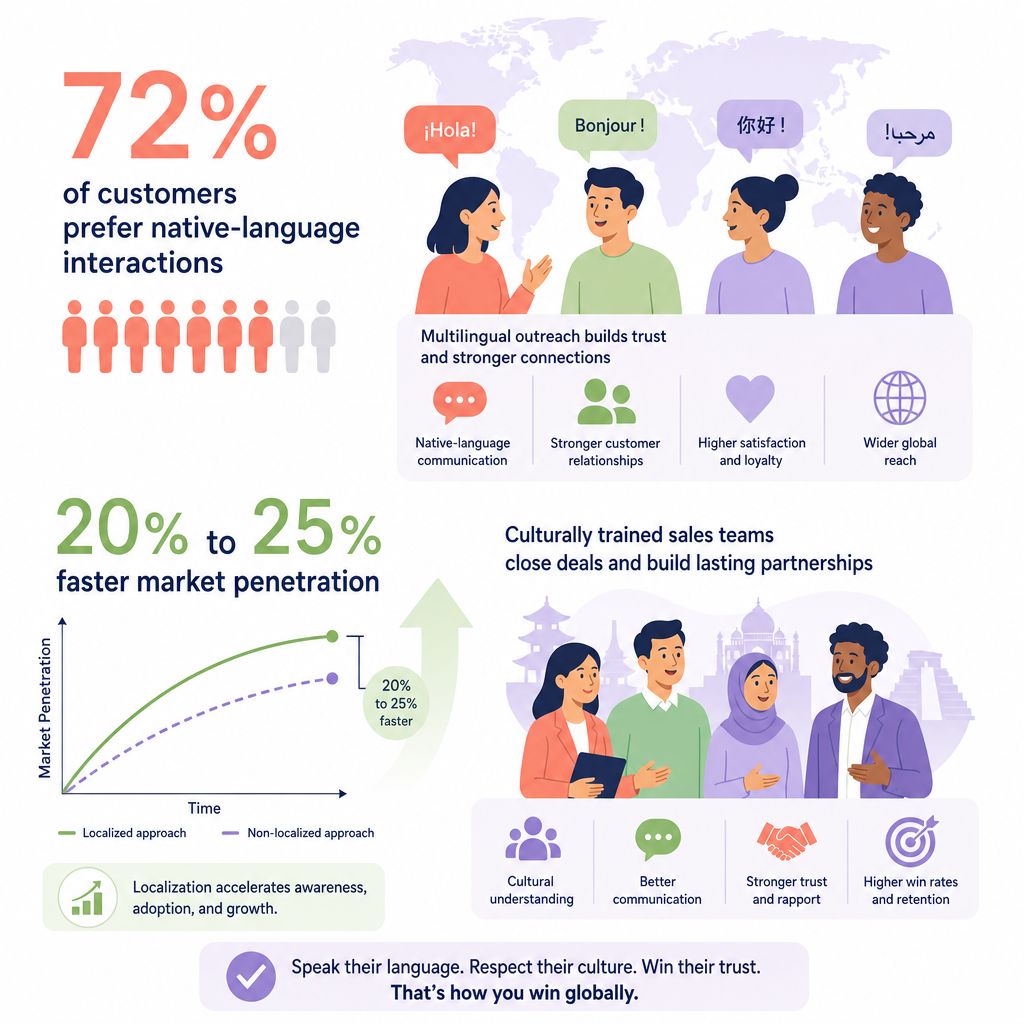
To build an efficient system for multilingual outreach for export sales, focus on these core tactics:
- Tailor your messaging: Do not rely on literal translations, which can decrease conversions by up to 56% compared to properly localized content. Adapt your sales emails, product brochures, and case studies to reflect local terminology, technical standards, and business etiquette.
- Calibrate your formality: Understand the cultural nuances of your target country. For example, German prospects expect detailed technical specifications and formal email structures, while U.S. buyers prefer direct, brief pitches. You can explore these differences in our guide on navigating cultural differences in selling.
- Adopt automated sales technology: Building an international sales pipeline manually is slow and expensive. Modern manufacturers are increasingly adopting sophisticated global customer acquisition strategies powered by smart automation to discover high-value prospects, qualify leads, and scale their initial outreach campaigns with limited administrative overhead.
Scale your export sales with confidence
Entering a new international market requires balancing careful risk management with proactive business development. By structuring your territories, verifying compliance, securing the right local partners, and localizing your outreach, you can turn international expansion into a highly predictable revenue driver.
If you are ready to identify and engage qualified buyers in your target markets, Sera can help. Sera’s AI-powered sales autopilot uses specialized AI agents to handle your market research, find decision-makers, and execute highly personalized, native-level outreach in over 100 languages.
Check out our manufacturing use cases to see how other industrial businesses use Sera to book meetings with global distributors and direct buyers, or request your first five verified leads for free today.