

Are your traditional outbound efforts failing to reach the right industrial buyers? Companies using predictive AI see an average 42% reduction in customer acquisition costs while boosting conversion rates by 31%.
The shifting landscape of industrial purchasing
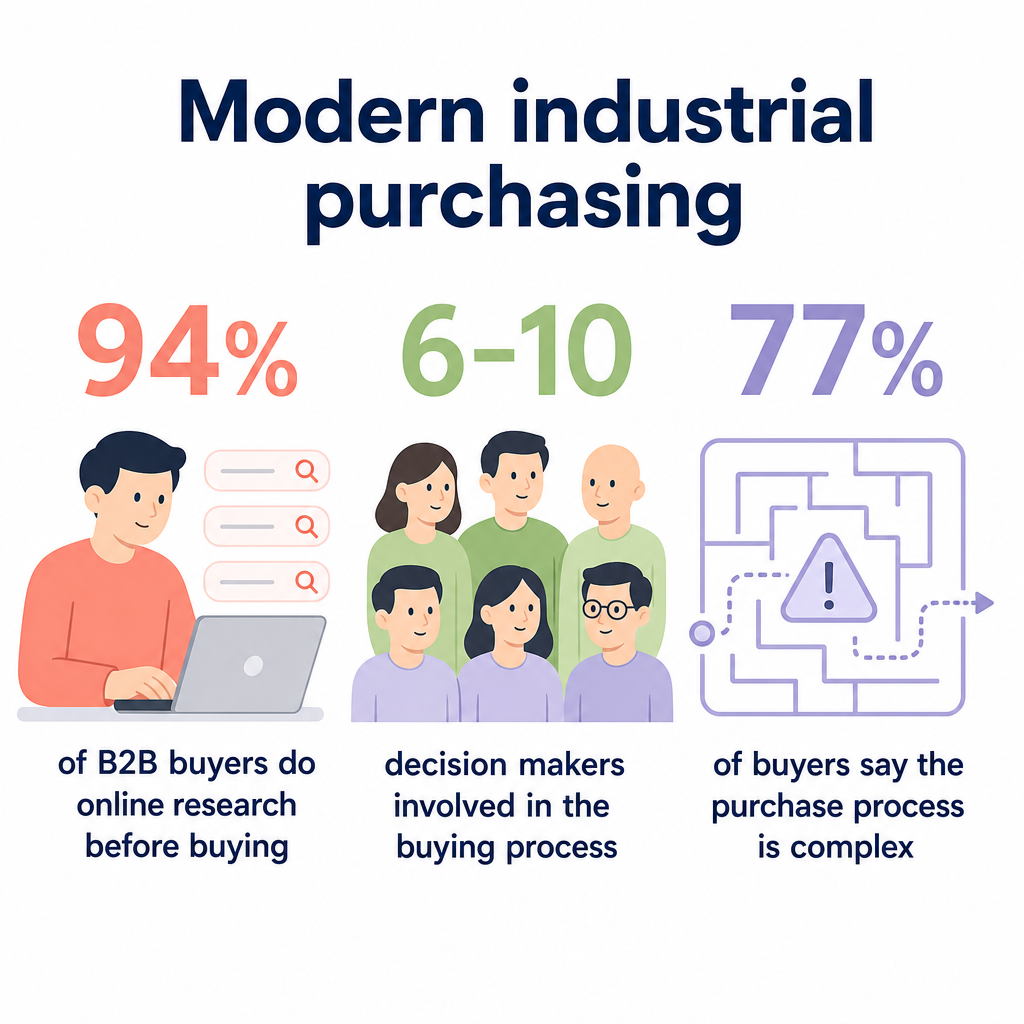
B2B buying behavior has changed permanently. Around 94% of B2B buyers conduct online research before purchasing a product, and the typical buying group now consists of 6 to 10 decision-makers. To make matters more difficult, 77% of these buyers describe their latest purchase as complex or hard to navigate.
Most importantly, only 12% of buyers want to meet in person with a sales representative during their decision-making process. If your sales team is still relying on cold visits, trade shows, and manual directory searches, you are missing out on active buyers.
Why AI lead generation is transforming manufacturing ROI
In the manufacturing sector, finding the right distributor, procurement manager, or commercial partner takes weeks of manual work. Sales reps spend hours digging through databases, verifying emails, and tailoring messages.
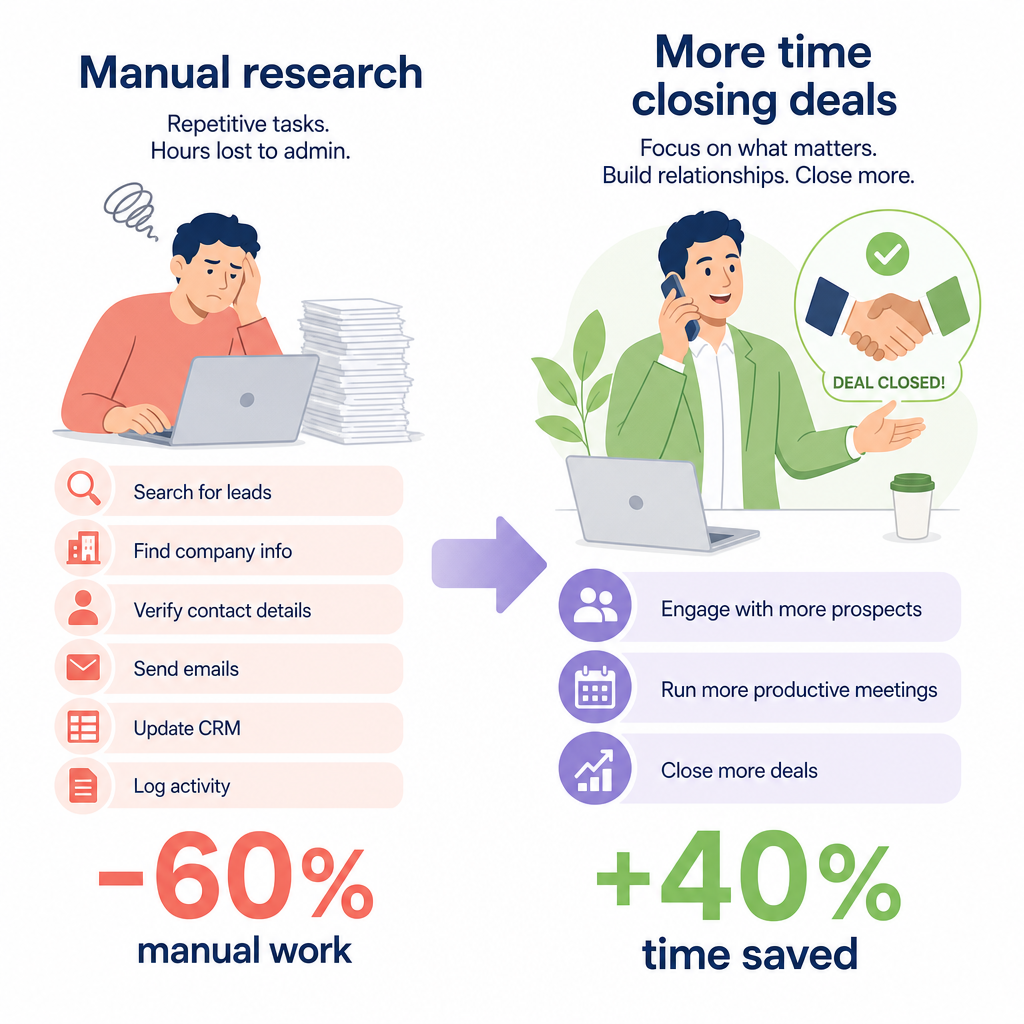
Modern AI deployments solve this problem by eliminating repetitive admin. AI systems can achieve a 60% reduction in manual work by automating routine tasks. This translates directly to a 40% time savings for your sales team, allowing them to redirect their energy toward closing deals rather than researching prospects. You can learn more about how to free your team from routine admin in our guide on AI-driven automation to reduce manual sales tasks.
Because these tools replace time-consuming manual labor, the return on investment is rapid. Typical payback periods for AI outbound systems range from 3 to 9 months, with small and medium-sized manufacturers often seeing the fastest financial return. Review our detailed cost-benefit analysis in our report on roi benchmarks for AI SDR deployments.
Tracking and measuring your lead generation return
To properly evaluate your return on investment, you must move beyond basic metrics like lead volume. True efficiency is measured by how effectively your pipeline converts initial interest into booked meetings and closed revenue.
When calculating your ROI, track these primary indicators:
- Lead qualification speed: How quickly can your team identify high-value buyers?
- Cost per qualified lead: The actual cost of finding and validating a decision-maker.
- Response time: The speed at which your systems engage a warm prospect.
- Customer acquisition cost: The total sales and marketing spend required to win one account.
Implementing automated qualification systems can reduce your lead qualification time by 30% to 50%. This ensures your sales engineers only spend time talking to buyers who have the budget, authority, and immediate need for your products. Explore these measurement strategies in our analysis of ROI optimization for international sales.
Practical techniques to optimize your pipeline
Modern AI tools allow manufacturers to run targeted, research-backed campaigns without expanding their internal head count.
- Website Visitor Identification: Most industrial buyers research your products anonymously. New AI tools identify these anonymous website visitors before they even fill out a form, turning your corporate site into an active prospecting tool. For details on capturing this hidden intent, read about boosting ROI with automated lead engagement strategies.
- Predictive Sales Intelligence: Rather than guessing which accounts are ready to buy, predictive algorithms analyze historical deal data and market signals to rank your prospects. For a deeper look at how data transforms your sales pipeline, read about predictive analytics for sales prospects.
- Coordinated Multi-Channel Outreach: Relying entirely on a single outreach channel leaves money on the table. Reaching out across email, LinkedIn, and phone can raise overall response rates by up to 40%. Learn how to build a unified campaign in our guide to multichannel outreach automation.
Enhancing lead qualification with automated systems
Traditional qualification relies on manual lead scoring, which is often slow and prone to human error. AI qualification engines run constantly in the background, analyzing cross-channel behavior to surface ready-to-buy accounts.
These systems look at multi-dimensional data, including company size, geographic region, and active behavioral triggers. For example, if a procurement manager visits your product specification page multiple times, the system recognizes this digital body language as a high-intent signal.
Instead of waiting for the prospect to reach out, the system automatically triggers a highly tailored, timely sequence. Discover how to build these triggers in our overview of best practices for AI-driven outreach customization.
To ensure your team acts on these insights immediately, these systems sync directly with your existing database. You can learn more about linking your records with predictive systems in our guide on integrating CRM data with AI prospect insights.
Scaling personalized outreach without losing the human touch
Industrial manufacturing relies on trust and long-term relationships. Generic, mass-scale spam emails do not work for five-figure or six-figure contracts.
However, manual personalization is incredibly difficult to scale. This is where AI excels. By analyzing industry pain points, active news, and company profiles, automated writers can draft highly personalized messages that read as if they were written by a human.
McKinsey research indicates that personalization typically drives a 10% to 15% revenue lift. Implementing automated personalization layers allows you to scale this outreach across multiple regions and languages without sacrificing quality. Read more about structuring these sequences in our guide to personalized outreach sequence automation.
This strategy has already been validated in the industrial sector. Companies like Viking Window have used highly targeted, research-driven automated outreach to open up new accounts across diverse European markets, including Germany, Ireland, and Poland. You can read more about these real-world campaigns in our manufacturing use cases and explore further industry success stories in our compilation of case studies on AI in lead generation.
Overcoming implementation hurdles
While the returns are clear, implementing AI lead generation requires addressing three specific challenges:
- Data Quality: Algorithmic predictions are only as good as the data feeding them. Regular data cleaning and automated enrichment are required to prevent bounced emails and inaccurate targeting.
- Regulatory Compliance: Targeting European and UK buyers requires strict adherence to GDPR. Ensure your chosen outreach tools use verified business data, include clear opt-out mechanisms, and protect sender reputation.
- Siloed Systems: Tools must communicate with each other. If your lead generation tool does not sync with your sales pipeline, valuable leads will slip through the cracks. Using integrated platforms ensures your team has absolute visibility. Learn how to track these connections in our breakdown of real-time analytics dashboards.
Why manufacturing leaders are choosing a supervised autopilot
Rather than stitching together separate software tools and hiring specialized agencies, progressive manufacturers are shifting to fully managed, agentic sales systems.
Sera operates as an end-to-end outbound autopilot powered by six specialized AI agents. Working together under expert human supervision, these agents build ultra-targeted lists, enrich prospect data, identify decision-makers, verify deliverability, and write human-sounding outreach in over 100 languages.
This low-volume, research-driven approach protects your brand’s reputation while consistently booking highly relevant meetings with target buyers.
Streamlining your industrial outbound for long-term growth
AI-driven lead generation is no longer an experimental luxury – it is an essential operational efficiency for modern B2B manufacturers. By automating administrative groundwork, adopting predictive scoring, and scaling hyper-personalized outreach, you can dramatically lower your acquisition costs while keeping your sales pipeline full.
Ready to automate your B2B sales outreach and fill your calendar with qualified meetings? Book a demo with Sera today to see how our human-supervised AI autopilot can scale your revenue.