

 Taavid Mikomägi, Head of Growth
Did you know that waiting just 30 minutes to contact a prospect makes you 21 times less likely to qualify them? If your sales team is wasting weeks chasing cold leads, AI feedback loops can automatically target your highest-value buyers in real time.
What are AI feedback loops in sales automation?
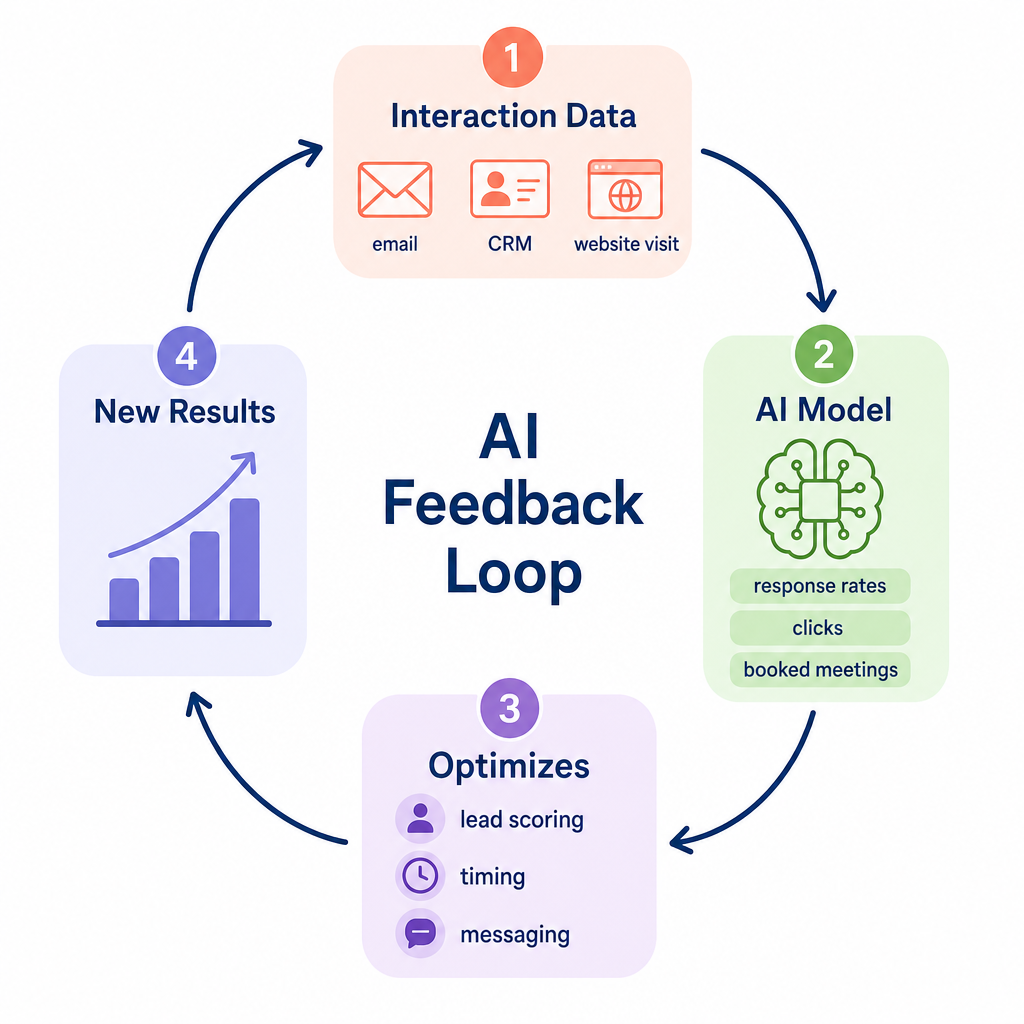
Unlike traditional sales workflows that follow static rules, AI feedback loops are continuous learning systems. They analyze outcomes like response rates, email clicks, and booked meetings to adapt your outreach strategies instantly.
Think of it as the difference between a GPS that automatically recalculates when you take a wrong turn, versus one block of static map directions that stubbornly tells you to stick to the original route.
Instead of relying on rigid, manual updates, these systems operate as a virtuous cycle:
- The system collects interaction data from emails, CRM updates, and website visits.
- An AI model analyzes these outcomes to detect patterns and buying signals.
- The algorithm automatically adjusts lead scoring, outreach timing, and messaging templates.
- New actions are executed, and the system monitors the results to repeat the process.
Currently, 28% of executives are piloting AI-led intelligent workflows, and another 34% are actively scaling them. Over half of C-suite leaders report positive performance outcomes after adopting these adaptive, self-correcting systems.
Stopping hot leads from cooling with adaptive qualification
In B2B manufacturing, timing is everything. Speed to lead is the single most critical factor in driving conversions. Reaching out to a prospect within five minutes can increase your qualification chances by up to 100x compared to waiting 30 minutes.
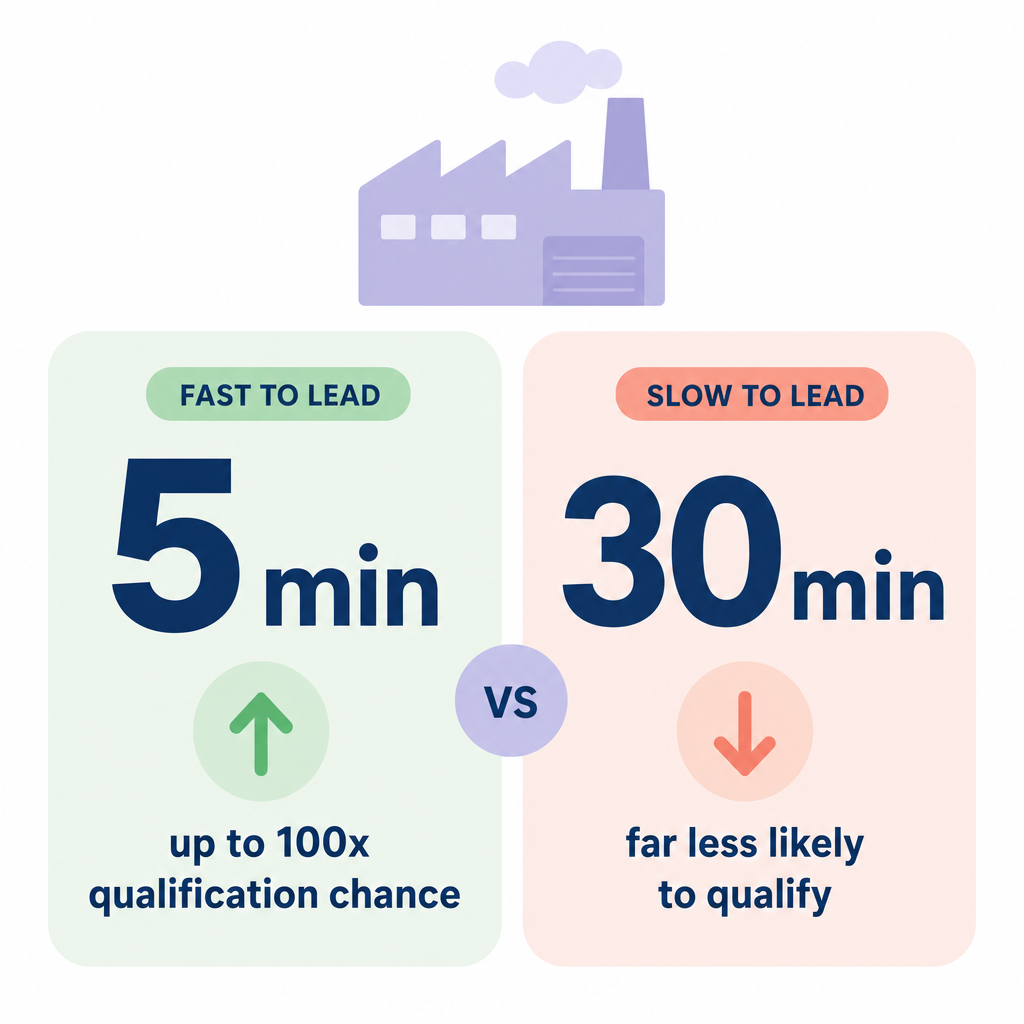
Static qualification methods often let these critical windows slip by. With adaptive machine learning models, you can optimize lead qualification with automation to evaluate prospects in real time.
These smart systems analyze historical conversion patterns to:
- Combine fit criteria, such as company size and industry, with intent signals like website engagement and content consumption.
- Automatically update lead scores the moment a prospect visits a pricing page or downloads a product specification sheet.
- Deliver highly prioritized, sales-ready prospects straight to your team.
This continuous evaluation ensures your sales reps do not waste time researching and pursuing cold leads. In fact, businesses using AI-driven qualification report a 50% increase in sales-ready leads and up to 60% lower customer acquisition costs.
Driving efficiency through automated follow-ups
Chasing prospects manually takes up valuable time that your team could spend building relationships. By introducing automated follow-up scheduling based on prospect behavior, you can trigger personalized touches without human delay.
If a prospect opens your email multiple times or revisits your website, the system detects this high-intent behavior. It immediately schedules a tailored follow-up or assigns a high-priority task to a sales representative. This ensures no high-value opportunity falls through the cracks.
To make these loops work effectively, your organization must streamline how information flows between tools. You can read about improving lead conversion rates with automation to see how automated scheduling, custom triggers, and synchronized databases shorten sales cycles.
Connecting CRM databases and AI insights
Your CRM is the lifeblood of your sales operations, but it only works if the data is accurate and up to date. Manual administrative work and repetitive logging can consume up to 40% of your sales team’s time.
Integrating your existing CRM with modern AI tools helps you recover these wasted hours. By integrating CRM data with AI prospect insights, you can automatically log activities, track communication patterns, and predict future buyer behaviors.
Additionally, integrating email outreach automation with CRM workflows ensures that when a prospect responds to an outreach sequence, their record updates instantly. This continuous feedback loop guarantees that your active sales outreach and records remain perfectly aligned.
Key strategies for building your feedback loop
Implementing these learning loops requires a deliberate approach that balances technology with human expertise. Consider these foundational best practices:
- Establish unified data mapping: Ensure that your email systems, website tracking scripts, and CRM sync flawlessly. Mismatched fields are the leading cause of automation workflow failures.
- Implement continuous A/B testing: Set up structured frameworks to test different messaging variants and value propositions. Let the AI evaluate response sentiments and automatically direct more resources to high-performing email templates.
- Maintain human oversight: Effective sales operations utilize AI-driven automation to reduce manual sales tasks like lead scoring and initial outreach. To execute this balance seamlessly, learn how to integrate AI tools into existing sales workflows without disrupting your current processes.
- Audit your models regularly: Perform regular reviews on your qualification thresholds to prevent model drift and ensure your automation adapts to shifting market conditions.
Real-world impact in the manufacturing sector
Old-school manufacturing companies are discovering that research-driven, automated outreach yields a massive competitive advantage. Instead of blasting thousands of generic emails, successful firms leverage intent signals to reach the right decision-makers at the right time.
For instance, leading manufacturers like Viking Window use target intelligence to identify companies entering buying phases. By tracking growth, hiring patterns, and specific behavioral signals, they engage prospects precisely when they are searching for solutions. You can explore how leading businesses validate new markets using targeted outreach on our manufacturing use cases page.
How to scale your sales pipeline with adaptive automation
By implementing AI-driven feedback loops, your sales team can shift away from repetitive, manual tasks and focus entirely on closing high-value deals. These adaptive systems continuously learn from every customer interaction, refining your sales approach automatically so your pipeline grows more efficient over time.
If you are ready to modernize your outbound strategy, explore how Sera’s specialized AI agents can act as an autopilot for your sales pipeline. Our system of coordinated agents works around the clock to find target accounts, verify decision-makers, and draft personalized outreach.
To see the power of automated intelligence firsthand, you can get five verified leads in three minutes with highly personalized messages customized for your target buyers. Discover how adaptive automation can transform your manufacturing GTM strategy by visiting Sera today.