


Are you tired of sending generic sales pitches that end up in the trash folders of busy plant managers? Standard cold emails in the industrial sector get ignored, but highly targeted campaigns can achieve up to 50% response rates.
The real cost of generic outreach in manufacturing
Many industrial companies still rely on broad, unsegmented lists. They send the same generic sales pitch to hundreds of procurement heads and operations directors. In the industrial sector, these mass emails yield dismal results.
Transitioning to high-precision, highly targeted campaigns can completely change your results. In fact, targeted cold outreach for manufacturing can achieve response rates as high as 40% to 50%.
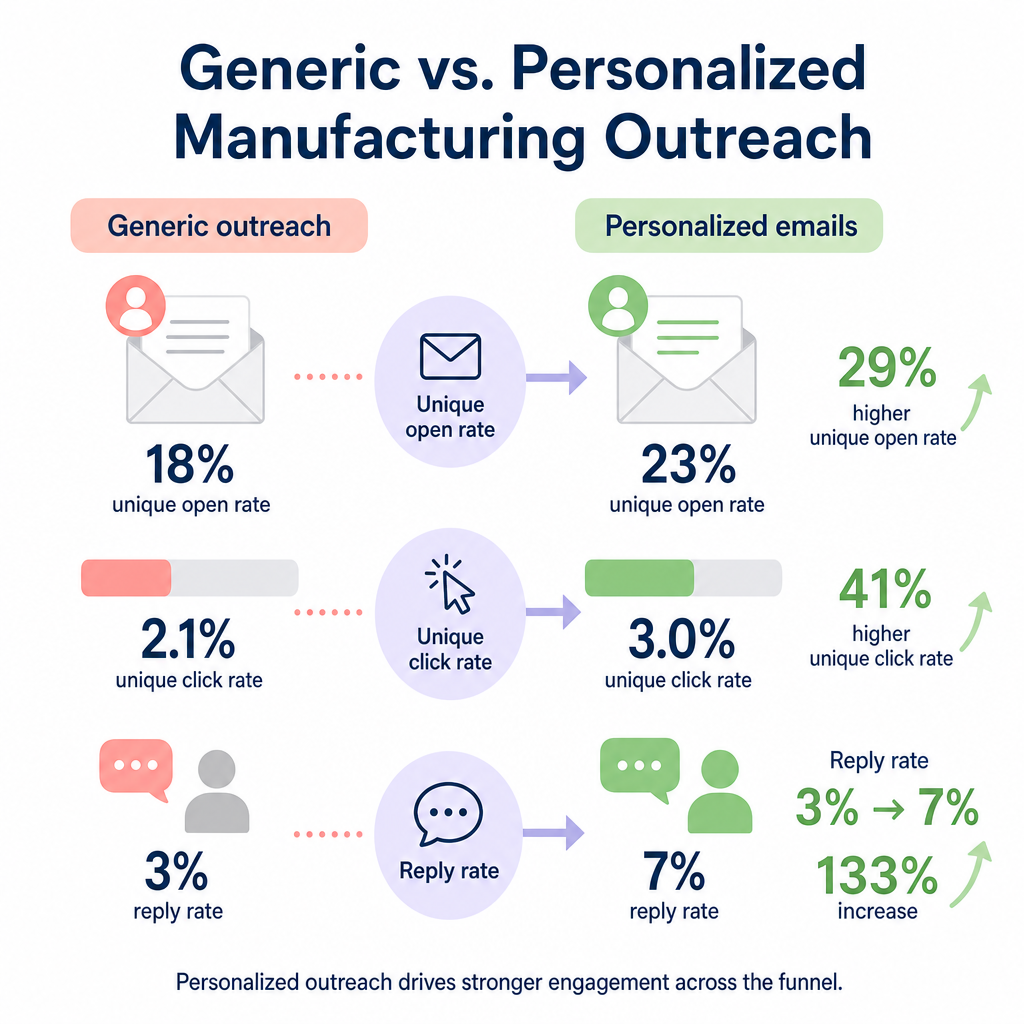
Data shows that personalized emails have a 29% higher unique open rate and a 41% higher unique click rate compared to non-personalized messages. When you transition from a generic template to a personalized one, reply rates can jump from 3% to 7% – a 133% increase. Truly effective personalization means understanding your prospect’s facility, localized challenges, and current operational goals.
The anatomy of a high-performing cold outreach message
Writing a cold message that gets a response requires structure, brevity, and relevance. Busy manufacturing executives do not have time to read long paragraphs. Keep your message focused on these key elements:
- A highly specific subject line: Your subject line must be relevant enough to stand out in a crowded inbox. Keep it under 50 characters so it remains visible on mobile devices. For example, instead of a generic title, use a localized hook like “Question about your Coventry facility?” You can use proven B2B sales email subject lines to boost your initial open rates.
- A personalized hook: Start by demonstrating that you have done your homework. Reference a specific trigger, such as a recent factory expansion, a new role change, or a localized development.
- The problem-solution match: Connect their current situation to a challenge you solve. If they are scaling operations, mention how you help similar companies reduce downtime or control material costs.
- A low-commitment call to action (CTA): Avoid asking for a 30-minute demo right away. Instead, ask a simple, open-ended question to start a conversation, such as “Are you open to looking at how we minimized production bottlenecks for [Similar Company]?”
- Concise formatting: Keep your email between 100 and 150 words. Use plain-text formatting and limit your links to one or two at most to avoid triggering spam filters.
To see these elements combined, you can explore our library of personalized email templates designed for different business scenarios.
A step-by-step framework for industrial outreach
To craft messages that resonate with decision-makers, you need a systematic approach to research and writing. You can build your next outreach campaign using these key steps.
Map your buyer personas to the buying cycle
Manufacturing deals involve long, multi-stakeholder buying cycles. Your outreach needs to target the correct role with the right message. Map your prospects to these key industrial roles:
- Champions and Influencers: Usually plant managers or engineering leads who care about daily operational efficiency and reducing downtime.
- Decision-makers and Budget holders: Operations directors or VPs who focus on overall cost reduction, ROI, and supply chain security.
- Blockers: Procurement managers who compare strict technical specifications and pricing structures.
Tailoring your value proposition to these specific priorities ensures higher engagement. You can find more details on how to apply these concepts in our guide on best practices for personalized sales messaging.
Identify relevant trigger events
The easiest way to make your message feel timely is to tie it to a real-world event. Look for:
- Facility expansions or relocations: Let the prospect know you noticed their growth, referencing their specific city or region.
- New executive hires: Reach out within a decision-maker’s first 30 days in a new role.
- New product or equipment lines: Address the operational adjustments they may need to make to their current workflows.
If you prefer using social channels, you can apply this strategy directly on professional networks using these LinkedIn outreach message templates built around facility growth and problem-solving.
Build a persistent follow-up sequence
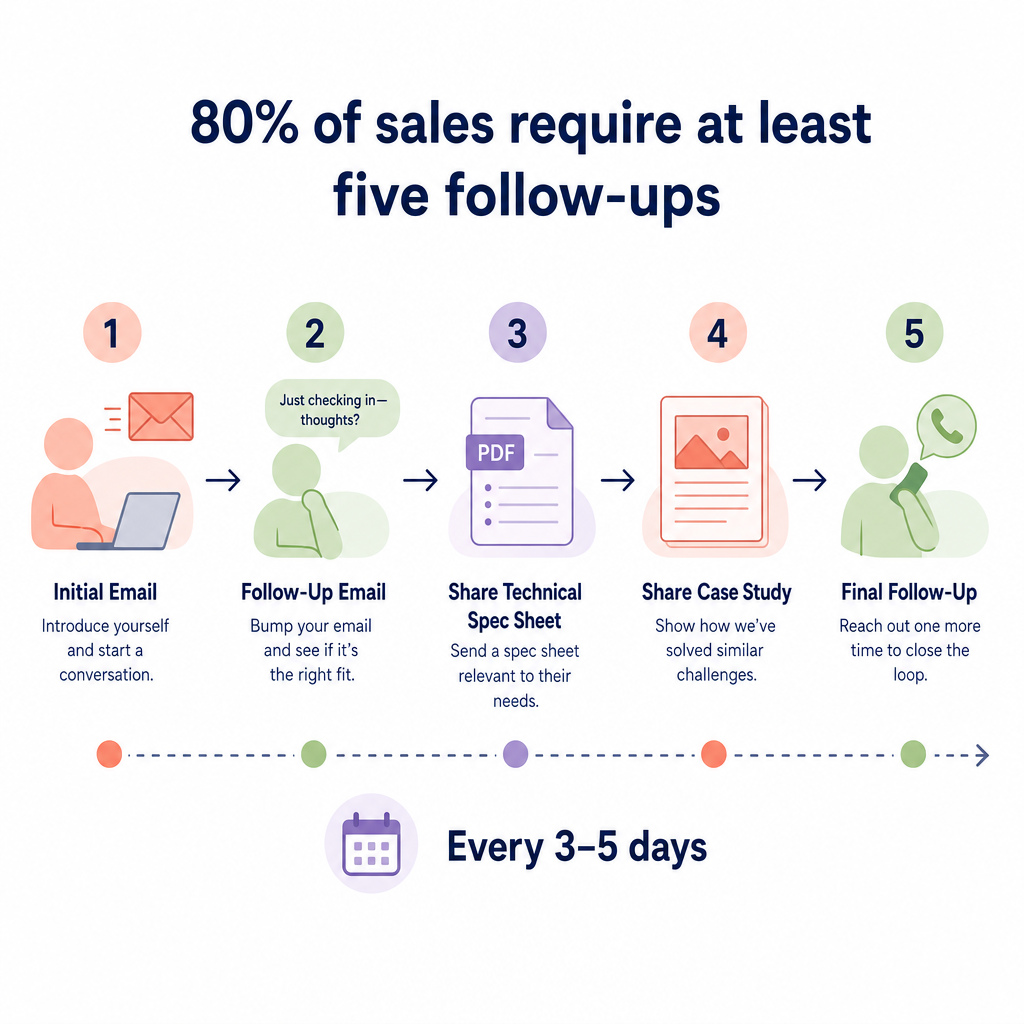
A single cold email rarely gets a response. Because 80% of sales require at least five follow-up touches, persistence is vital. Space your follow-ups 3 to 5 days apart, and make sure each subsequent message adds new value – such as sharing a relevant technical spec sheet or a brief case study. Learn how to draft these touches with our framework for a follow-up email after no response.
Protecting your sender reputation and deliverability
The most beautifully written cold message is useless if it lands in the spam folder. When recipients consistently ignore or delete generic emails, email service providers (ESPs) mark your domain as low value.
To protect your business and keep your deliverability high, implement these baseline technical practices:
- Set up domain authentication: Ensure your domain has proper SPF, DKIM, and DMARC records configured. Without these safeguards, ESPs are highly likely to block your emails.
- Use secondary domains: Avoid sending cold outreach campaigns from your primary company domain. Use dedicated subdomains or alternative domains to isolate your prospecting activity.
- Warm up your email addresses: Start new sending addresses with a low volume of 10 to 20 emails per day, and gradually scale up over several weeks.
- Include a clear opt-out: Always provide an easy, straightforward way for recipients to unsubscribe. This complies with legal requirements and builds professional trust.
How to scale personalized outreach without losing quality
Deeply researching every prospect takes time. If your sales team spends all their hours looking up facility locations and mapping out decision-makers, they have less time to actually close deals.
Many modern manufacturing GTM teams are turning to automated systems to solve this bottleneck. By using AI to personalize cold email campaigns, you can maintain a highly tailored approach at scale. AI-driven personalization can double your reply rates while lowering your overall lead generation costs by up to 60%.
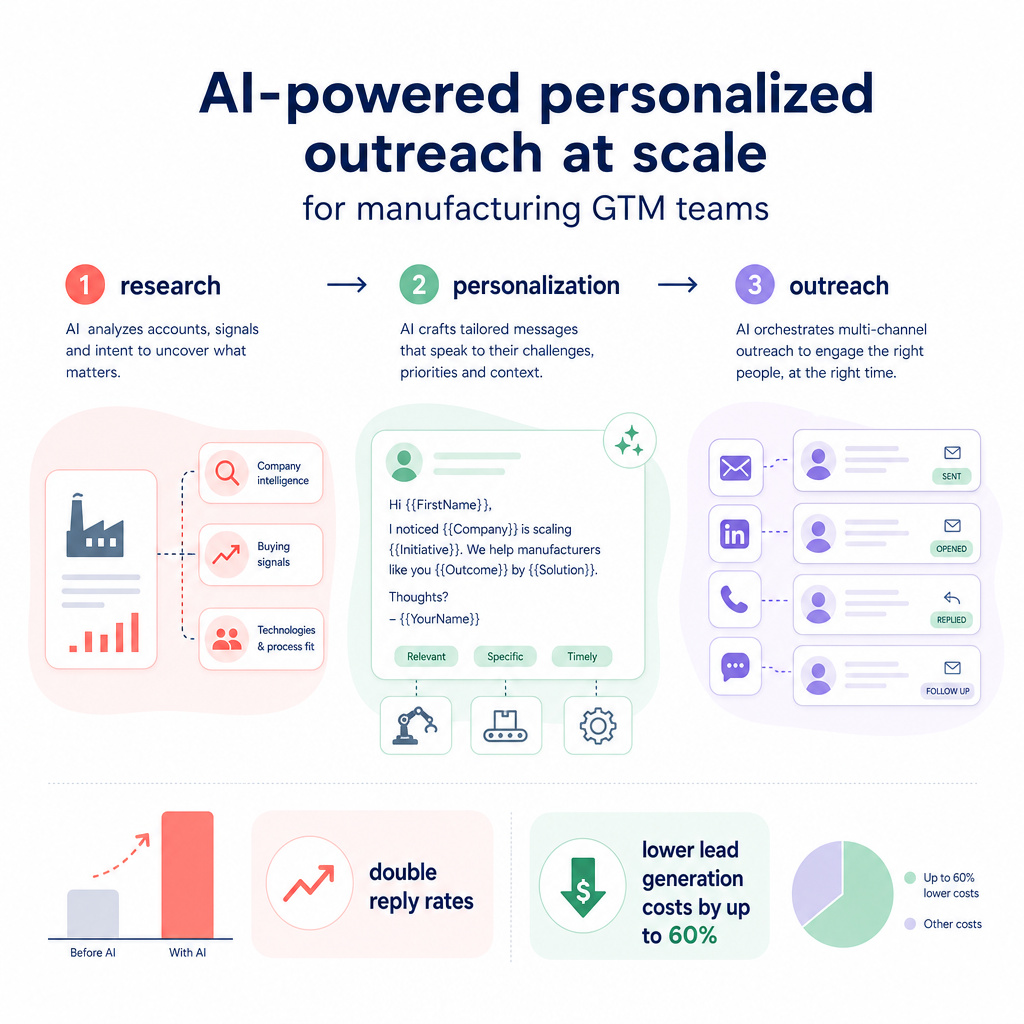
Using a multi-layered research approach allows you to scale up. You can group prospects by industry pain points, combine those with real-time buying signals, and generate human-sounding copy automatically. This balance of quality and quantity is key to escaping low reply rates. To learn more about setting up this infrastructure, explore our insights on cold email personalization at scale.
Transform your outreach into active business conversations
Effective cold outreach isn’t about tricking prospects into a meeting. It is about identifying a genuine business need, proving you have done your research, and starting a conversation with the right person at the right time. By setting up a clean email infrastructure, keeping your copy short, and focusing on localized manufacturing challenges, you can build a highly reliable outbound sales pipeline.
If you want to skip the tedious manual research and start speaking directly with qualified buyers, let Sera’s AI Autopilot do the heavy lifting for you. Our system uses specialized AI agents to research accounts, confirm exact decision-makers, and write personalized, deliverability-safe outreach on autopilot.
Ready to scale your outbound pipeline? You can get five verified leads with highly personalized outreach in just three minutes. To see how we can help you grow your business and automate your meeting generation, explore Sera today.