

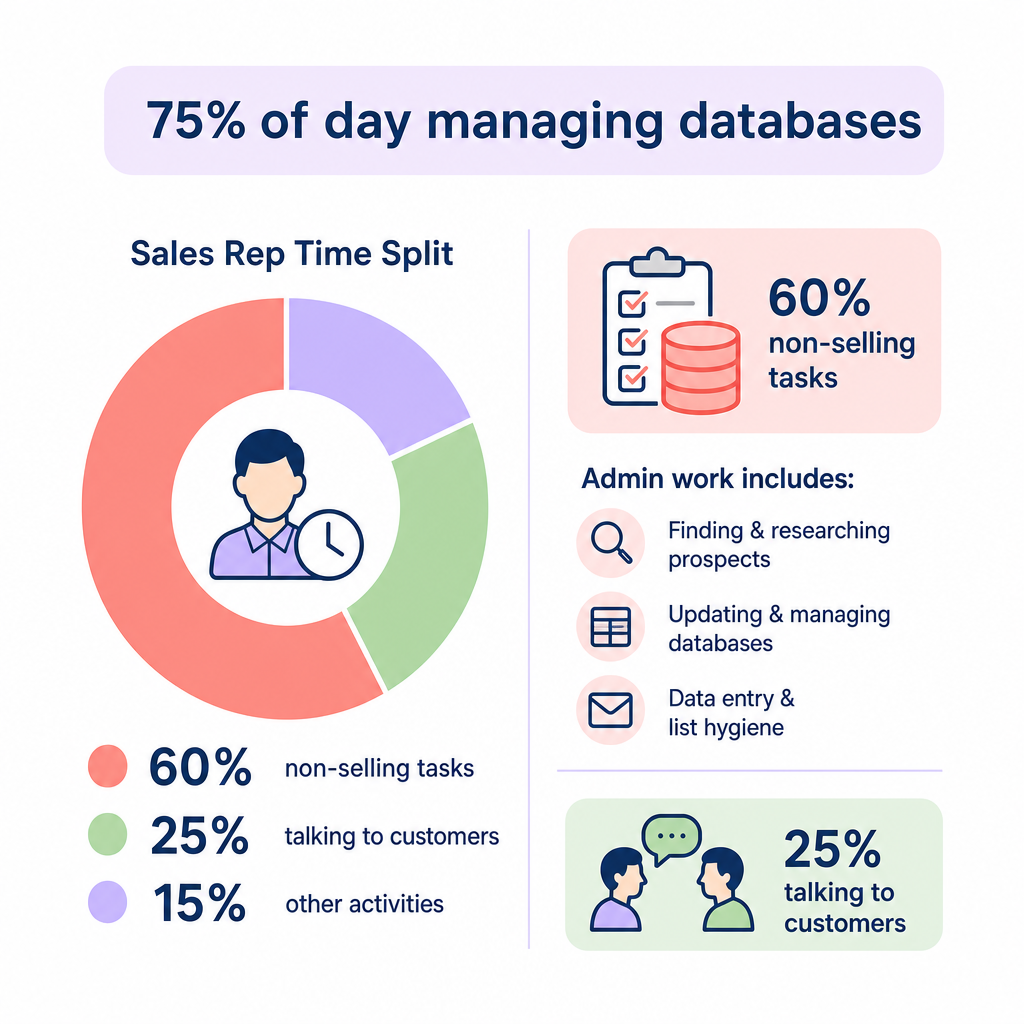
Why are your highly paid sales reps spending 75% of their day managing databases instead of closing deals? Choosing between Clay and ZoomInfo in 2026 is critical, but the right decision depends on whether you want to manage complex software or simply book more meetings.
ZoomInfo in 2026: the enterprise database giant
ZoomInfo has long been the legacy giant for B2B intelligence. Its strongest asset is its extensive North American database, which is updated daily by scanning over 38 million online sources, including SEC filings, job postings, and news articles. It uses machine learning alongside a team of human data scientists to verify information and assign confidence scores to its contact profiles.
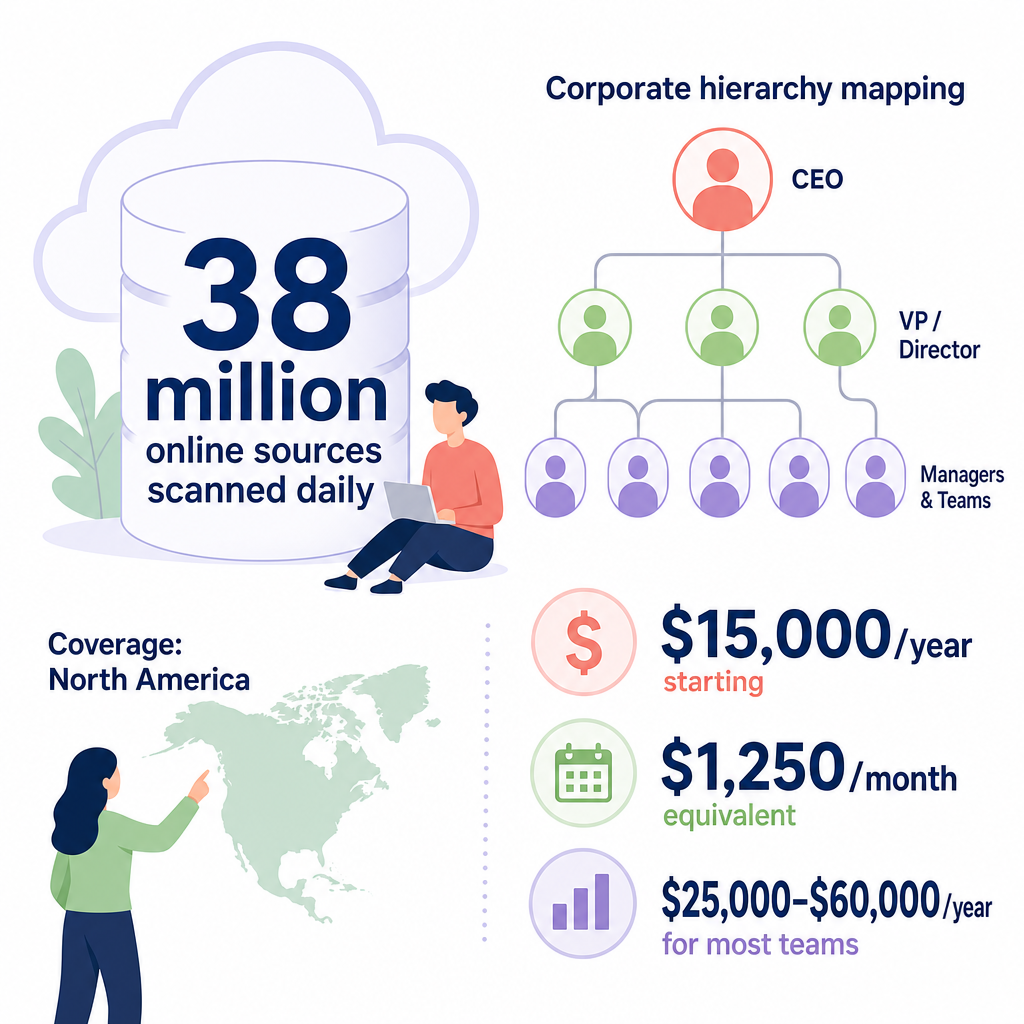
For heavy industry and manufacturing, ZoomInfo is highly effective at mapping out complex parent-subsidiary corporate relationships. However, accessing this data is incredibly expensive:
- No monthly billing: ZoomInfo only offers annual contracts.
- High entry costs: The starting price is roughly $15,000 per year ($1,250 per month) for a single-user SalesOS license.
- Scaling expenses: Most teams pay between $25,000 to $60,000 per year depending on seats, add-ons, and credit usage.
If you are targeting European markets, you may also encounter data gaps and compliance friction compared to more specialized tools. To see how ZoomInfo stacks up against other databases, read our comparison of ZoomInfo and Cognism or explore our breakdown of Lusha vs ZoomInfo. For a deeper dive into its features, check out our ZoomInfo 2026 review.
Clay in 2026: the data orchestration engine
Clay takes a completely different approach. It does not own any native data. Instead, Clay acts as an orchestration platform that aggregates information from over 150 external data providers in a credit-based marketplace.
Its key strength is “waterfall enrichment.” If one data provider does not have a manufacturing plant manager’s email, Clay automatically checks a second and third provider until it finds a verified address. Additionally, its AI-powered “Claygent” can visit company websites to extract specific real-time information, such as facility updates or machinery details.
Clay’s pricing is more modular than ZoomInfo’s, but it can scale up quickly:
- Launch Plan: Starts at $185 per month (includes 2,500 data credits and 15,000 actions).
- Growth Plan: Starts at $495 per month (includes 6,000 data credits, 40,000 actions, and CRM auto-sync).
- Enterprise Plan: Requires a custom annual commitment for advanced security, data warehouse syncs, and higher limits.
- Additional Credits: Start at $0.05 each and become cheaper as you scale.
While powerful, Clay has a steep learning curve. It currently holds a G2 ease-of-use score of 7.9, meaning your team will likely need a dedicated, highly technical operator to build and troubleshoot workflows. To learn more about this complexity, read our full Clay 2026 review or look over these Clay alternatives worth considering.
The manual bottleneck: paying the SDR tax
Whether you buy ZoomInfo’s database or build workflows in Clay, both platforms suffer from the same problem: they are manual tools that require human effort to operate.
According to reports from Salesforce, sales reps spend 60% of their time on non-selling tasks like manual data entry and searching for resources. Further research by Bain & Company reveals that sellers may spend only about 25% of their time actually talking to customers.
When you purchase complex sales software, you pay an “SDR tax.” Your team must still spend hours:
- Defining ideal customer profiles (ICPs) and cleaning lists.
- Writing outreach copy and setting up sequences.
- Managing technical domain deliverability to prevent emails from landing in spam.
Stricter inbox rules implemented by major email providers in 2026 mean that if you blast generic lists purchased from databases, your domain will likely be blacklisted within weeks. To learn how modern organizations are moving away from manual setup, read our analysis of Clay vs Apollo.
Why manufacturing teams are shifting to AI agents
Leading industrial companies are realizing that sales reps should not spend their days clicking buttons in databases. Research by Gartner shows that sellers who effectively partner with AI tools are 3.7 times more likely to meet their quotas.
Instead of managing software, manufacturers are using Sera’s AI outreach Autopilot. Sera is an agentic sales system powered by six specialized AI agents that handle 93% of the outbound prospecting lifecycle under human supervision:

- List Building Agent: Sources high-quality leads from a database of over 1 billion professional profiles and 300 million companies.
- Enrichment Engine: Automatically appends rich firmographic, technographic, and financial data.
- Research Analyst: Searches the web for active buying signals, news, and site-specific updates.
- Decision Maker Identifier: Verifies the exact buyer and confirms direct-dial contact details.
- Deliverability Guard: Automatically warms up new domains and monitors sender reputation to keep deliverability above 99%.
- Outreach Writer: Crafts highly personalized, human-sounding emails in over 100 languages.
This system is built specifically for high-value B2B deals. For example, Viking Window and over 39 other manufacturers rely on Sera’s specialized AI agents to initiate relationships and open complex deals across Europe.
Connect your systems and track what matters
To protect your investments and keep operations smooth, any AI tool must fit into your existing business environment. Sera integrates with your CRM, calendars, and communication channels to pass clean, qualified leads directly to your sales reps.
Instead of measuring activity metrics like “emails sent” or “credits used,” manufacturing executives can focus on bottom-line performance indicators:
- Meeting booking rate
- Email response rate
- Sales rep time savings
- Show rate and pipeline ROI
Choosing the right path for your business
If you have a dedicated RevOps team and need to map out massive, complex corporate hierarchies in North America, ZoomInfo remains a powerful, albeit expensive, traditional choice. If you have highly technical staff who enjoy building custom API connections and custom data tables, Clay offers unparalleled flexible orchestration.
However, if you want your sales team focused entirely on closing deals rather than managing databases and writing email sequences, delegating the manual work to AI is the most efficient choice.
To see how you can automate your sales development pipeline, check out our transparent pricing packages, or take three minutes to get 5 verified leads and 5 personalized messages for free. Ready to discuss your pipeline? Book a free 30-minute consultation with Sera today.