


Are your domestic sales plateauing while your machinery runs below capacity? Expanding globally is the most reliable way to scale, but finding qualified overseas buyers remains a major hurdle. This guide provides a systematic, step-by-step strategy to locate, qualify, and secure international clients for your factory.
Why export sales are the ultimate growth lever for factories
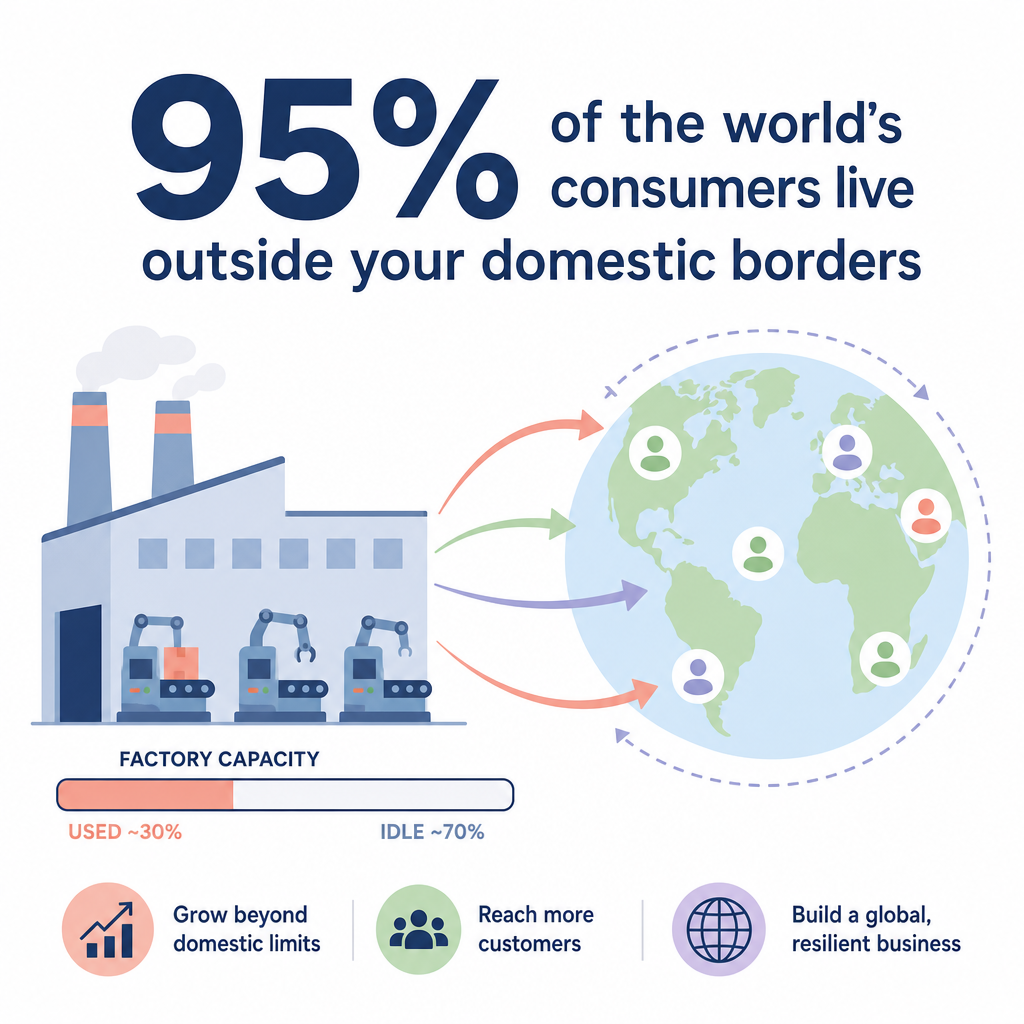
If your factory relies solely on domestic buyers, you are missing out on the vast majority of your potential market. Statistically, 95% of the world’s consumers live outside your domestic borders. Accessing even a fraction of this global demand can unlock rapid growth and maximize your production capacity.
Expanding your footprint internationally does more than just increase your order book. Research shows that exporting companies enjoy distinct operational advantages:
- Increased productivity: Exporters are, on average, 70% more productive than non-exporting manufacturers.
- Higher earning potential: Exporting companies typically pay 18% higher wages than domestic-only competitors.
- Economic resilience: Diversifying your customer base across multiple geographic regions makes your factory far less vulnerable to domestic recessions or local supply chain shocks.
To capture these benefits, you must establish structured processes. You can start by mastering the basics of how manufacturers can grow export sales to build a strong foundation for your international expansion.
Assessing your readiness and export compliance
Before reaching out to overseas clients, you need to ensure your manufacturing operations and compliance frameworks are ready for international trade. A structured approach helps clarify your capabilities and operational readiness:
- Evaluate your export readiness: Complete an online self-assessment to check if your production capacity, staffing, and capital can support international orders.
- Seek training and counseling: Work with local export assistance centers to understand trade terminology, logistics, and documentation.
- Create an export business plan: Define your company’s current status, target markets, specific goals, and operational constraints.
- Conduct market research: Use trade databases to identify foreign markets with high demand for your specific product category.
- Find buyers: Combine government support programs, digital prospecting, and trade events to build your lead pipeline.
- Investigate financing options: Familiarize yourself with working capital loans, cargo insurance, and credit facilities designed to finance international transactions.
Navigating export licenses and compliance
A common myth is that export licensing is too complex for medium-sized factories. However, roughly 95% of all commercial items exported do not require an export license.
To ensure compliance, check if your products are on the Commerce Control List (CCL) and have an Export Control Classification Number (ECCN). If your commercial goods are not listed on the CCL, they are designated as EAR99, meaning they generally do not require an export license unless you are shipping to a restricted destination, end-user, or end-use. Always run your prospects against the Consolidated Screening List (CSL) to verify you are not doing business with restricted parties.
Additionally, remember to build a robust landed-cost calculator. Factoring in foreign duties, local VAT, freight, and currency hedging will protect your margins and help you build smart international pricing strategies.
Traditional channels to find international buyers
For decades, factories have relied on a core group of offline and government-supported channels to identify potential overseas buyers. These channels remain valuable components of a diversified export strategy.
Government export programs and commercial services
Government agencies are highly motivated to help local manufacturers export. The U.S. Commercial Service, for example, helps businesses find overseas buyers and verified partners through a global network of trade specialists.
By listing your factory in their online directories, you can get direct inquiries vetted by embassy trade experts. You can also leverage Country Commercial Guides to study market dynamics, competitor landscapes, and local purchasing habits before entering a new region.
Trade shows and exhibitions
International trade shows allow you to meet hundreds of prospective buyers face-to-face. However, exhibiting is a major financial investment, and the real ROI is won or lost during the follow-up process.
Shockingly, 80% of trade show leads are never followed up on, even though the vast majority of attendees hold purchasing authority. To avoid wasting your exhibition budget, you need a disciplined post-show workflow. Learn how to execute a systematic trade show follow-up strategy to convert booth visitors into paying clients.
Partnering with distributors and sales agents
If you lack the resources to build an in-house international sales team, you can leverage third-party networks. You have two primary options:
- Distributors: They buy your inventory wholesale, import it, and handle local marketing, logistics, and customer support.
- Sales Agents: They represent your brand on a commission basis, leaving you in control of pricing, inventory, and customer relationships.
Choosing the wrong channel partner can result in six-figure losses, brand damage, and legal headaches. Weigh the pros and cons using our comparison of distributors vs agents vs direct sales.
If you decide to work with intermediaries, use a standardized vetting process to qualify distributors and sales agents before signing any exclusivity agreements.
Building a repeatable digital export pipeline
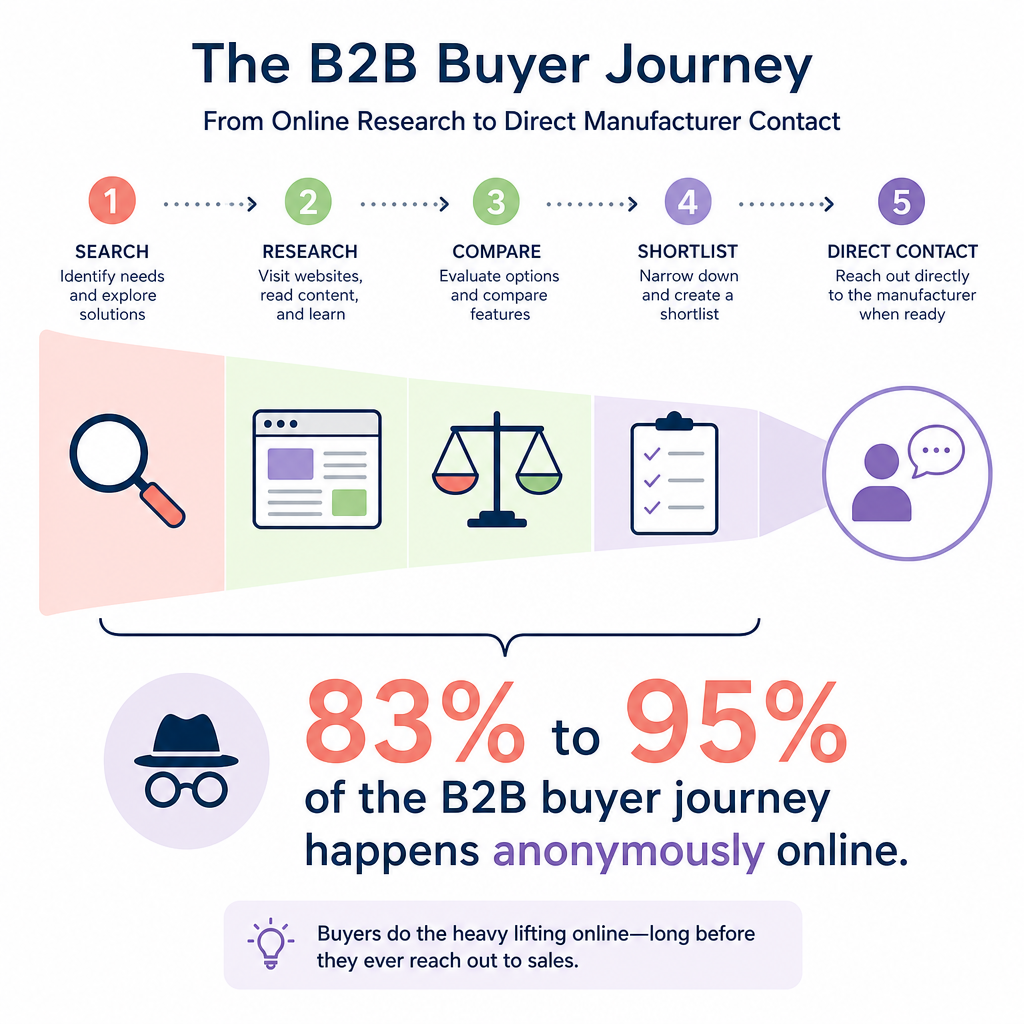
Relying entirely on trade shows and government introductions is reactive. Modern industrial buyers have changed how they source suppliers. In fact, between 83% and 95% of the B2B buyer journey now happens anonymously online before a buyer ever contacts a manufacturer directly. To capture these high-intent buyers, your factory must establish a proactive digital prospecting engine.
Map your industrial buyer personas
Unlike consumer sales, industrial B2B purchases are made by multi-stakeholder committees, often including procurement directors, operations engineers, CFOs, and compliance officers.
To craft outreach that resonates, you must map the priorities and pain points of each stakeholder. Use our framework on how to create buyer personas for industrial markets to build highly tailored sales messaging for each member of the buying committee.
Design targeted outbound cold outreach
Once you know who your ideal buyers are, you can reach out directly via targeted email and LinkedIn campaigns. Cold outreach remains incredibly cost-effective for manufacturers when it is hyper-personalized and highly technical.
Generic bulk pitches will quickly land your domain in the spam folder. Instead, you need to set up a dedicated cold email infrastructure, warm up your outreach domains, and write problem-focused sequences. Follow our step-by-step guide to cold outreach for manufacturing to build an outreach system that gets replies.
Structure your export territories and account plans
As your pipeline grows, you will need to organize your sales resources strategically. Grouping your prospects haphazardly leads to neglected leads and burnt-out sales reps.
Instead, segment your global targets by value, geographic density, and language requirements. Learn how to structure sales territories and account plans for export markets to balance workloads and prioritize high-value strategic accounts. You can also study how buyers research suppliers to align your accounts with their natural search habits.
Overcoming language and time zone barriers with AI
Scaling an international sales pipeline introduces two massive challenges: language barriers and time zone differences.
Replicating your sales process across cultures
Approaching global markets with English-only sales materials limits your growth. Research shows that localized sales content drives up to 56% higher conversion rates compared to non-localized equivalents.
True localization is not about simple word-for-word translation. It is about adapting your messaging to match the tone, technical standards, and business formalities of the target country. Review our best practices on how to run multilingual outreach for export sales to scale your outreach without hiring expensive local agencies.
Navigating the clock
If your sales team is based in Europe, managing real-time conversations with prospects in North America or Asia is incredibly difficult. Time zone misalignment can delay communication by 24 to 48 hours, stalling your deals.
To keep momentum, you must build time-zone-conscious workflows, use asynchronous communication, and optimize your outreach timing. Read about the impact of time zones on global sales strategies to streamline your international communication.
Scaling your outreach on Autopilot
Executing global prospecting, personalization, translation, and follow-up manually requires hundreds of hours. This is where modern AI-driven lead generation platforms transform the export process.
By automating the top of your sales funnel, you can identify international buyers’ exact needs across 196 countries and engage them with ultra-targeted, localized outreach. To understand how these automated workflows fit together, explore our guide on modern global customer acquisition strategies.
Sera’s AI-powered B2B outreach Autopilot is designed specifically to solve this problem for manufacturers. Powered by six specialized AI agents, Sera handles the entire process: building highly targeted lead lists, enriching firmographic data, researching local timing signals, identifying key decision-makers, and writing natural, multilingual emails in over 100 languages.
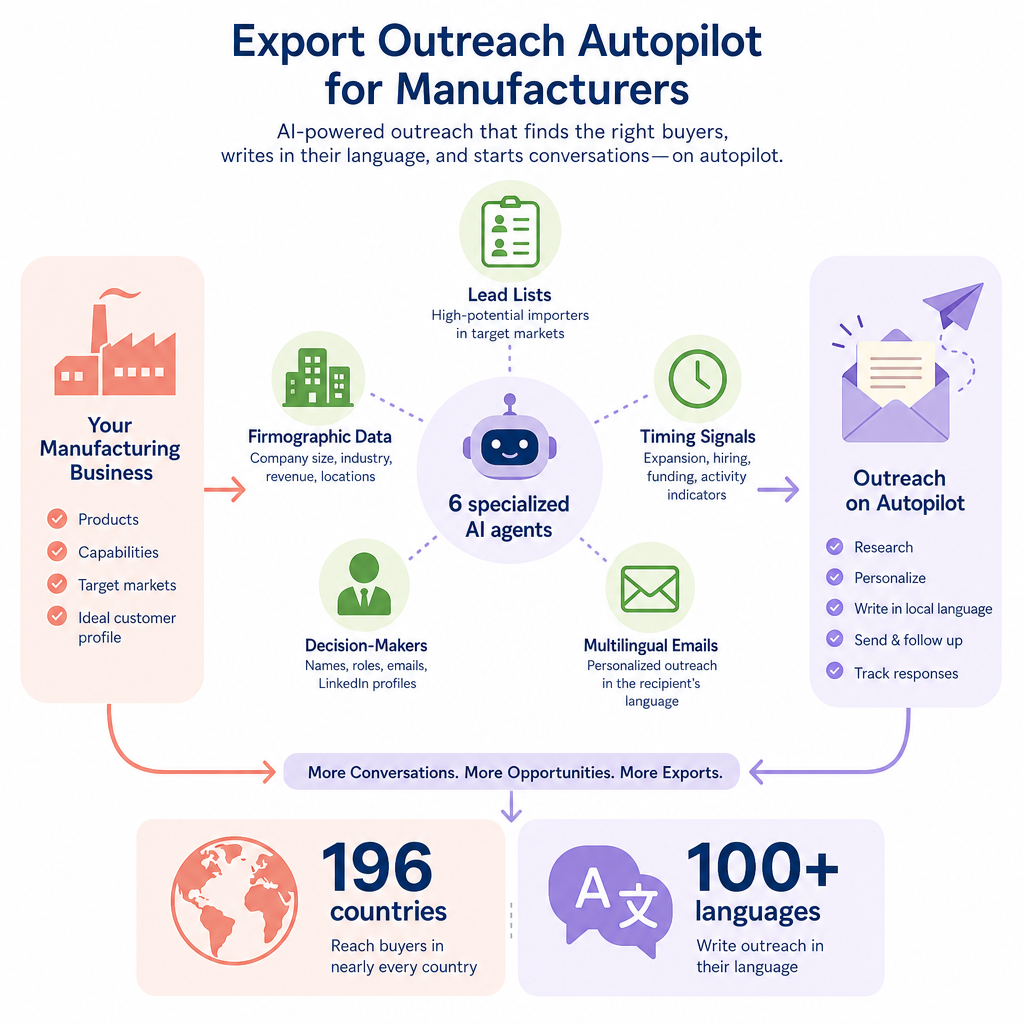
Instead of spending weeks hunting for contact details, your sales team simply steps in when qualified overseas buyers reply and are ready to book a meeting.
Building your export sales pipeline
Building an international pipeline does not have to happen all at once. You can start with a focused, highly manageable approach:
- Select one target market: Pick a single country with high demand, favorable trade agreements, and manageable regulatory compliance.
- Define your ideal buyer persona: Identify the exact job titles (e.g., Procurement Manager, Head of Supply Chain) at your target companies.
- Draft your localized offer: Highlight your factory’s technical capabilities, quality standards, and export readiness in their native language.
- Deploy automated outreach: Use modern prospecting tools to systematically contact decision-makers, keeping your messaging highly personalized and low-volume to maximize response rates.
If you want to bypass the manual work of searching for overseas contacts, you can get started immediately. You can get five verified leads in three minutes with highly personalized messages customized for your target export market.
To see how AI can manage your international prospecting, localize your messaging, and book high-value meetings for your factory, explore Sera’s outreach platform today.