


Choosing the wrong sales channel can drain your margins and leave your brand in the hands of a partner who does not prioritize your growth. For manufacturing executives, deciding between distributors, agents, and direct sales is a high-stakes balance of cost, control, and market speed.
Understanding the primary routes to market
Before restructuring your operations, you must define what each channel requires from your factory. Distributors are independent businesses that purchase goods directly from you to resell. They take ownership of the inventory, handle the logistics, and typically provide after-sales service. In this model, you are selling to the distributor, not the end user.
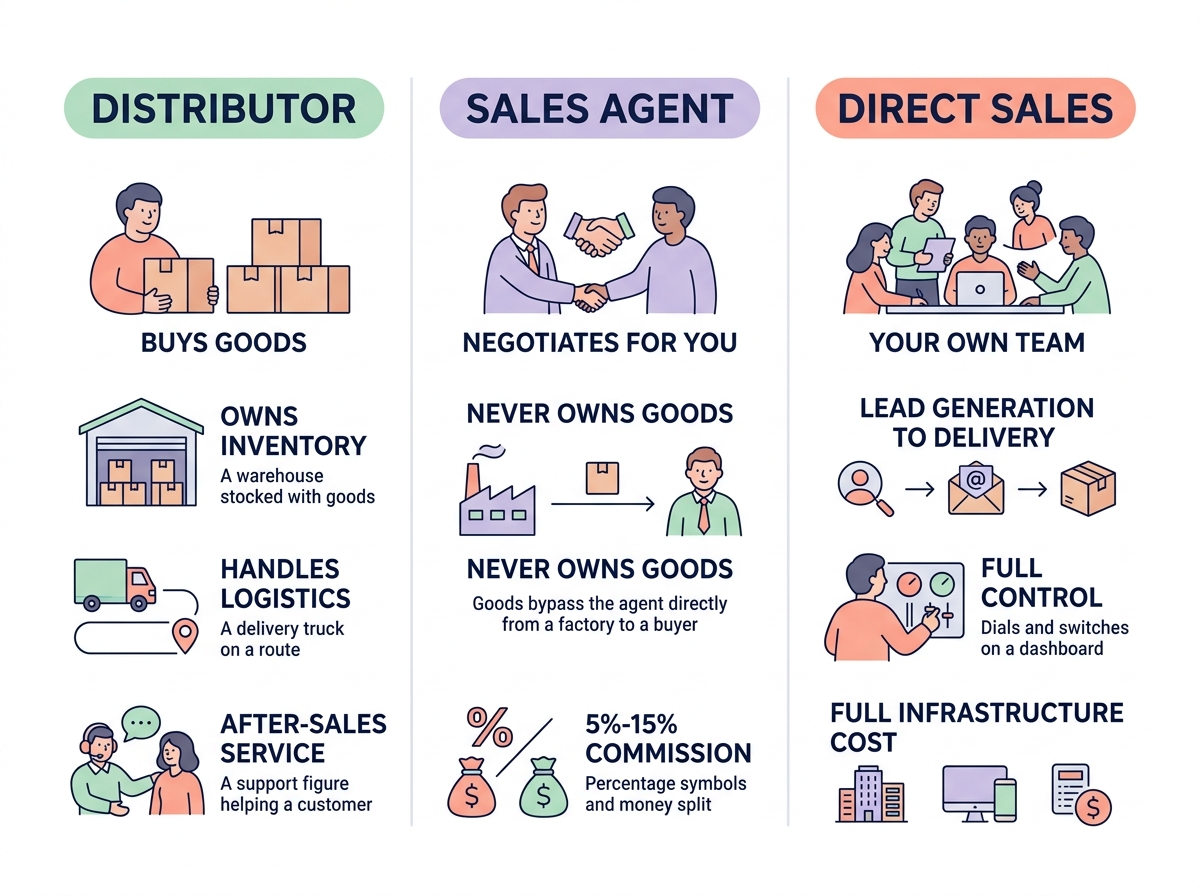
Sales agents operate differently. They act as your representatives and negotiate contracts on your behalf but never take title to the goods. You retain ownership of the inventory until the final sale is made, and the agent earns a commission on the transaction.
Direct sales involves your own employees handling the entire process, from lead generation to delivery. While this eliminates intermediaries, it places the full burden of infrastructure and salary costs on your balance sheet. Most manufacturers find that the nature of their goods determines the right path, as high-volume commodities often favor distributors while complex, technical equipment may require the direct touch of an agent or internal team.
Why distributors dominate broad market coverage
Distributors are often the fastest way to enter a new market because they leverage existing customer relationships and local infrastructure. Because they buy and own your inventory, they provide an immediate boost to your working capital. They typically operate on margins between 15% and 40%, and they assume the credit risk associated with the end customer.
While they offer scale, you surrender significant control. The distributor sets the resale price and manages the customer relationship. If you terminate the agreement, you may find that the customers stay with the distributor rather than following your brand. Before signing a contract, you should qualify distributors and sales agents to ensure their financial stability and technical competence match your standards.
The technical advantages of sales agents
If your product requires a consultative sales process or deep technical expertise, a sales agent is often more effective than a broad distributor. Agents do not carry inventory, which means you keep control over your pricing and the final customer data. You invoice the customer directly, and the agent receives a commission, typically ranging from 5% to 15%.
This model is particularly useful for mid-sized manufacturers selling high-value components. It allows you to maintain a direct line of communication with the market without the overhead of a full-time local sales force. However, because the agent does not buy the stock, your capital remains tied up in inventory until the deal closes. You must also be aware of statutory protections for agents, such as the Commercial Agents Regulations in the UK and EU, which can make termination more complex and costly than a standard commercial contract.
Maximizing control through direct sales
Building a direct sales operation allows you to capture the highest possible margins because you are not ceding a percentage to a third party. Direct sales teams also tend to have higher win rates, averaging between 25% and 35%, compared to the 15% to 25% typically seen in distributor channels. This model gives you total ownership of the customer experience and the richest possible market feedback.
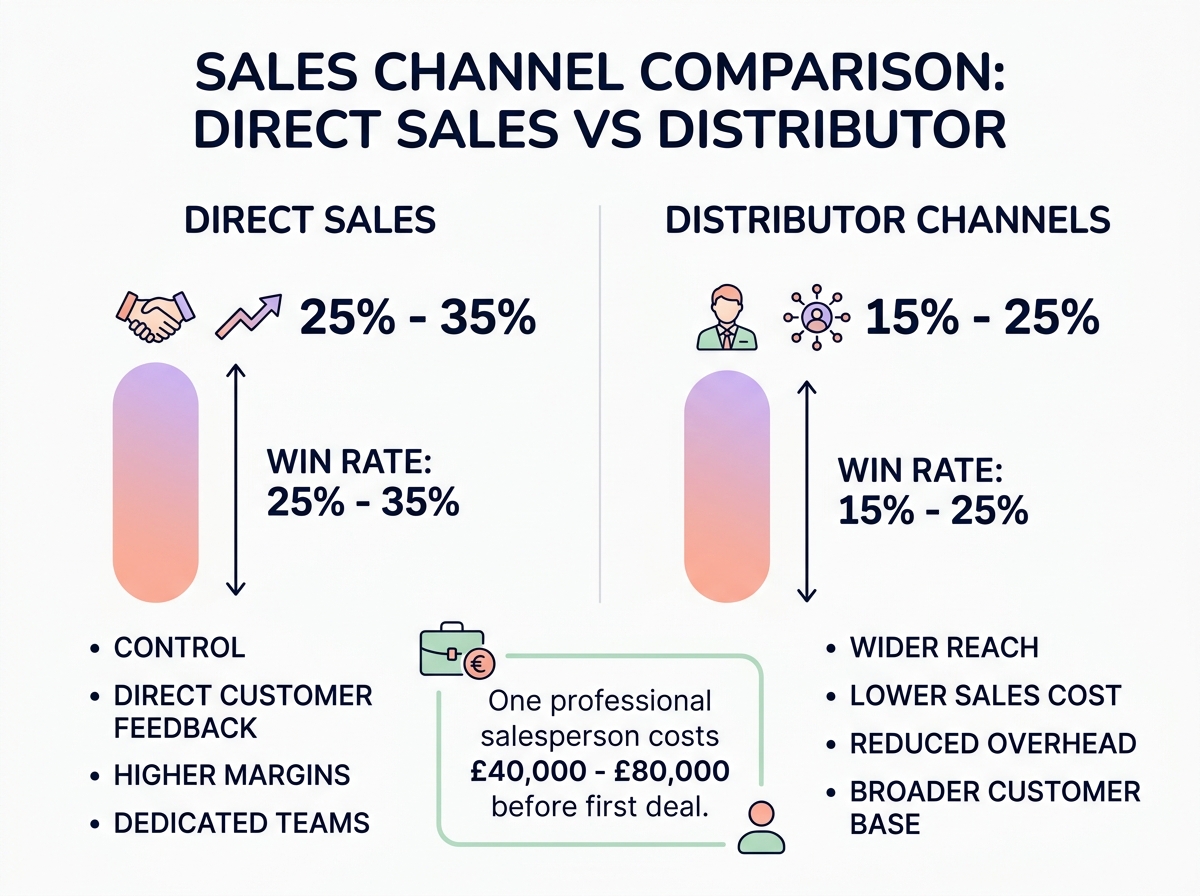
The tradeoff is the significant upfront investment required. A single professional salesperson can cost between £40,000 and £80,000 in salary and benefits before they have closed their first deal. You also bear all the operational risks, including credit risk and inventory storage. To make this model viable, you need a robust process for export sales for manufacturers that can justify these high fixed costs through consistent volume and high deal values.
Operational and financial tradeoffs
Your choice of channel directly affects your financial health and speed to market. Distributors offer the fastest ramp-up and lowest capital exposure, making them ideal for simple products in mature channels. In contrast, direct sales has the slowest ramp-up but offers the best long-term brand control. When planning your expansion, consider these core factors:
- Distributors improve your cash flow by purchasing stock upfront, usually on 30-to-90-day terms.
- Direct sales teams provide the best market intelligence but require the highest execution burden from your management team.
- Agents balance these needs by offering quick market entry with better pricing control than a distributor.
Your export pricing strategy must account for these differences. For example, you must decide whether to absorb the 15-40% margin a distributor requires or invest that same capital into your own sales infrastructure.
Implementing a hybrid channel strategy
Many successful manufacturers do not rely on a single model. You might use distributors to handle small, high-frequency orders while maintaining a direct sales team for your top 10% of strategic accounts. This approach allows you to balance broad market coverage with the specialized attention required for high-value contracts.
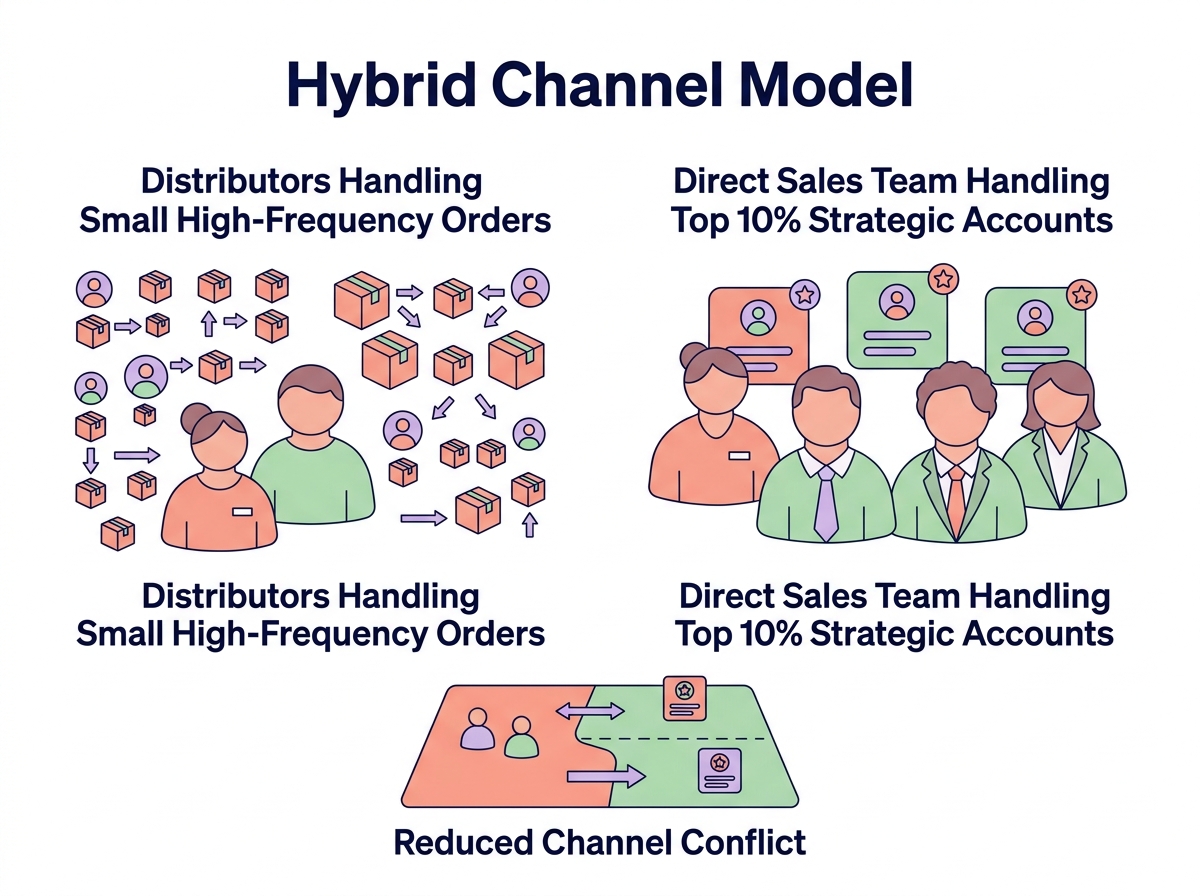
Effective management of multiple channels requires careful territory and account planning for export to avoid channel conflict. If your internal team and your distributors are chasing the same leads, you will damage your partnerships and confuse your customers. Clear territory definitions and tiered account assignments are essential for a harmonious hybrid model.
Modernizing your sales outreach
Technology is fundamentally changing the economics of these traditional models. In the past, the high cost of direct sales often forced manufacturers to use distributors. Today, automation allows small teams to manage global outreach with the same efficiency as much larger organizations. For those looking to expand internationally, multilingual outreach for export sales can now be managed with AI tools that adapt your messaging to local cultural norms in over 100 languages.
This shift allows you to test markets directly before committing to a long-term distributor contract. By using data-driven outreach, you can identify where the highest demand exists and then decide if you want to continue selling directly or appoint a local partner to handle the fulfillment.
Selecting the right route to market is not a permanent decision, but a strategic choice that should evolve with your business. Whether you choose the rapid scale of a distributor, the technical focus of an agent, or the high-control environment of direct sales, the goal is to align your channel with your customer’s buying habits and your own financial capacity.
If you are ready to scale your sales without the overhead of a massive team, Sera’s AI-powered Autopilot can help you identify decision-makers and book meetings across global markets. Learn how Sera can accelerate your growth by automating the most time-consuming parts of your sales process.