


Did you know that 17% of cold emails never even reach the prospect’s inbox? If you are running automated sales outreach, this silent deliverability leak is quietly draining your potential revenue and wasting your GTM team’s hard work.
Why deliverability is the true engine of sales performance
In automated sales, sent volume means absolutely nothing if your messages are invisible. When your emails repeatedly fail to land in the inbox, email service providers lower your sender reputation. This creates a compounding negative effect that is incredibly difficult to recover from.
Poor inbox placement directly limits your sales pipeline and inflates your customer acquisition costs. By focusing on quality over sheer volume, a UK-based business successfully raised its inbox placement from 72% to 94%. This improvement immediately translated to more open doors and higher conversions.
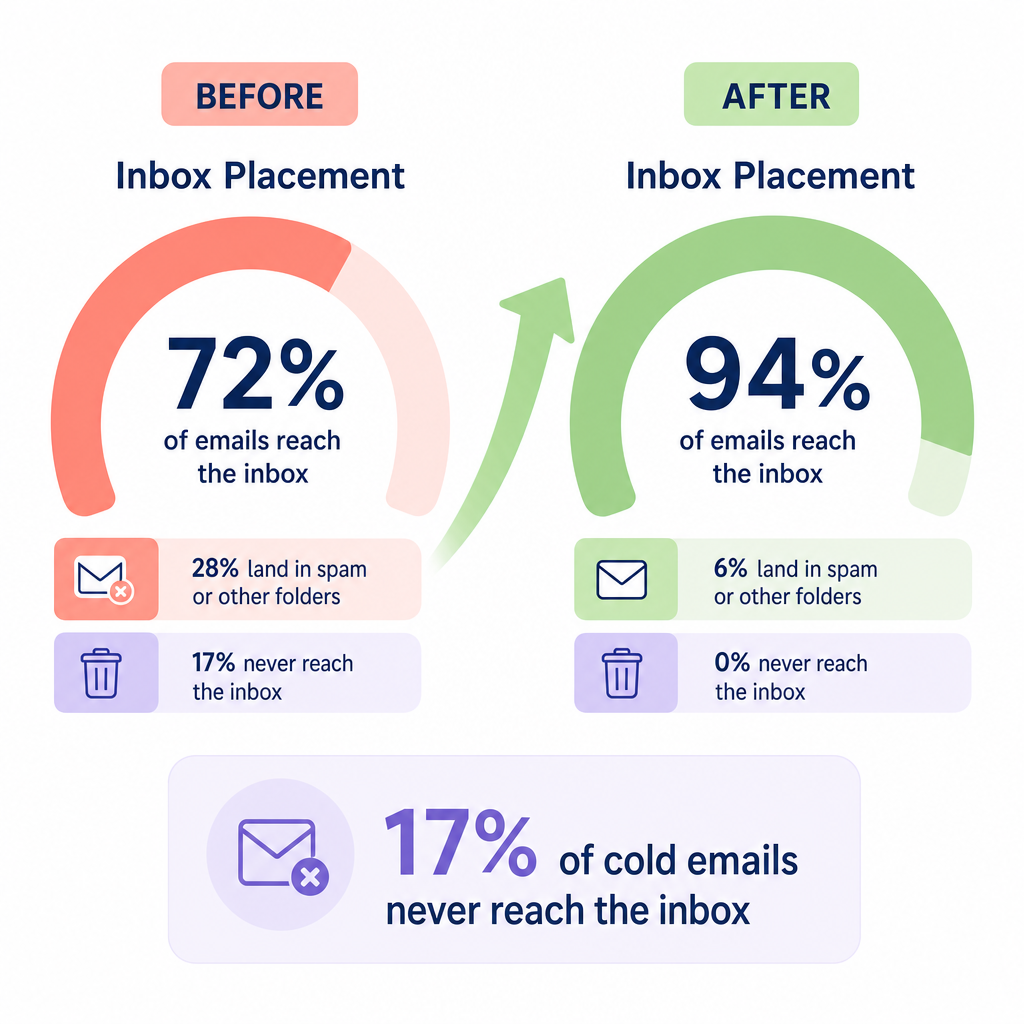
Understanding how your emails perform is the first step toward optimization. You can learn more about linking your outreach performance to actual revenue metrics in our guide on measuring email deliverability’s impact on your global sales pipeline.
Setting up technical authentication protocols
To email networks, your authentication records function like a digital passport. Without them, major providers like Google, Yahoo, and Microsoft are highly likely to mark your messages as spam.
Setting up proper domain authentication is no longer optional for professional sales teams. You must configure several key records at your domain provider:
- SPF (Sender Policy Framework): This record lists the specific servers and IP addresses authorized to send emails on behalf of your domain.
- DKIM (DomainKeys Identified Mail): This protocol adds a cryptographic signature to your emails, verifying that the message was not tampered with during transmission.
- DMARC (Domain-based Message Authentication): This policy tells receiving servers how to handle emails that fail SPF or DKIM checks. Senders must publish a DMARC policy with at least
p=none(or stronger, likep=quarantineorp=reject) to satisfy major providers.
By 2025, Microsoft will require DMARC authentication for high-volume senders dispatching over 5,000 daily emails to consumer accounts. Google and Yahoo also enforce strict alignment rules where the sender’s “From” header must align with either the SPF or DKIM domain.
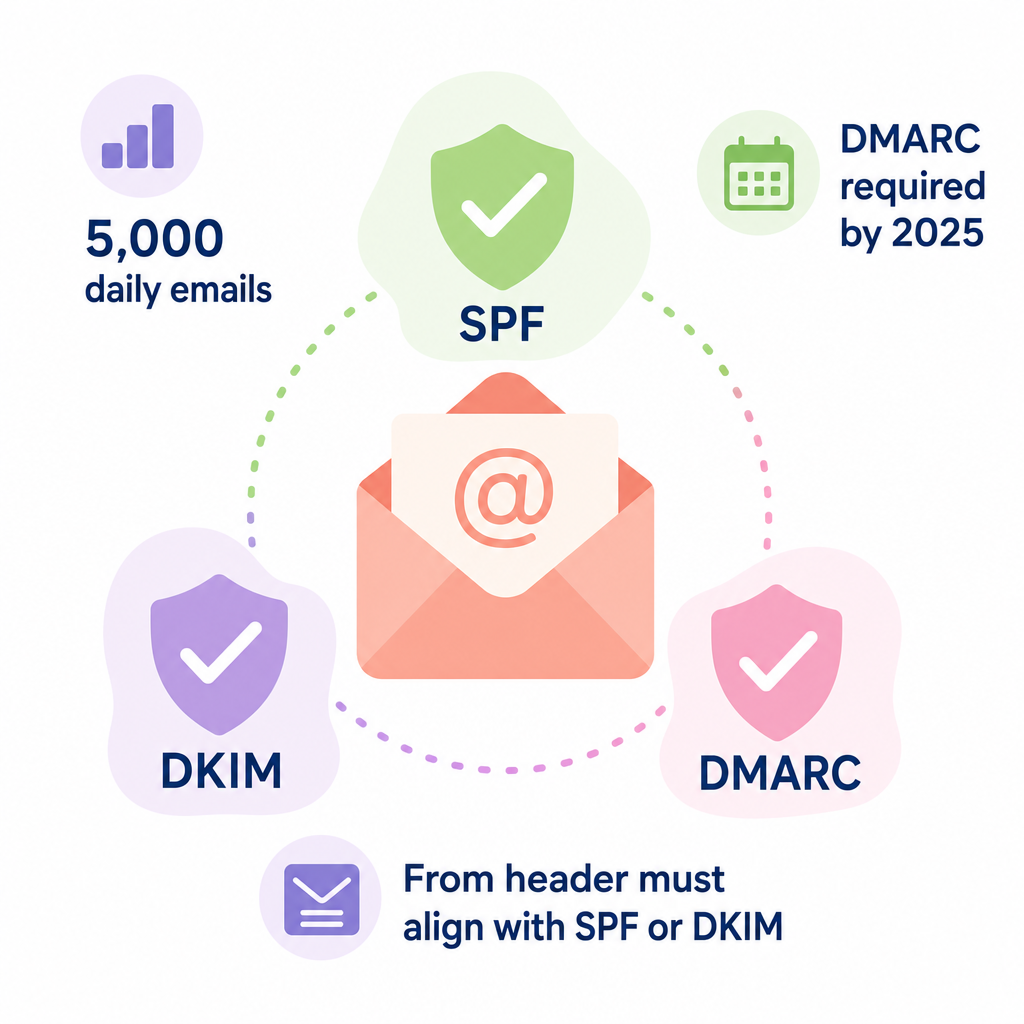
For a complete breakdown of setting up these technical safeguards, read our playbook on DKIM, opt-out links, and send volume thresholds. Correctly configuring these elements is a fundamental part of ensuring email deliverability in personalized campaigns.
Mastering the rules for bulk and automated sending
If your domain sends close to 5,000 messages in a 24-hour period, email providers classify you as a bulk sender. However, even low-volume sales teams should adhere to bulk sender best practices to protect their domains:
- Keep spam rates extremely low: You must keep your spam complaint rate below 0.1%. Senders should prevent their spam rate from ever reaching 0.3% or higher to avoid getting blocked.
- Simplify the unsubscribe process: Commercial messages must include a clearly visible unsubscribe link in the body. They must also include a functioning list-unsubscribe header that supports one-click unsubscribe.
- Honor opt-outs quickly: Senders must process unsubscribe requests within 2 business days.
- Establish valid reverse DNS (PTR) records: Ensure you publish valid, non-generic PTR records for all of your sending IP addresses.
- Avoid sudden volume spikes: Gradually warm up new domains. Start with small volumes of 10 to 20 emails daily, and increase your volume slowly by 10% to 15% each week to build solid reputation signals.
Using bad data is the fastest way to trigger filters. Never purchase pre-packaged mailing lists, and avoid subscribing users via automatic opt-in checkboxes on your website.
Monitoring sender reputation and list hygiene
Maintaining a high sender reputation requires continuous monitoring and proactive hygiene. If your list contains invalid email addresses or unengaged contacts, your bounce and spam rates will climb, signaling to ISPs that you are an irresponsible sender.
- Monitor Outlook deliverability: Microsoft uses Smart Network Data Services (SNDS) to share data on your IP reputation and complaints. Use this dashboard to identify unusual activity and pause campaigns if you detect persistent filtering.
- Check your Gmail health: Google Postmaster Tools provides daily aggregated reports on domain reputation, IP reputation, encryption, and delivery errors. Keep in mind that this data is always 48 hours behind real-time.
- Verify contact data: Regularly clean your lists to keep hard bounce rates below 2%. Removing inactive recipients and validating emails weekly can lead to 28% higher deliverability rates.
- Separate your sending IPs: Do not send automated cold outreach from the exact same IP addresses you use for your day-to-day corporate communication or critical transactional alerts.
To scale your operations across different borders, you must understand how local laws and international ISPs handle outreach. Discover more regional tips in our guide to email deliverability in international sales.
Additionally, syncing your campaigns with your database helps maintain clean records. Check out our resource on integrating email outreach automation with CRM workflows to see how automated data-cleansing rules protect your sender reputation.
Overcoming deliverability hurdles with AI and automation
Managing deliverability manually is incredibly time-consuming. From warming up domains to checking SPF records and personalizing copy to bypass spam filters, GTM teams often spend more time troubleshooting IT issues than talking to buyers.
Modern artificial intelligence can automate these complex steps. By implementing smart list hygiene, predicting engagement patterns, and optimizing send times, AI keeps your domain reputation safe. For a deeper look at these technical solutions, explore our article on overcoming email deliverability challenges with AI automation.
Using machine learning also enables you to write highly natural, hyper-localized copy that recipients actually want to open. This relevance prevents people from hitting the spam button, which is the primary driver behind enhancing international email deliverability with AI.
Sera’s AI Autopilot is designed specifically to solve these technical and strategic outreach problems. Six specialized AI agents handle the heavy lifting for you:
- The List Building Agent creates ultra-targeted lists to avoid generic addresses and spam traps.
- The Enrichment Engine and Research Analyst find timing, relevance, and deep company insights.
- The Decision Maker Identifier confirms the correct target buyers.
- The Outreach Writer drafts human-sounding, highly tailored messages in over 100 languages.
- The Deliverability Guard acts as a virtual shield, monitoring your technical setup and regulating send patterns to protect your inbox placement.
While these agents handle approximately 93% of the repetitive sales tasks, human supervisors oversee the workflow to ensure quality remains flawless. This low-volume, research-driven approach protects your domain from bulk-sender penalties while generating consistent, high-value meetings.
If you are ready to modernize your sales process and secure your inbox placement, explore how Sera’s automated outreach platform can safely scale your GTM operations.