

Is your sales team spending more time managing spreadsheets than talking to plant managers? In 2026, Clay offers powerful data orchestration, but its technical complexity might actually slow down a traditional manufacturing firm.
Understanding Clay as a data orchestration engine
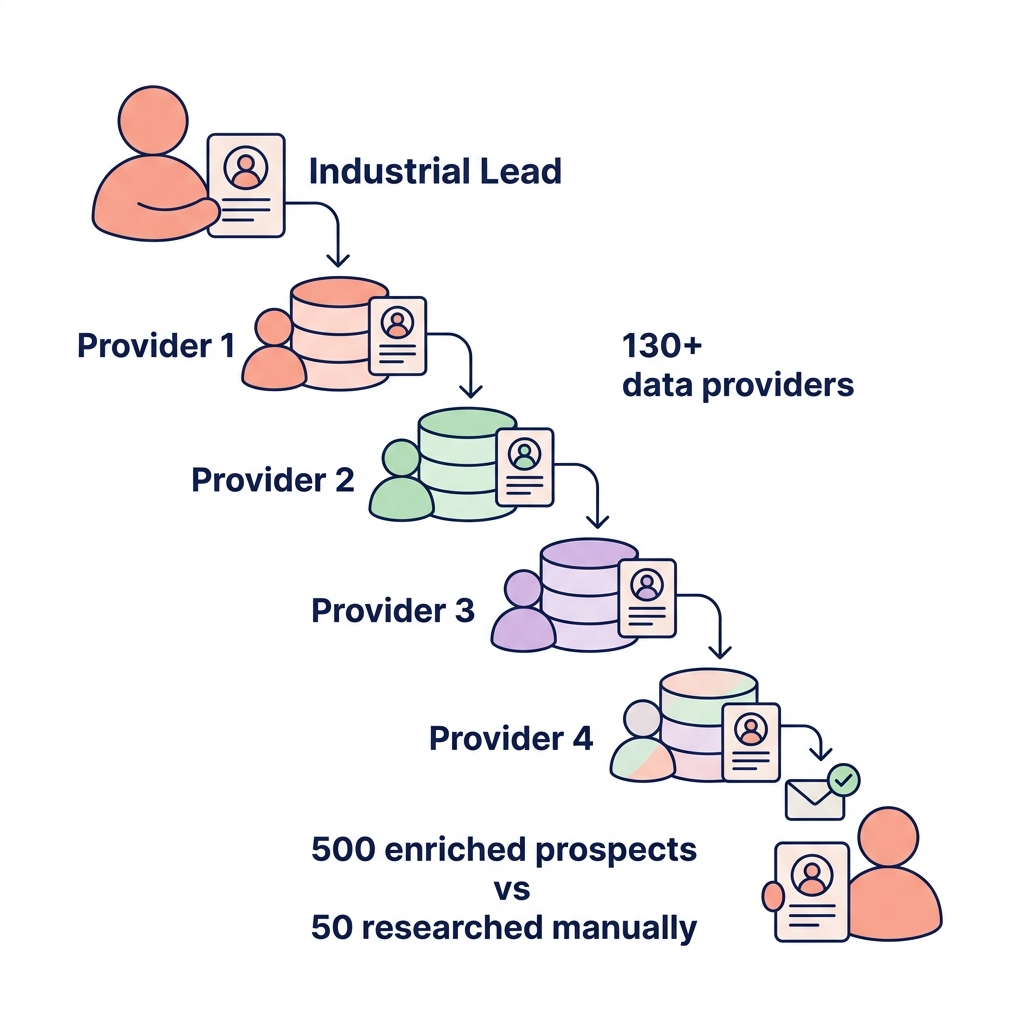
Clay is not a standard contact database like ZoomInfo or Apollo. Instead, it acts as a data orchestration platform that aggregates information from over 130 different data providers. For a manufacturing executive, think of it as a central hub that pulls niche industrial data, LinkedIn profiles, and technographic details into one unified view.
The core of its power lies in a concept called waterfall enrichment. If the first data source does not have a prospect’s email, Clay automatically moves to the second, third, and fourth providers until it finds a verified match. This multi-source approach delivers a level of contact accuracy that single-provider tools often miss. In fact, many teams use this to process 500 enriched prospects in the time previously required to research just 50.
Why manufacturing leaders use Clay for niche targeting
Industrial markets are often fragmented, making it difficult to find the right decision-makers at niche fabrication plants or regional distributors. Clay addresses these pain points by allowing you to build custom account scoring based on specific manufacturing signals.
The platform includes an AI agent called Claygent that can visit company websites to extract specific insights. This might include identifying recent production line investments, machinery purchases, or facility expansions. When these signals are detected, the system can automatically flag high-priority leads in your CRM.
While these features are powerful, they require a specific prospecting workflow to be successful. Manufacturing firms using this type of automation have seen a 14.2% increase in sales productivity by reducing the time spent on manual data entry. You can see how this compares to other leading tools in our Clay vs Apollo 2026 review.
The hidden costs: credits and the SDR tax
Despite its capabilities, Clay is not a “set it and forget it” solution. It requires a significant amount of manual setup and ongoing maintenance. In 2026, users still face what many call the “SDR tax,” where human operators must spend hours defining ICP parameters, writing prompts for the AI, and troubleshooting broken API connections.
The pricing structure can also be complex for budget planning. Clay uses a credit-based model that typically starts around $149 per month, but heavy users in the manufacturing sector often spend $500 to $1,000 or more as enrichment complexity grows. Furthermore, Clay is not a native sending platform. To actually launch a campaign, you must pay for additional software to handle email execution and deliverability.
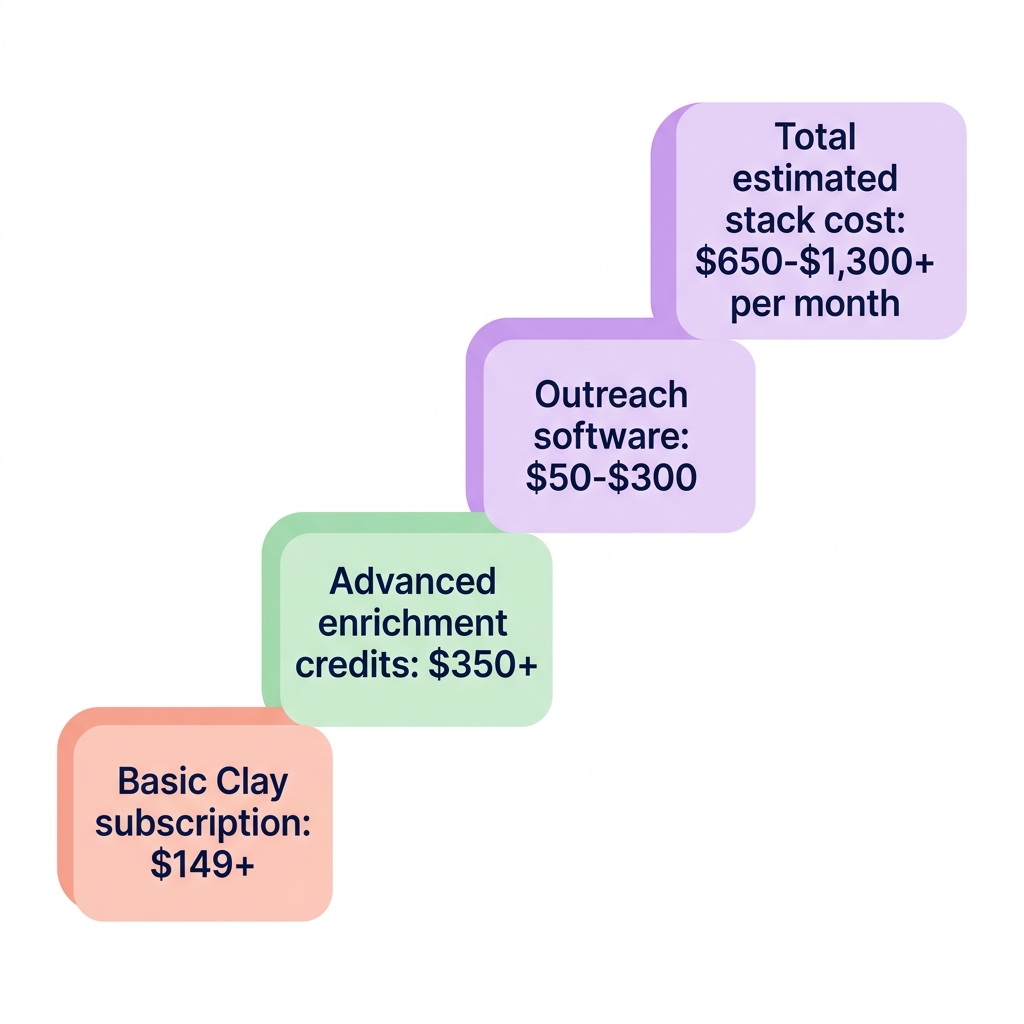
- Basic Clay subscription: $149+ per month.
- Advanced enrichment credits: $350+ per month.
- Separate outreach/sequencing software: $50 to $300 per month.
- Total estimated stack cost: $650 to $1,300+ per month.
Weighing the pros and cons for industrial sales
Choosing the right tool depends on your team’s technical capacity. Clay currently holds a G2 ease-of-use score of 7.9, which is lower than many Clay alternatives for 2026. This indicates a steep learning curve that might overwhelm lean sales teams without dedicated operations support.
- Superior data depth by aggregating 130+ sources.
- Waterfall enrichment minimizes “dead ends” in niche markets.
- Claygent AI automates deep research into equipment and facility updates.
- High technical complexity requires a dedicated operator.
- No native email sending or call capabilities.
- Predicting monthly credit consumption can be difficult.
For teams that need a faster setup, an AISDR platform review might reveal a more streamlined, albeit less customizable, alternative for high-volume outreach.
Shifting from manual tools to autonomous outreach
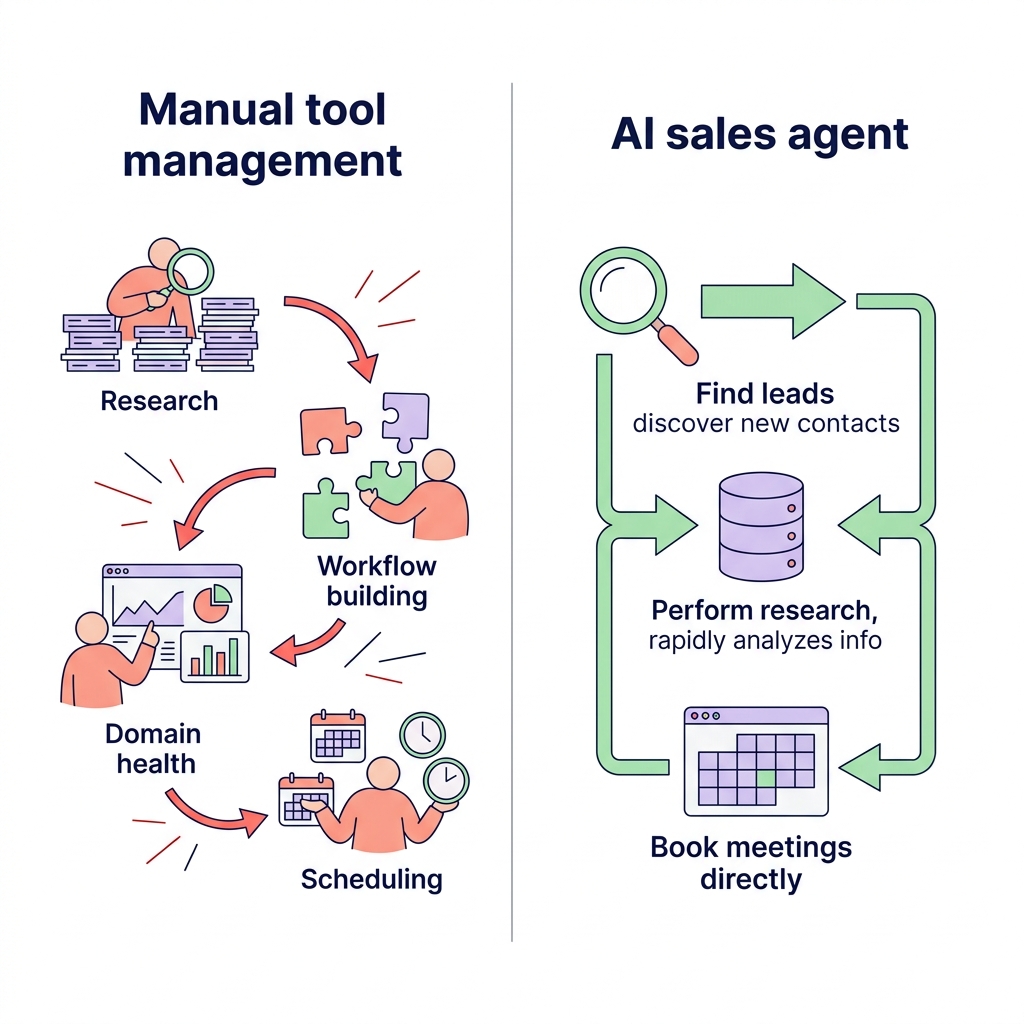
The central question for manufacturing executives in 2026 is whether your team should be managing software at all. While Clay reduces research time from hours to minutes, your staff is still responsible for managing the platform, monitoring domain health, and handling the initial back-and-forth of scheduling.
Modern industrial leaders are increasingly using an AI sales agent to handle the end-to-end process. Instead of building complex workflows yourself, autonomous systems find the leads, perform the research, and book the meetings directly onto your calendar. This allows your sales engineers to stop acting as data entry clerks and start focusing on high-value technical negotiations.
Sera provides a human-supervised AI Autopilot that manages the entire outreach lifecycle. By utilizing six specialized AI agents, Sera handles everything from list building and deep research to multilingual writing and deliverability protection. This approach ensures that your outreach remains low-volume and high-precision, protecting your brand reputation while filling your pipeline with qualified opportunities.
If you are ready to move past manual tool management and start growing your revenue on autopilot, visit the Sera homepage to see how autonomous agents can transform your sales process.