


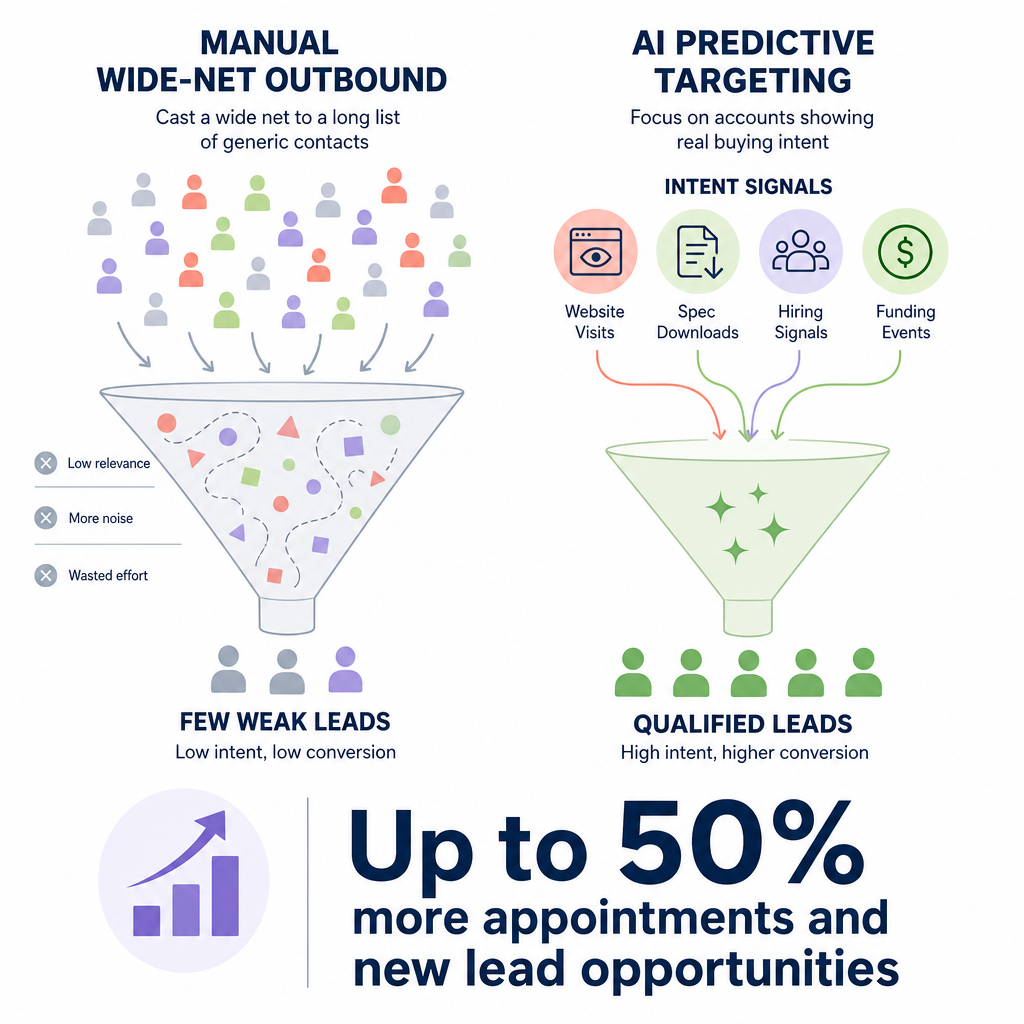
Traditional outbound marketing casts a wide net and hopes for the best. This approach is highly inefficient for specialized B2B service and manufacturing sectors. Predictive targeting flips this model by analyzing digital behaviors to find prospects who are actively looking to buy.
To target effectively, you must first define your ideal customer. Using a structured B2B ideal customer profile template helps you identify the exact firmographics, operational markers, and behavioral signals of your highest-value buyers. In manufacturing, this means looking past basic company size to track specific machinery, ERP setups, or quality certifications.
Once your profile is set, AI agents can aggregate intent signals across thousands of digital channels. Instead of cold-calling random accounts, your team focuses on buyers who have recently:
- Visited competitor websites or product comparison pages.
- Downloaded technical specifications or CAD files.
- Posted job openings indicating expansion or technical shifts.
- Secured new funding or tier-one manufacturing contracts.
This intent-based approach ensures your team reaches out at the perfect moment. Research shows that sales teams using AI-driven predictive targeting achieve up to 50% increases in appointments and new lead opportunities.
Personalization that matches industry standards
Generic mass emails no longer work. In fact, 52% of UK consumers and business buyers will abandon brands whose outreach lacks personalization. However, manually researching every prospect to write a unique email takes too many hours.
To solve this, sales teams use personalized outreach sequence automation to deliver relevant messaging at scale. AI platforms analyze a prospect’s digital footprint – including recent news, role changes, and industry challenges – to write tailored emails.
Effective personalization goes beyond adding a contact’s first name to a template. To build trust with technical buyers, your messaging should reflect their specific operating environment. Adhering to best practices for AI-driven outreach customization helps you maintain high-quality interactions. These practices include:
- Tailoring the value proposition to the prospect’s specific job role and industry.
- Adapting the technical depth of your content to match the buyer’s professional background.
- Adjusting the tone and currency of your pricing to match local regional markets.
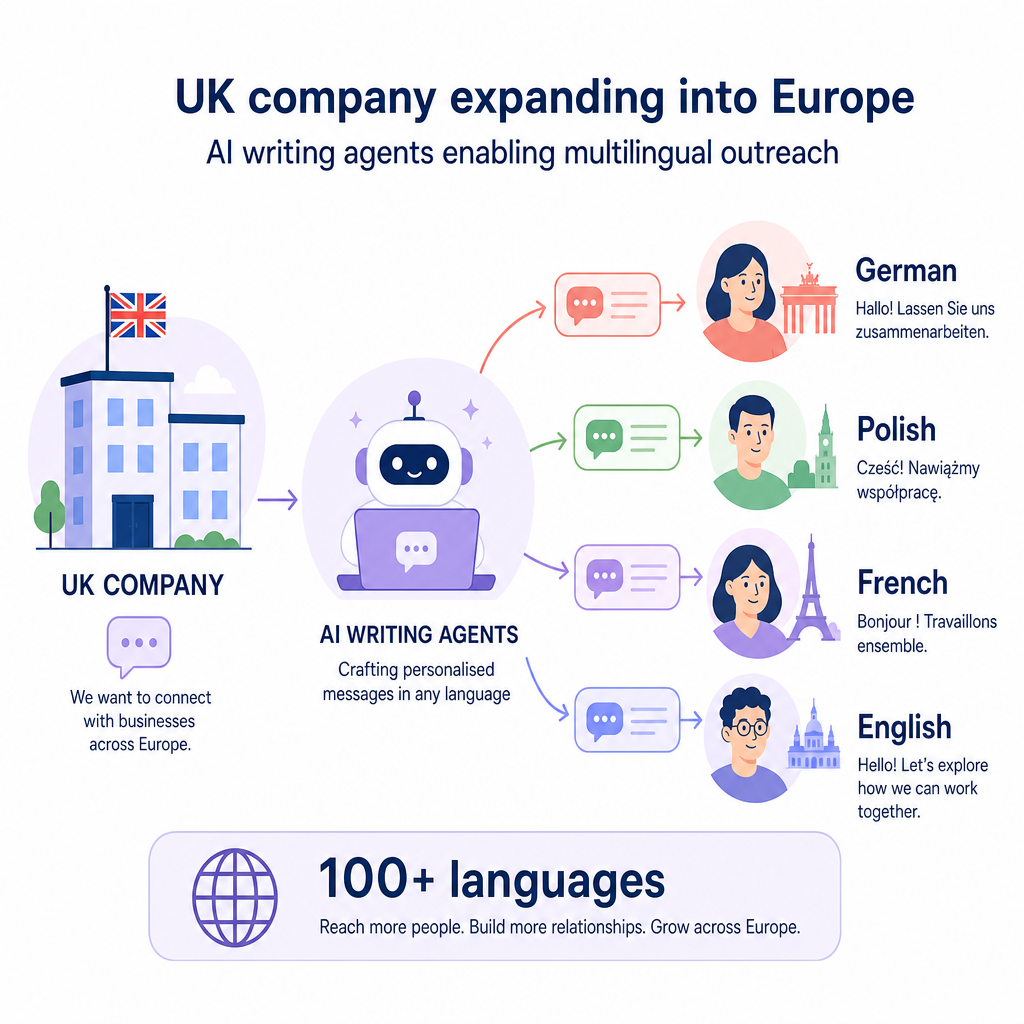
For UK firms expanding into Europe, regional language barriers can be a significant bottleneck. Advanced AI writing agents can adapt messaging into over 100 languages. This allows you to scale global lead generation while maintaining natural, culturally accurate communication standards.
Automated lead qualification for busy sales teams
Many sales reps waste hours chasing low-intent prospects. In fact, studies show 44% of sales professionals struggle with poor lead quality.
Using AI, you can easily optimize lead qualification with automation by replacing static, manual scoring models with adaptive algorithms. Instead of assigning arbitrary points to basic actions, AI monitors how prospects interact with your brand over time. High-intent actions include:
- Spending multiple minutes reviewing your pricing page.
- Downloading detailed technical spec sheets or white papers.
- Visiting your site multiple times within a 48-hour window.
When a prospect crosses your qualification threshold, the system routes the lead directly to a sales representative. This rapid turnaround is crucial. Research shows that contacting a warm prospect within five minutes makes them 21 times more likely to convert compared to waiting 30 minutes or more.
Setting up multi-channel and multilingual workflows
Relying on a single marketing channel leaves your pipeline vulnerable. Modern customer acquisition requires coordinating multiple touchpoints – like email, LinkedIn, and website interactions – into a unified workflow.
Deploying AI-driven multi-channel outreach automation allows your team to keep conversations consistent across different platforms. For example, if a prospect opens an email but does not reply, the system can automatically send a soft follow-up on LinkedIn a few days later. This structured, multi-channel approach can boost overall reply rates by up to 40%.
Setting up AI automation for B2B lead generation also ensures your outreach runs continuously in the background. While your reps are in meetings or asleep, AI engines can identify prospects, verify email deliverability, and handle initial follow-ups. This ensures your sales pipeline keeps moving 24/7 without requiring manual effort.
Real-world results: what B2B firms achieve
B2B service providers and manufacturers are seeing significant returns by replacing traditional outreach tools with intelligent automation.
Reviewing case studies on AI in lead generation reveals the substantial impact of these systems:
- A UK manufacturing firm reduced its sales cycle by 15% and boosted conversion rates by 22% by automating its lead-routing and nurturing workflows.
- Viking Window used automated, research-driven outreach to successfully open new accounts and expand sales across Ireland, Germany, Poland, Finland, and the Netherlands.
- High-growth B2B brands like Bolt and Montonio use targeted AI systems to identify and secure corporate partnerships with minimal manual overhead.
By automating early-stage prospecting, these companies free their sales teams to focus entirely on building relationships and closing contracts.
Measuring success and ROI of AI acquisition
To justify your technology investment, you must closely track key performance indicators. Using a defined set of metrics to measure AI-led lead generation success allows you to monitor exactly how automation impacts your sales funnel.
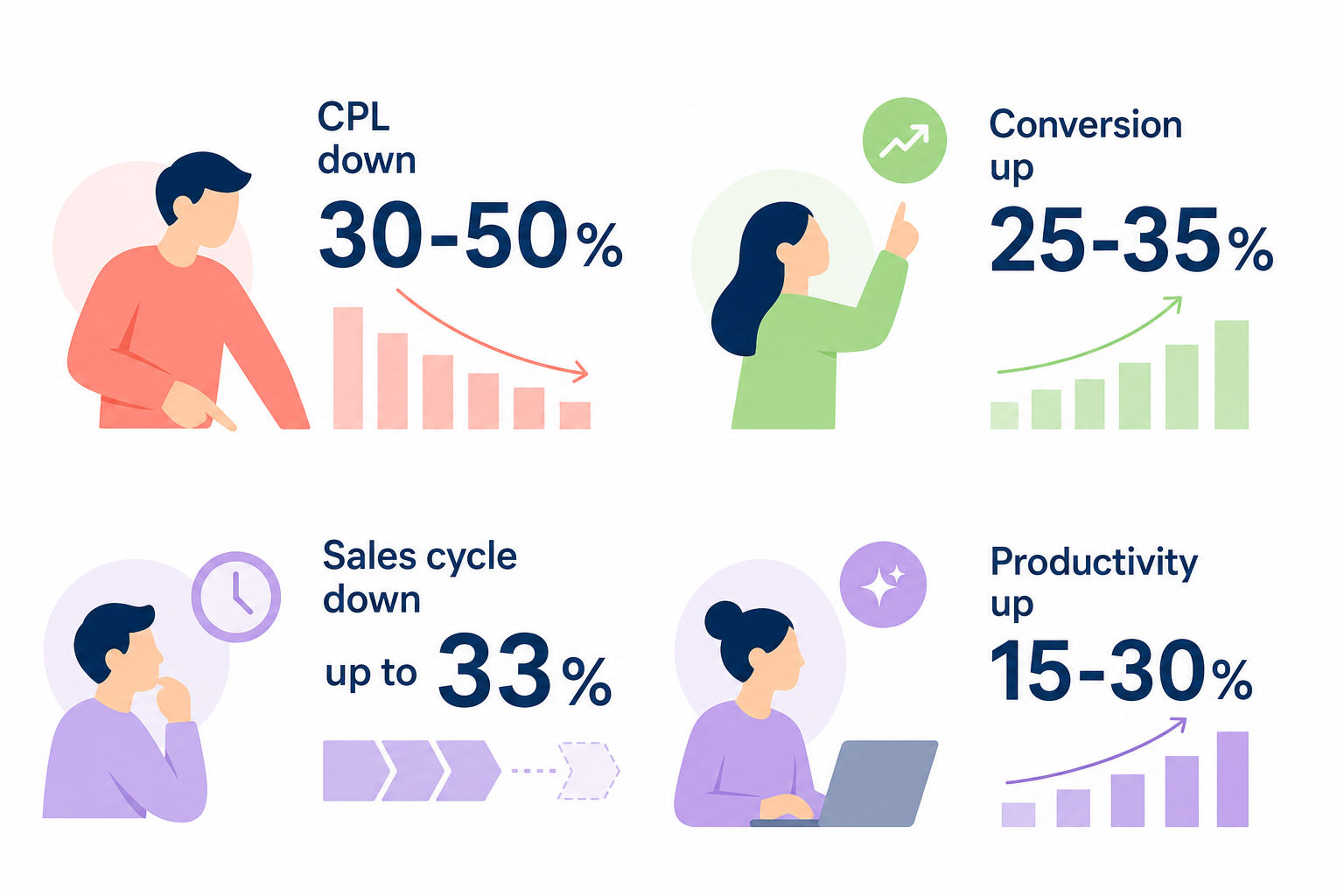
Key metrics to evaluate include:
- Cost Per Lead (CPL): AI-driven targeting and automated research typically lower CPL by 30% to 50%.
- Lead-to-Opportunity Conversion: Expect a 25% to 35% increase in conversion rates due to sharper qualification and timing.
- Sales Cycle Duration: Automated follow-ups and prompt lead routing generally shorten sales cycles by up to 33%.
- Sales Rep Productivity: Teams typically see a 15% to 30% boost in productivity as reps shift their focus from database building to closing deals.
Evaluating the overall ROI of AI-based lead generation solutions helps business leaders make informed budget decisions. Reducing customer acquisition costs while simultaneously lifting conversion rates makes AI-driven acquisition highly profitable over time.
Selecting the right AI tools for your tech stack
Building a modern acquisition stack requires choosing software that integrates smoothly with your existing customer relationship management (CRM) database.
When researching AI lead generation tools for sales teams, prioritize tools that focus on data hygiene, deliverability, and workflow alignment. Common categories include:
- Intent platforms (like 6sense or Leadspace) for identifying in-market accounts.
- Data enrichment engines (like Cognism or ZoomInfo) to verify contact details.
- Conversational chatbots (like Drift or Intercom) for real-time website qualification.
For companies seeking an end-to-end service rather than complex software to manage, Sera offers an all-in-one outreach autopilot. It uses six coordinated AI agents to run about 93% of the outbound work under expert human supervision:
- The List Building Agent creates highly targeted lists of prospects matching your ICP.
- The Enrichment Engine appends rich firmographics and behavioral data.
- The Research Analyst identifies perfect timing and relevance indicators.
- The Decision Maker Identifier confirms the exact buyers in your target accounts.
- The Deliverability Guard protects your sender reputation so emails avoid the spam folder.
- The Outreach Writer crafts human-sounding, personalized messages in over 100 languages.
Key compliance and data governance standards
As AI use grows, compliance remains a top priority for B2B executives. With the ICO continuously updating guidelines for automated decision-making and data collection, ignoring compliance is a major business risk.
To keep your acquisition strategies safe and compliant:
- Ensure all website tracking and identification tools utilize clear consent management protocols.
- Keep documented records of where your prospect data originates and how it is processed.
- Implement strict retention policies to automatically purge old or unresponsive contact records.
- Work only with platforms that prioritize GDPR-compliant databases and explicit opt-out mechanisms.
Using clean, verified data protects your brand’s reputation and prevents costly compliance penalties.
Step-by-step roadmap to start scaling
Transitioning to automated customer acquisition does not have to happen overnight. A phased approach ensures your sales team adopts the new system successfully:
- Audit your data: Clean your current CRM contacts and identify your most profitable historical customer profiles.
- Define your criteria: Align your sales and marketing teams on exact scoring definitions for qualified leads.
- Launch a pilot: Deploy automated campaigns for a small, specific target segment to test your email deliverability and messaging.
- Analyze the results: Track your conversion rates and gather direct feedback from your sales reps on lead quality.
- Scale and optimize: Gradually expand your automation to new target regions and channels, continuously refining your target profiles.
Elevate your customer acquisition
The B2B companies leading their industries are moving away from manual, repetitive admin work. By automating list building, verification, and early-stage personalization, they run lean, highly efficient acquisition funnels. This systematic approach lowers customer acquisition costs, shortens sales cycles, and allows sales reps to focus on what they do best: closing high-value contracts.
If you are ready to stop chasing cold leads and start filling your sales calendar with qualified, high-intent buyers, book a free consultation with the Sera team to see how our human-supervised AI autopilot can scale your B2B outreach.