


Are your sales engineers wasting hours drafting complex technical quotes for prospects who never buy? In manufacturing, chasing bad-fit leads drains your margins and stalls growth.
To scale your operations efficiently, you need a structured approach to filter out low-value inquiries and focus your sales team on high-probability deals. This guide outlines practical B2B lead qualification frameworks and criteria designed specifically for industrial sectors.
Why traditional manufacturing sales waste valuable time
Industrial procurement is rarely a straightforward, single-person decision. B2B purchases in manufacturing involve long sales cycles of 12 to 18 months and require buy-in from multiple departments. In fact, an industrial buying committee averages more than 10 stakeholders, ranging from operations managers to procurement directors.
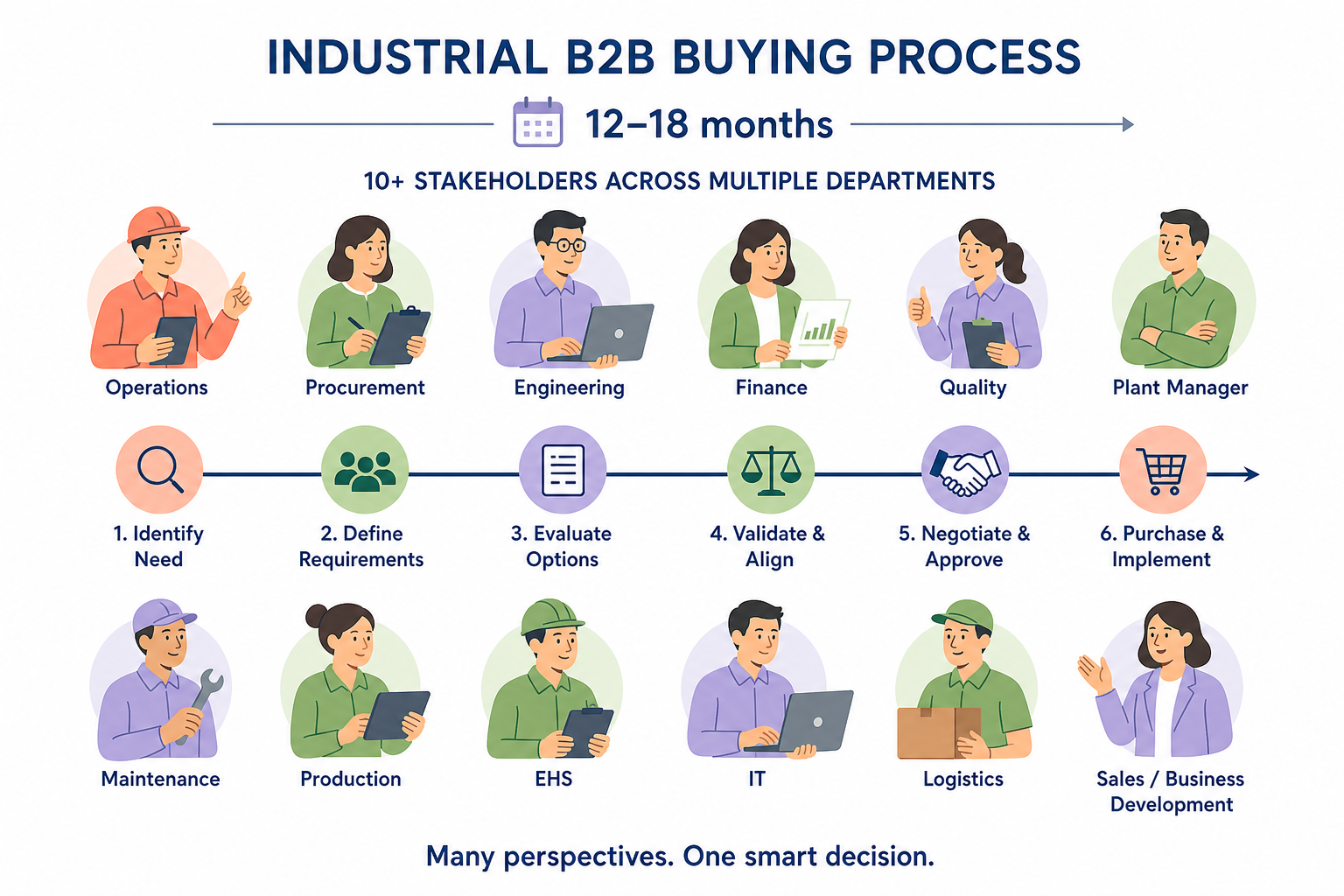
If your team treats every incoming inquiry or request for proposal (RFP) with the same level of priority, you will quickly bottleneck your engineering resources. To prevent this, you must map out your target profiles and understand how different stakeholders evaluate suppliers. Defining clear buyer personas for industrial markets ensures your team knows exactly who is a champion, who is a decision-maker, and who is simply researching with no intent to buy.
Four lead qualification frameworks for industrial sales
Sales teams use several core frameworks to evaluate lead quality. Selecting the right one depends on your deal complexity and average contract value.
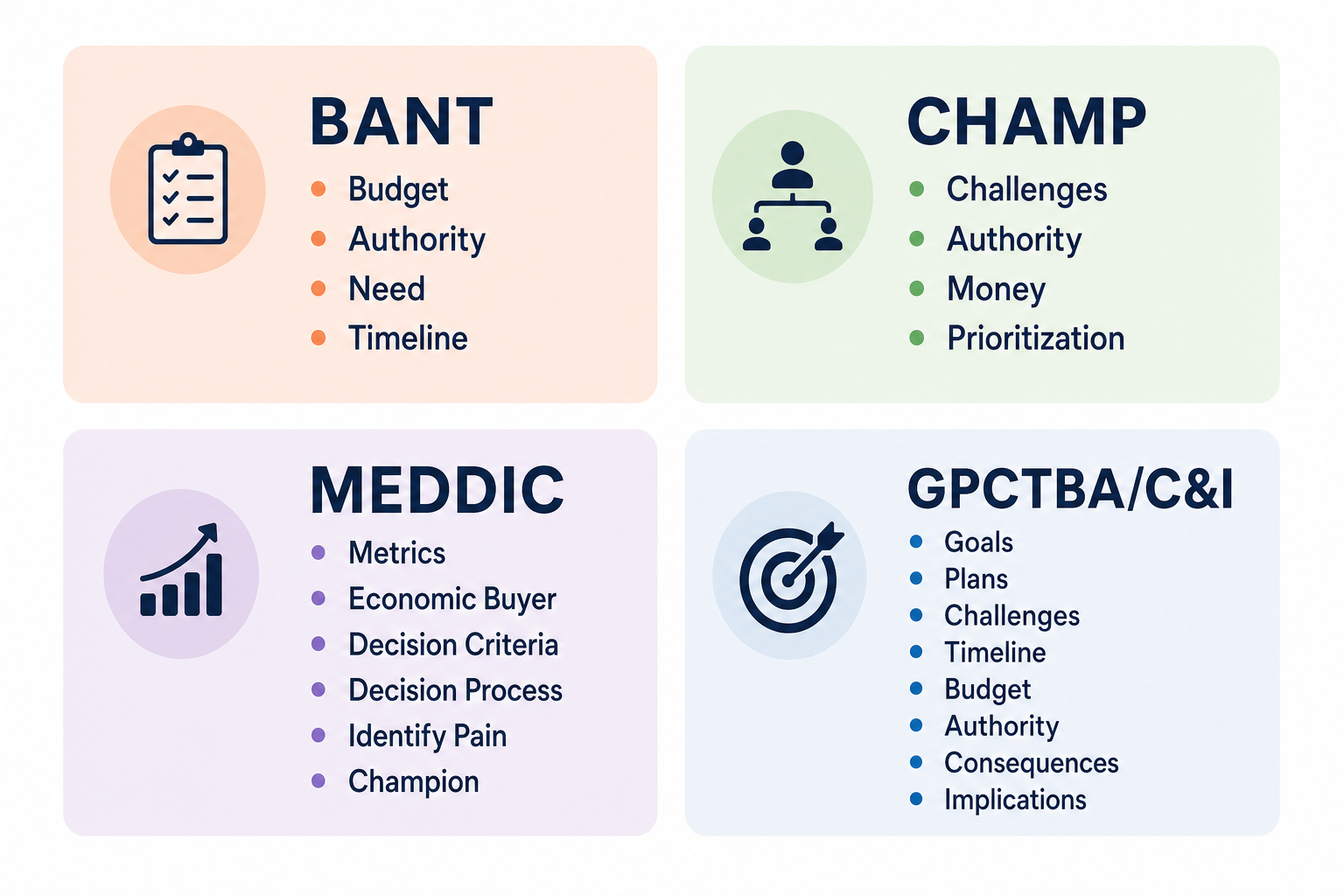
- BANT (Budget, Authority, Need, Timeline): This is the traditional benchmark for initial screening. You look at whether the prospect has the financial resources, whether you are speaking with a decision-maker who can sign off on the contract, whether your solution solves their specific operational pain point, and when they plan to implement it. While BANT is simple, it can sometimes be too rigid for complex industrial deals where budgets are flexible depending on the projected return on investment (ROI).
- CHAMP (Challenges, Authority, Money, Prioritization): This framework places the prospect’s operational bottlenecks first. You identify their production bottlenecks, downtime, or quality issues, map out the organizational structure, assess their investment capacity, and determine if solving this challenge is a top operational priority this quarter. CHAMP works well for technical sales because it starts with the problem on the factory floor rather than the balance sheet.
- MEDDIC (Metrics, Economic Buyer, Decision Criteria, Decision Process, Identify Pain, Champion): For high-value capital equipment and major original equipment manufacturer (OEM) contracts, MEDDIC is highly effective. It forces your sales team to map out the entire procurement process, identify internal champions, and understand the exact economic metrics the prospect will use to measure success.
- GPCTBA/C&I (Goals, Plans, Challenges, Timeline, Budget, Authority, Consequences, and Implications): This comprehensive framework looks at the broader business goals, the plan to achieve them, the timeline, and the negative consequences of not addressing the issue. It helps your team position your manufacturing capability as a strategic necessity rather than a simple commodity.
Defining key industrial evaluation criteria
To build a robust qualification checklist, you must look at how industrial buyers evaluate their vendors. High-value prospects generally measure potential suppliers against a specific set of vendor selection criteria:
- Technical specifications and quality: Does your product or service meet their precise engineering tolerances and technical requirements?
- Total Cost of Ownership (TCO): What is the overall value relative to cost? Do you offer volume discounts, favorable payment terms, or clear calculations of transportation and shipping costs?
- Operational reliability: Can you prove on-time delivery metrics? Do you have the financial strength to ensure long-term spare parts supply and support?
- Supplier flexibility: Can you scale deliveries up or down based on their fluctuating production schedules across multiple assembly locations?
- Trust and compliance: Do you possess the necessary industry certifications, excellent customer references, strong data security practices, and a clear commitment to environmental, social, and governance (ESG) sustainability?
By training your team to assess these criteria during early discovery calls, you can weed out prospects who are looking for a cheaper commodity supplier rather than a strategic manufacturing partner.
Modernizing qualification with automated systems
Qualifying leads manually via spreadsheets and endless follow-up emails is slow and prone to human error. If your team takes days to qualify an inbound lead, that prospect may already be talking to a competitor.
Modern sales teams use automation to assess and score prospects in real-time based on firmographic fit and digital behavior. Incorporating lead qualification automation allows you to apply uniform standards across your entire pipeline, which eliminates sales bias and ensures only high-intent prospects reach your sales engineers.
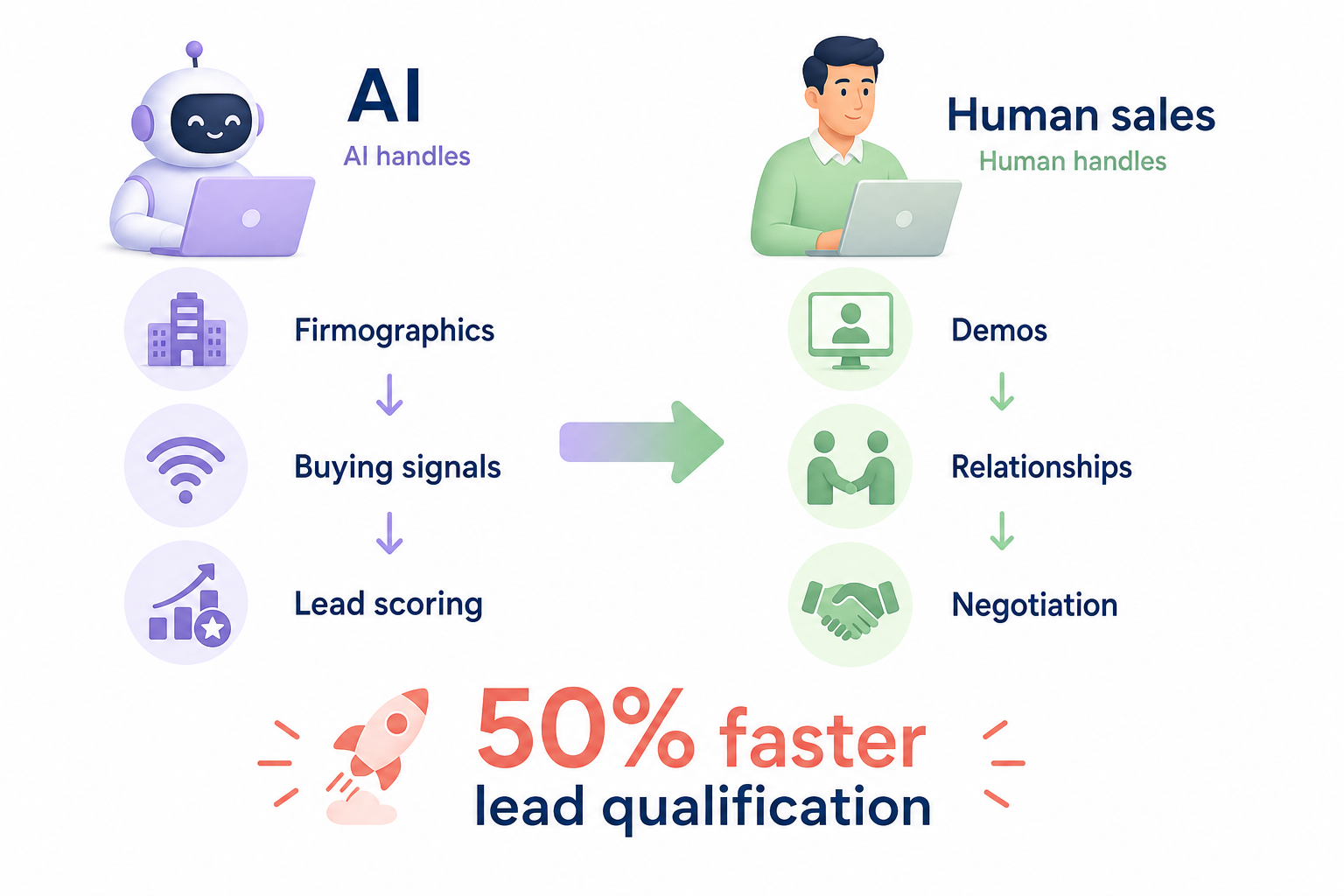
To maximize efficiency without losing the personal touch required for complex deals, many manufacturers adopt hybrid human-AI qualification models. In this setup:
- AI systems handle the repetitive, data-intensive tasks: verifying company size, researching firmographics, detecting buying signals, and scoring the lead.
- Human sales professionals step in to handle customized technical demos, build relationships, and negotiate complex contract terms.
Additionally, leveraging predictive analytics for sales prospects helps you target organizations that are actively researching solutions during their annual budget cycles. The real-world impact of these technologies is significant. According to recent AI lead generation case studies, a UK industrial equipment supplier cut lead qualification times by 50% simply by automating their initial prospect screening.
A step-by-step manufacturing qualification workflow
To build an efficient lead qualification engine for your manufacturing business, follow this structured process:
- Align sales and marketing on lead definitions: Define what qualifies as a Marketing Qualified Lead (MQL) versus a Sales Qualified Lead (SQL). An MQL might be a prospect who downloads a technical catalog, while an SQL is a decision-maker from a target industry requesting custom pricing.
- Establish an Ideal Customer Profile (ICP): Document your target company size, annual revenue, geographic location, and industry verticals. If a lead does not fit your ICP, filter it out early.
- Implement multi-dimensional lead scoring: Assign point values to leads based on firmographics (such as target manufacturing sectors), demographics (such as operations directors or VP-level decision-makers), and behavior (such as viewing your technical specifications or pricing pages multiple times).
- Run regular audits: Review your qualification criteria quarterly. Look at your closed-lost deals to see if bad-fit leads are slipping through your filters, and adjust your scoring thresholds accordingly.
Implementing a structured qualification framework helps you protect your margins and focus your engineering talent on the deals most likely to close. If you want to streamline this process further, you can explore how manufacturing companies use tailored outreach to connect with pre-qualified industrial buyers by reviewing Sera’s B2B manufacturing use cases.
To see how automated prospect discovery can help your sales team find and engage the right decision-makers with zero manual prospecting, check out Sera’s automated prospecting autopilot.