

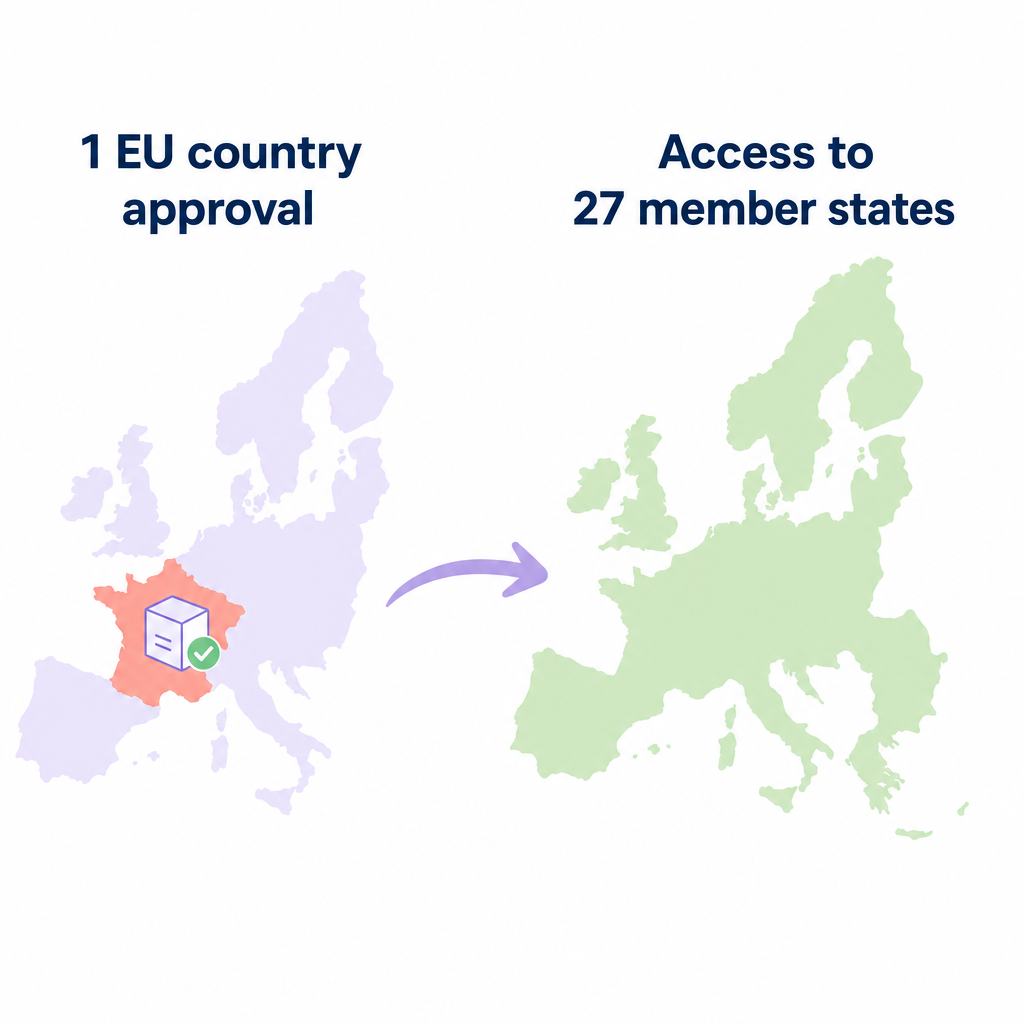
Did you know that product approval in just one EU country grants access to all 27 member states? While breaking into European supply chains is highly lucrative, complex regulations often stall unprepared exporters.
Navigating European product compliance and regulations
Before you can begin selling components or products to European manufacturers, your goods must comply with strict EU-wide standards. Failing to meet these requirements can lead to impounded shipments, heavy fines, or complete exclusion from the market.
CE marking
The CE mark is a declaration by the manufacturer that the product meets all applicable EU safety, health, and environmental protection requirements. However, CE marking is only required for products covered by harmonised EU rules that specifically mandate it. If no such EU requirements exist for your product category, you must not use the CE mark.
To apply the CE mark, you must:
- Identify all relevant EU-wide product requirements for your component.
- Determine whether you can self-assess the product or if you must use a third-party notified body for a formal conformity assessment.
- Assemble a comprehensive technical file containing product descriptions, intended use, manufacturing steps, and design drawings.
- Draft and sign an official EU Declaration of Conformity.
- Affix the CE marking so that it is visible, legible, and indelible directly on the product or its data plate.
- Keep the technical documentation and Declaration of Conformity updated and retained for at least 10 years after the product is first placed on the market.
REACH regulation
REACH (Registration, Evaluation, Authorisation and Restriction of Chemicals) shifts the responsibility to industry to manage chemical risks. If you manufacture or import chemical substances – either as raw materials, mixtures, or within articles under certain conditions – into the EU in quantities exceeding 1 tonne per year, you must register them with the European Chemicals Agency (ECHA).
Furthermore, if your manufactured components contain a Substance of Very High Concern (SVHC) in a concentration above 0.1% weight-by-weight, you are legally obligated to communicate this safety information to your downstream customers and submit a SCIP notification to ECHA.
RoHS directive
If your components are destined for electrical and electronic equipment (EEE), you must comply with the Restriction of Hazardous Substances (RoHS) directive. RoHS strictly limits the use of specific hazardous materials in electronic products.
Under RoHS, your products must not exceed maximum concentration tolerance levels, including:
- Cadmium (0.01% limit)
- Lead, mercury, hexavalent chromium, polybrominated biphenyls (PBB), polybrominated diphenyl ethers (PBDE), and specific phthalates like DEHP, BBP, DBP, and DIBP (0.1% each)
To achieve compliance, you must carry out conformity assessments, maintain detailed technical documentation for 10 years after the last product is first placed on the market, issue an EU Declaration of Conformity, and apply the CE mark to the finished equipment.
The General Product Safety Regulation and the “responsible person”
A significant compliance requirement under the General Product Safety Regulation (GPSR) is the mandate for a “responsible person” established within the EU.
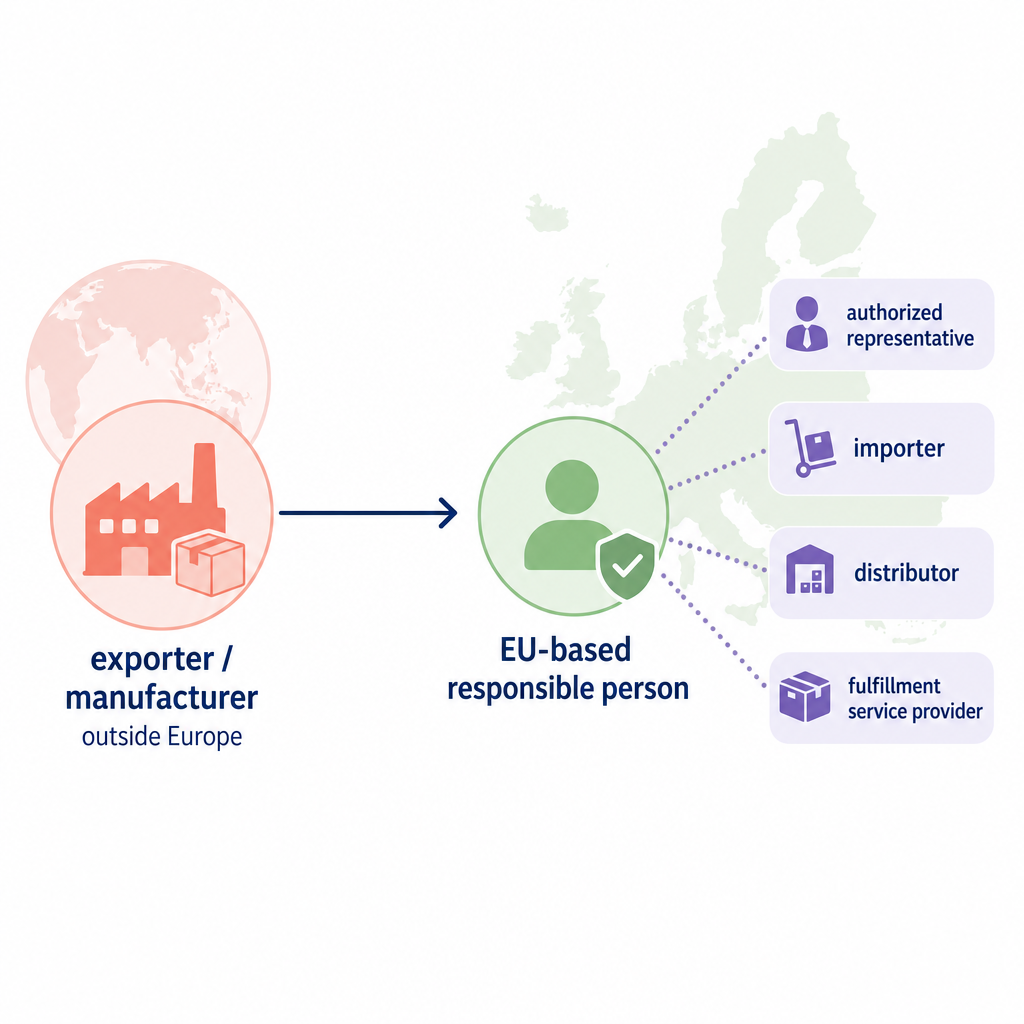
If your manufacturing facility is based outside of Europe, you must designate a natural or legal person inside the EU to act as the official point of contact for product safety and compliance. This responsible person can be an authorized representative, an importer, a distributor, or a fulfillment service provider established in the EU. If you do not have an established representative, the importer automatically assumes the legal obligations of the producer.
The designated representative must have direct access to your technical documentation and the EU Declaration of Conformity. They are responsible for cooperating with local market surveillance authorities and coordinating actions, such as product recalls, if safety issues arise.
Quality certifications required for supply chain access
European procurement teams prioritize risk mitigation. To get your foot in the door, you must prove your operations run on world-class quality management systems.
ISO 9001
At a bare minimum, European manufacturers expect their suppliers to be ISO 9001 certified. This baseline certification proves you have consistent processes for quality control, continuous improvement, and customer satisfaction.
IATF 16949 for automotive supply chains
If you plan to sell components to European automotive Original Equipment Manufacturers (OEMs) or Tier-1 suppliers, working toward IATF 16949 compliance is mandatory. IATF 16949 is the global quality management standard for the automotive industry. It is not a standalone standard; instead, it is supplementary to ISO 9001 and must be implemented in conjunction with this standard. Certification is required for almost any organization involved in the design, development, production, and servicing of automotive-related parts, irrespective of organization size.
Strategic steps to approach European buyers
Once you have established regulatory and quality compliance, you must design a structured market entry strategy. To do this, focus on three critical operational pillars:
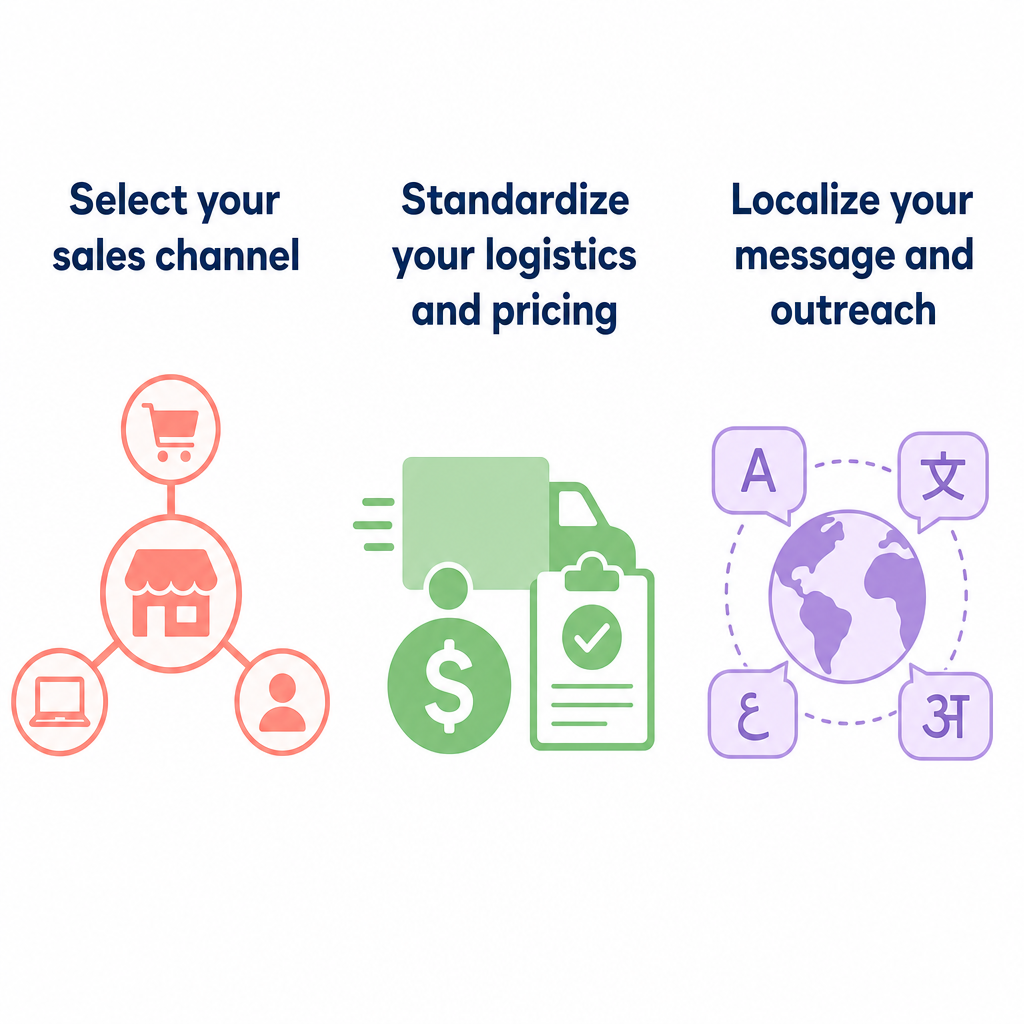
- Select your sales channel: You must decide how to structure your commercial presence in Europe. You can choose to work with local intermediaries or build an internal sales team. Carefully evaluate the pros and cons of channel strategy options such as distributors, agents, and direct sales to see which model aligns with your margins and risk tolerance. If you decide to utilize third-party partners, you must systematically execute a process for qualifying and vetting local commercial partners by checking their financial stability, current ratio, and technical capabilities. Keep in mind that European commercial agents enjoy strong statutory protections under the Commercial Agents Regulations that make termination complex and potentially costly.
- Standardize your logistics and pricing: Logistics and legal responsibilities must be crystal clear before you send a quote. You should master selecting the correct Incoterms for your shipping quotes to define exactly where costs, duties, and risks transfer from you to the European buyer. These terms will directly impact your export pricing strategy for international markets. Your pricing model must factor in true landed costs – including international freight, packaging, customs duties, and currency hedging – so you do not accidentally erode your profit margins.
- Localize your message and outreach: A generic, English-only sales pitch rarely works with old-school European manufacturers. You need to focus on localizing your B2B value proposition to emphasize the specific metrics European buyers care about, such as energy efficiency, supply chain stability, and localized technical support. Be mindful of cultural differences in B2B sales. For example, German buyers generally demand exhaustive technical documentation and direct, transparent communication, while buyers in southern Europe often require longer relationship-building cycles. To break through regional noise, deploy highly personalized, GDPR-compliant, and multilingual outreach campaigns written in the prospect’s native language. If you execute these commercial steps alongside a disciplined plan, you can systematically work toward growing your export sales in international markets and turn the European market into a predictable engine of revenue growth.
Accelerate your European expansion
Securing compliance and preparing your value proposition are the foundations of European market entry. However, the hardest part of the equation is often finding the right decision-makers at target manufacturing plants and starting meaningful business conversations with them.
If you want to bypass the slow, manual process of building prospect lists and translating outreach templates, explore how automated tools can assist. You can scale your operations, protect your reputation, and connect directly with key decision-makers across Europe.
Ready to scale your European pipeline? Discover how Sera’s AI-driven B2B outreach platform can automate your lead discovery and natively personalized outreach to book more meetings with European manufacturing executives.