


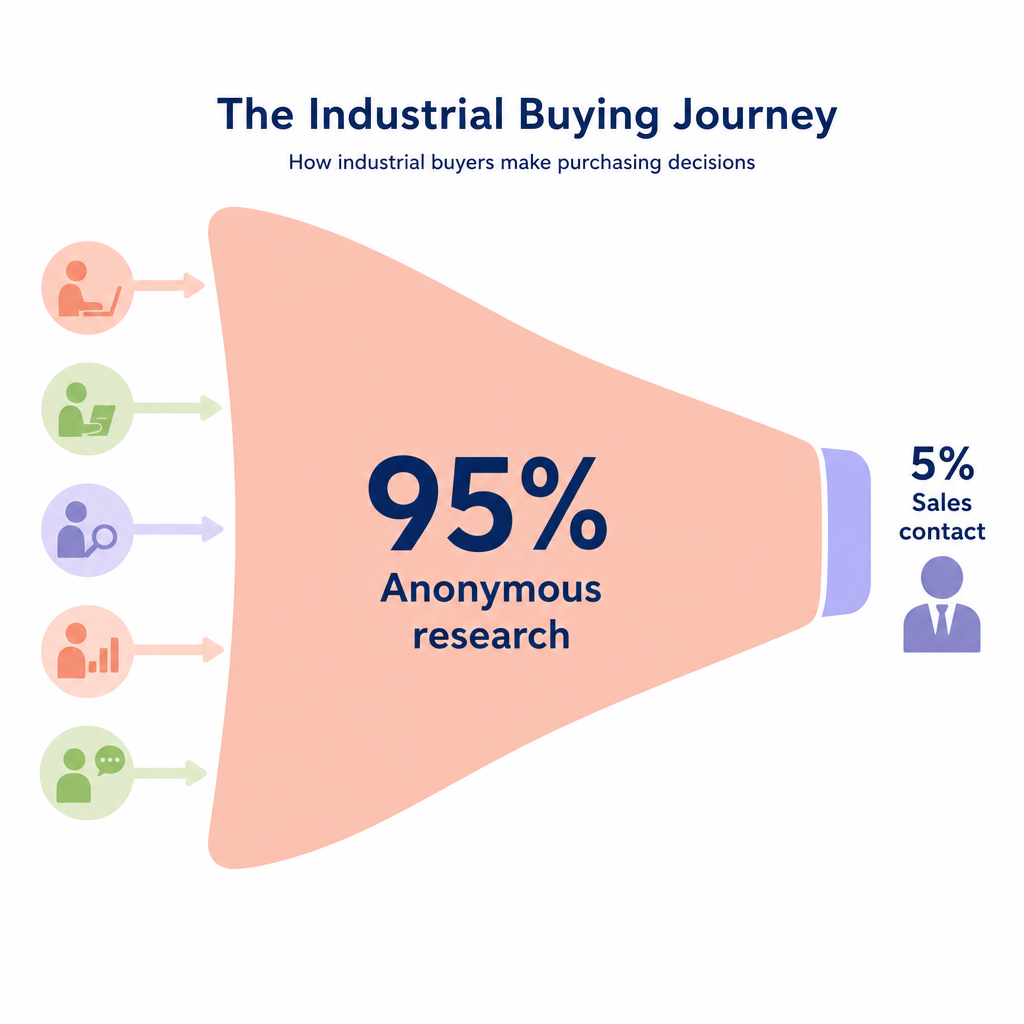
Did you know up to 95% of the industrial buying journey happens anonymously before a prospect ever contacts your sales team? If you wait for buyers to find you, competitors are already winning their business.
What is sales intent data?
In the manufacturing sector, sales cycles are traditionally long, complex, and high-stakes. Procurement managers do not make hasty decisions when sourcing custom components, raw materials, or industrial machinery. Instead, they spend months conducting independent online research before they ever speak with a representative.
Sales intent data – often called buyer intent data – is the digital footprint left by these prospective buyers during their research phase. It captures the digital signals and content consumption patterns that indicate when a specific organization is actively in the market for your products.
Instead of guessing which accounts are ready to buy, intent data helps you identify businesses that are already showing interest. According to industry research, analyzing these digital signals can boost conversion rates by 30% through predictive analytics for sales prospects.
Understanding the types of buyer intent data
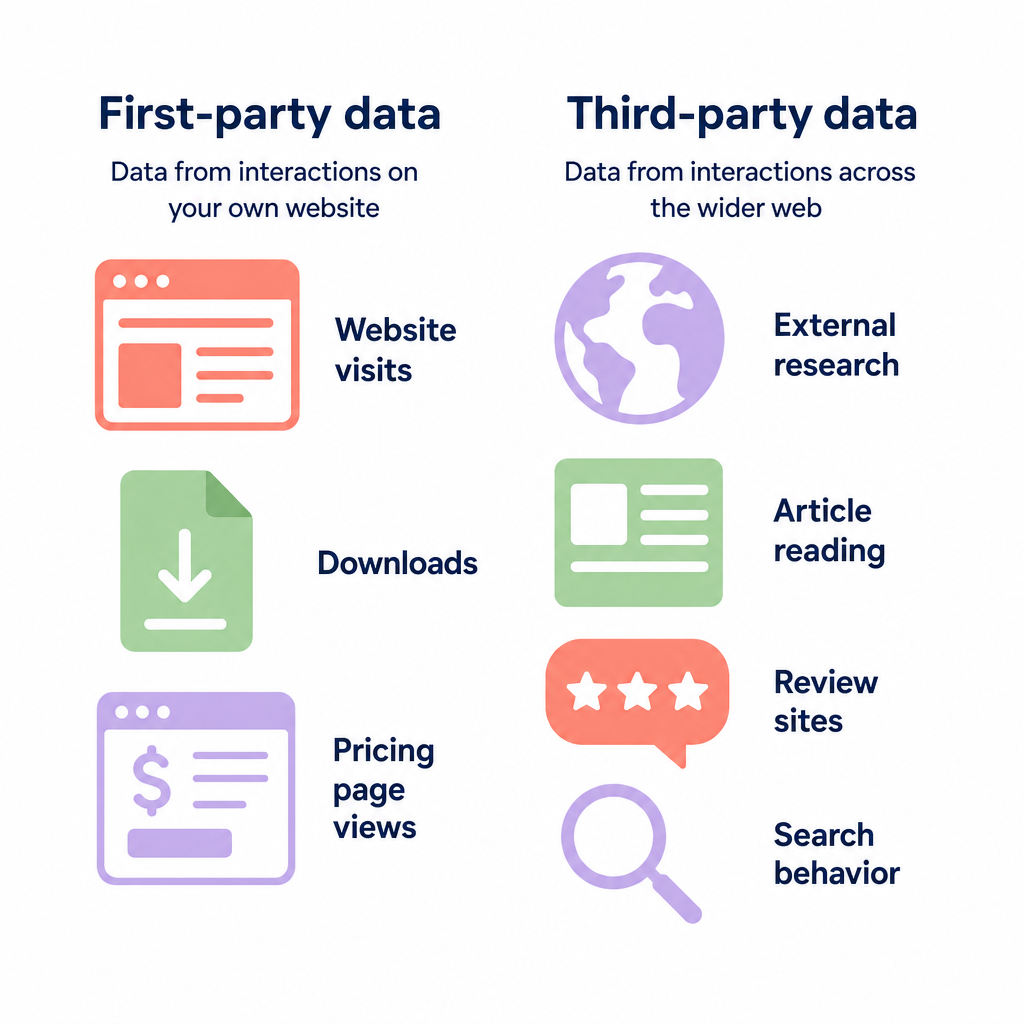
To use intent data effectively, you need to understand where it comes from. These digital signals are broadly divided into two main categories: first-party and third-party data.
First-party intent data
This data is generated directly on your own digital channels. Key examples include:
- Website visits: An anonymous user reviewing your product specification sheets.
- Content downloads: A prospect downloading a technical whitepaper, CAD drawing, or material safety data sheet.
- Pricing page views: A potential client checking your volume discount structures.
First-party data is highly accurate and reliable, but it only captures accounts that have already discovered your brand. To reveal the identity of these anonymous accounts, you can deploy website visitor intelligence tools that match incoming traffic with corporate profiles.
Third-party intent data
Third-party intent data captures research behavior across the wider web. This is highly valuable because of how buyers behave today. Modern procurement teams prefer self-guided digital research before committing to sales conversations. To learn more about this behavior, read our guide on how buyers research suppliers.
Third-party data is generally sourced through three primary methods:
- Bidstream and cooperative intent: Publisher networks track content consumption across thousands of business websites. When employees at a specific company read articles about topics related to your industry at rates above their usual baseline, a “surge” is detected. This data is aggregated at the account level using reverse-IP lookup.
- Review-site intent: This high-fidelity signal comes from B2B software and service review directories. When engineering or purchasing teams compare manufacturing solutions or read supplier reviews, they are demonstrating clear commercial intent.
- Search intent: This tracks keyword research patterns. If employees at a target firm search for terms like “heavy duty conveyor systems” or “cnc machining alternatives,” they are likely in the middle of active supplier evaluation.
How intent data is processed and delivered
Raw web traffic is noisy and unstructured. To make it highly useful for your sales representatives, intent data providers process these raw signals through several distinct stages:
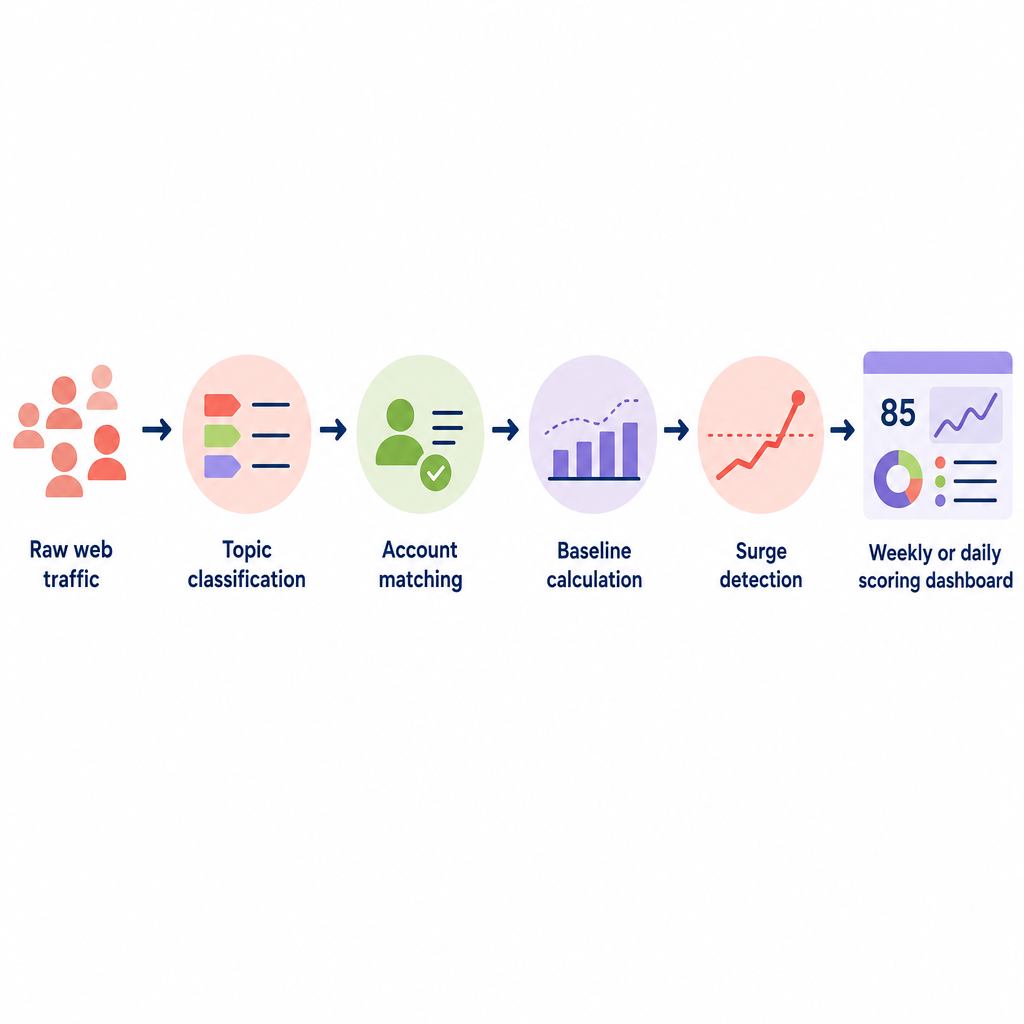
- Topic classification: Mapping web content to specific categories, such as filing an article under “injection molding services.”
- Account matching: Resolving anonymous IP addresses to actual business records so you know exactly which company is researching.
- Baseline calculation: Determining what a “normal” level of research activity looks like for a specific business over time.
- Surge detection: Flagging accounts whose current research activity significantly exceeds their historical baseline, indicating an active project.
The final output is typically delivered to your team as a weekly or daily scoring dashboard showing elevated interest in specific topics.
Practical applications for manufacturing sales teams
Once you have access to intent data, you must turn it into structured, actionable workflows. Here is how manufacturing sales teams can apply these insights.
Prioritize your outreach list
Your sales team has limited hours in the day. Instead of calling generic lists based on company size alone, you can focus on accounts actively researching your solutions. Implementing AI-driven sales prospect scoring allows you to automatically weigh these signals and rank prospects by their likelihood to convert, saving your team hours of manual prospecting.
Implement dynamic lead scoring
You can set up a scoring system within your CRM. Assign points based on the value of the action:
- Low intent: Reading a generic blog post (10 points).
- Medium intent: Searching for industry keywords or downloading a product brochure (30 points).
- High intent: Repeated visits to a pricing page or viewing a product comparison guide (80+ points).
Syncing these rules with your CRM ensures your team receives alerts the moment a lead crosses your threshold. For practical implementation steps, explore our guide on AI-driven lead scoring and routing best practices.
Personalize your message
If you know exactly what a prospect is researching, you can tailor your outreach to their specific pain points. For example, if intent data reveals a target account is researching “precision steel tolerances,” your sales team can reach out with a case study detailing your tight tolerance capabilities. Aligning your communication with behavioral analytics in sales leads to significantly higher response rates.
Shorten sales cycles with real-time response
In industrial sales, timing is everything. Utilizing real-time prospect data analysis ensures you reach out at the exact moment a prospect is thinking about your category. This allows you to influence their requirements before they have already finalized a competitor’s shortlist.
Scaling your outreach with automation
While intent data tells you who to target and when, your team still needs to find the correct decision-makers and draft personalized messages. This manual effort can quickly bottleneck your pipeline.
This is where modern sales automation bridges the gap. Solutions like Sera’s AI-driven outreach autopilot can take these high-intent signals and run targeted, low-volume campaigns on your behalf. Powered by six specialized AI agents, Sera handles everything from identifying the right procurement manager to writing tailored, multilingual emails that read as if they were written by an industry veteran.
By combining the precision of sales intent data with targeted AI-driven outreach, you can fill your sales pipeline with qualified opportunities while keeping your team focused on what they do best: building relationships and closing deals.
To see how automated, research-driven outreach can transform your manufacturing pipeline, learn more about how Sera can act as your outreach partner.