


Your inbox placement sits at 40%. Your reps spend two hours a day clicking through dashboards. Every campaign feels like a coin flip.
Sound familiar? You’re weighing Lemlist versus Instantly versus a dozen other outreach platforms, trying to figure out which one will finally get your messages into inboxes instead of spam folders. The real question isn’t which button-clicking tool to buy – it’s whether you should be clicking buttons at all.
The cold email landscape has shifted
Three years ago, sending 500 cold emails per day per mailbox was standard advice. Bulk sequences, minimal personalization, spray-and-pray. Those days are over.
Google and Yahoo now enforce strict deliverability requirements for anyone sending over 5,000 emails daily to their users. Microsoft demands DMARC authentication. UK ISPs prioritize engagement signals over everything else. Prospects have learned to spot generic templates from a mile away.
The platforms haven’t stood still either. Lemlist now offers built-in warm-up through Lemwarm, spam monitoring, and domain health checks, while Woodpecker includes free email warm-up and inbox rotation as standard. Instantly operates on a flat-fee model with unlimited email accounts and built-in warmup, compared to traditional per-seat pricing.
Adding features to dashboards doesn’t solve the core problem: your team is spending time operating software instead of closing deals.
Lemlist vs Instantly: what you’re actually comparing
Let’s break down what these platforms offer and where they differ.
Pricing structures
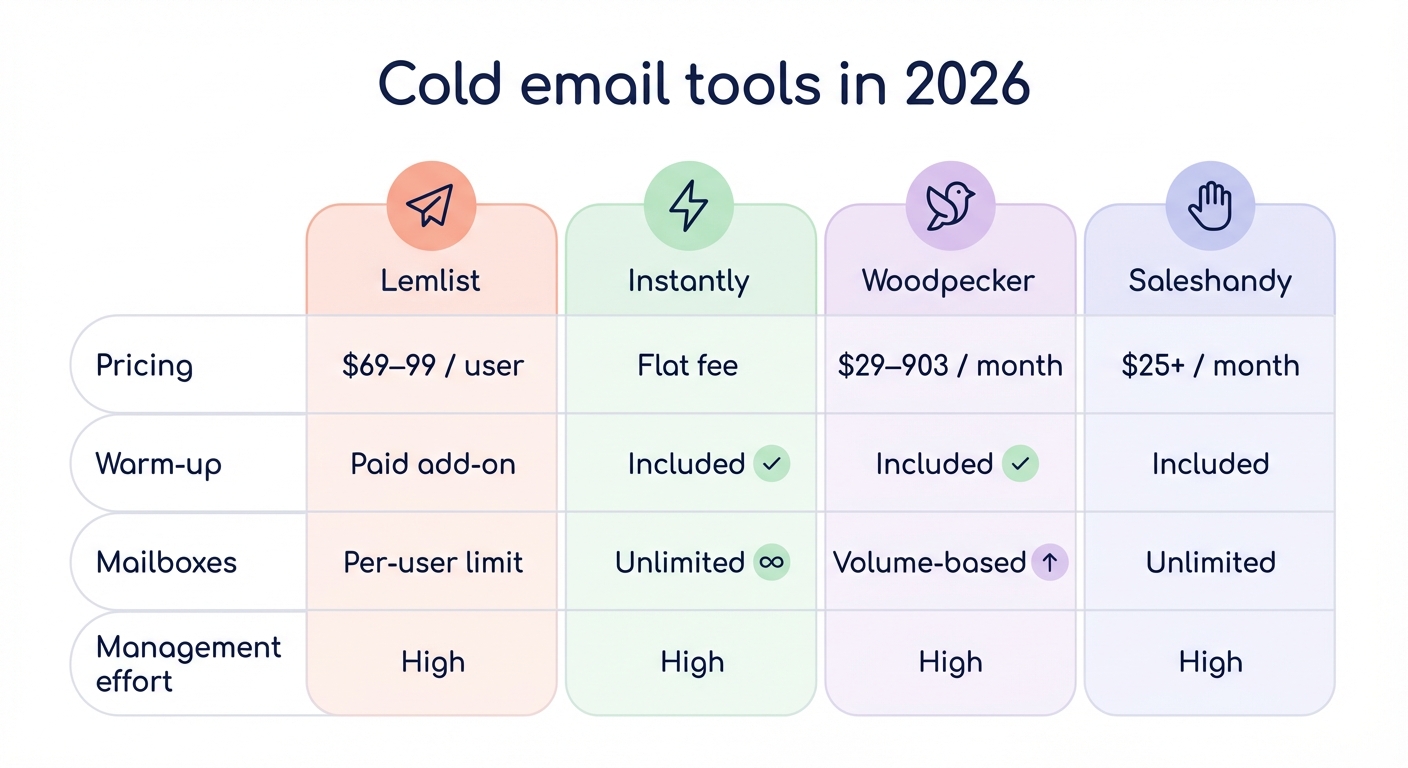
Lemlist pricing starts at $69/month per user for the Email Pro plan and $99/month per user for the Multi-Channel Expert plan. Warm-up services cost extra.
Instantly uses a flat-fee model with unlimited email accounts and built-in warmup included. No per-seat charges.
Apollo offers a free plan with 100 credits, then $59 for Basic and $99 for higher tiers. Maximum 15 mailboxes per user.
Woodpecker ranges from $29-903/month depending on your sending volume, with warm-up included as standard.
Deliverability features
Deliverability determines whether prospects ever see your message. Here’s how the platforms stack up.
Lemlist provides Lemwarm (built-in warm-up), spam monitoring, and domain health checks. Woodpecker includes free email warm-up, inbox rotation, and deliverability monitoring without extra charges.
Instantly bundles warm-up into its flat fee, ensuring every mailbox gets reputation protection from day one. Apollo provides only basic deliverability features with no warm-up capability.
The catch? All of these require you to configure SPF, DKIM, and DMARC records correctly, monitor bounce rates manually, and adjust sending volumes based on engagement patterns. Miss one configuration step and your entire domain reputation suffers.
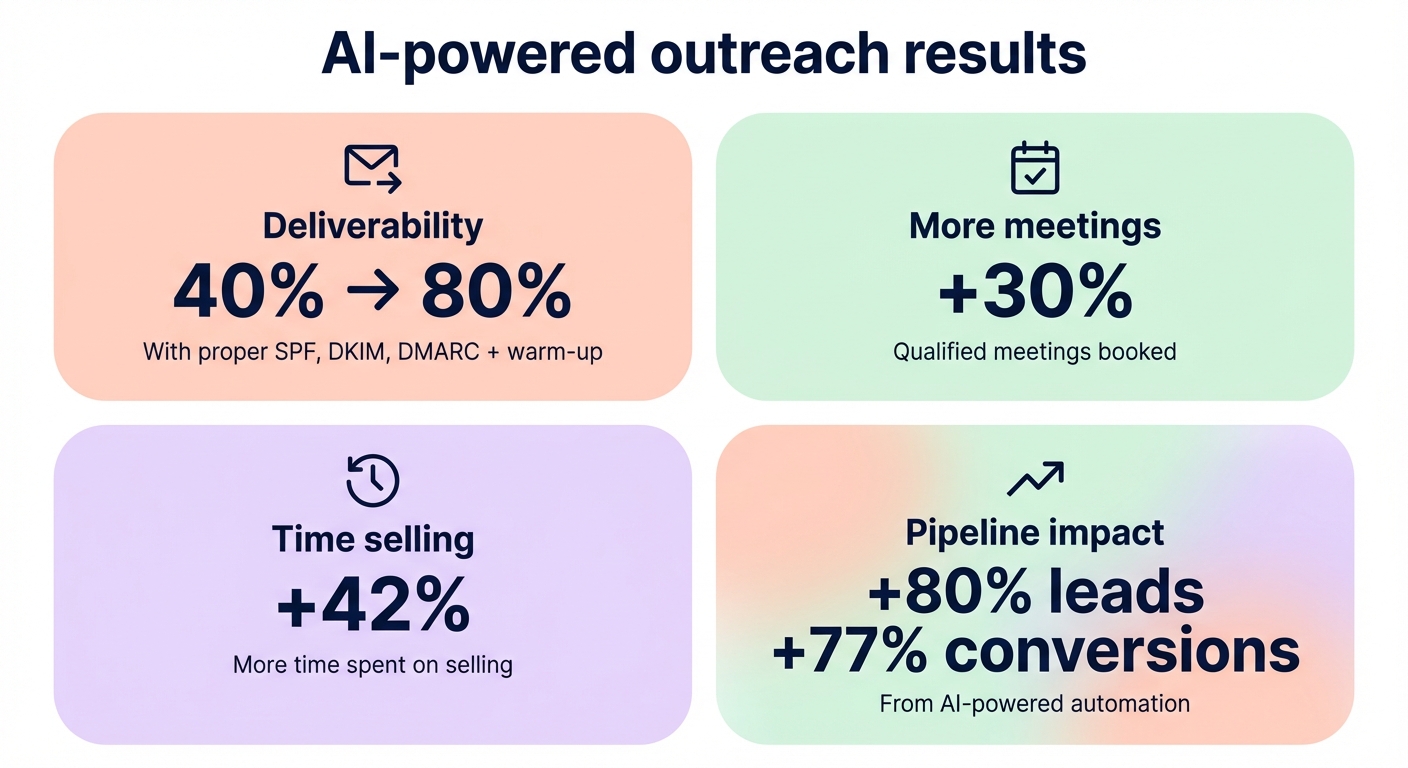
Proper authentication protocols can improve deliverability by 20-30%, but only if you implement them correctly across every mailbox. One UK B2B software company raised inbox placement from below 40% to 80% after implementing SPF/DKIM/DMARC, domain warming, and list segmentation – but it took constant monitoring and adjustment.
Database and contact quality
Instantly provides 450M+ B2B contacts through SuperSearch, while Apollo’s database contains approximately 210M+ contacts and 35M+ companies. Saleshandy offers a 700+ million lead database with unlimited email accounts starting at $25/month.
Larger databases sound impressive until you realize that raw contact volume doesn’t equal quality. How many of those 450 million contacts are decision-makers at companies that actually match your ideal customer profile? How many email addresses are still valid? How many contacts have you already burned through failed campaigns last quarter?
Database size matters less than verification, enrichment, and targeting. A list of 100 verified decision-makers who match your ICP will outperform 10,000 generic “VP Sales” contacts every time.
Personalization and sequence features
Lemlist supports multichannel outreach including LinkedIn voice notes and has top-tier personalization capabilities for text, images, and videos. It provides visual branching sequences for adaptive campaigns.
Instantly’s AI generator feature is unavailable on the Growth plan, though templates can be edited. Apollo’s sequence design is more linear with less flexibility than Lemlist’s branching logic.
The question is: who’s doing the personalization work? If your SDRs are spending hours researching prospects, crafting custom first lines, and manually adjusting sequences, you’re paying people to operate software instead of having conversations with buyers.
Agency and team features
Woodpecker offers agency-friendly features including centralized billing and permissions management. Lemlist’s multi-workspace option is more expensive. Apollo lacks dedicated agency support.
If you’re running campaigns for multiple clients or business units, workspace management matters. It’s still manual work – copying campaigns, adjusting targeting, monitoring results across dashboards.
Support and reliability
Instantly has been rated higher than Apollo for support ticket response times, answering 40% faster according to some benchmarks. The platform is noted for smooth user experience and dependable performance compared to competitors with slow dashboards.
Fast support matters when your campaign breaks at 4pm on Friday. The best support is not needing support because the system handles edge cases automatically.
The hidden costs nobody mentions
Every platform lists monthly subscription fees. None of them highlight the real costs.
Time. Your SDRs spend 15-30 hours per week managing these tools – uploading lists, setting up sequences, monitoring deliverability, adjusting campaigns, exporting data to your CRM. That’s half their available selling time going to software operation.
Deliverability risk. One misconfigured campaign can tank your domain reputation for months. A UK manufacturing firm fell to under 40% deliverability for nearly two months after switching providers without proper authentication setup.
Learning curves. Each platform has its own quirks, best practices, and gotchas. Training new team members takes weeks. Onboarding a new tool after switching platforms takes months.
Integration headaches. You need data flowing between your outreach tool, CRM, enrichment providers, and calendar systems. Inadequate data mapping is the number one cause of integration failures. Manual CSV uploads and syncing eat hours every week.
What if you stopped managing software entirely?
Here’s a different question: what if outreach didn’t require you to manage a platform at all?
By 2025, 80% of UK sales teams will use AI for lead generation, according to Forrester research. Not AI features bolted onto existing tools. Actual AI agents that handle the work from end to end.
Think about what you’re actually trying to accomplish. Find companies that match your ideal customer profile. Identify the right decision-maker at each company. Research each prospect to understand their situation. Write a personalized message that addresses their specific challenges. Send that message at the right time through the right channel. Monitor engagement and adjust your approach. Follow up appropriately based on responses. Ensure deliverability stays above 95%. Log everything in your CRM. Schedule meetings with interested prospects.
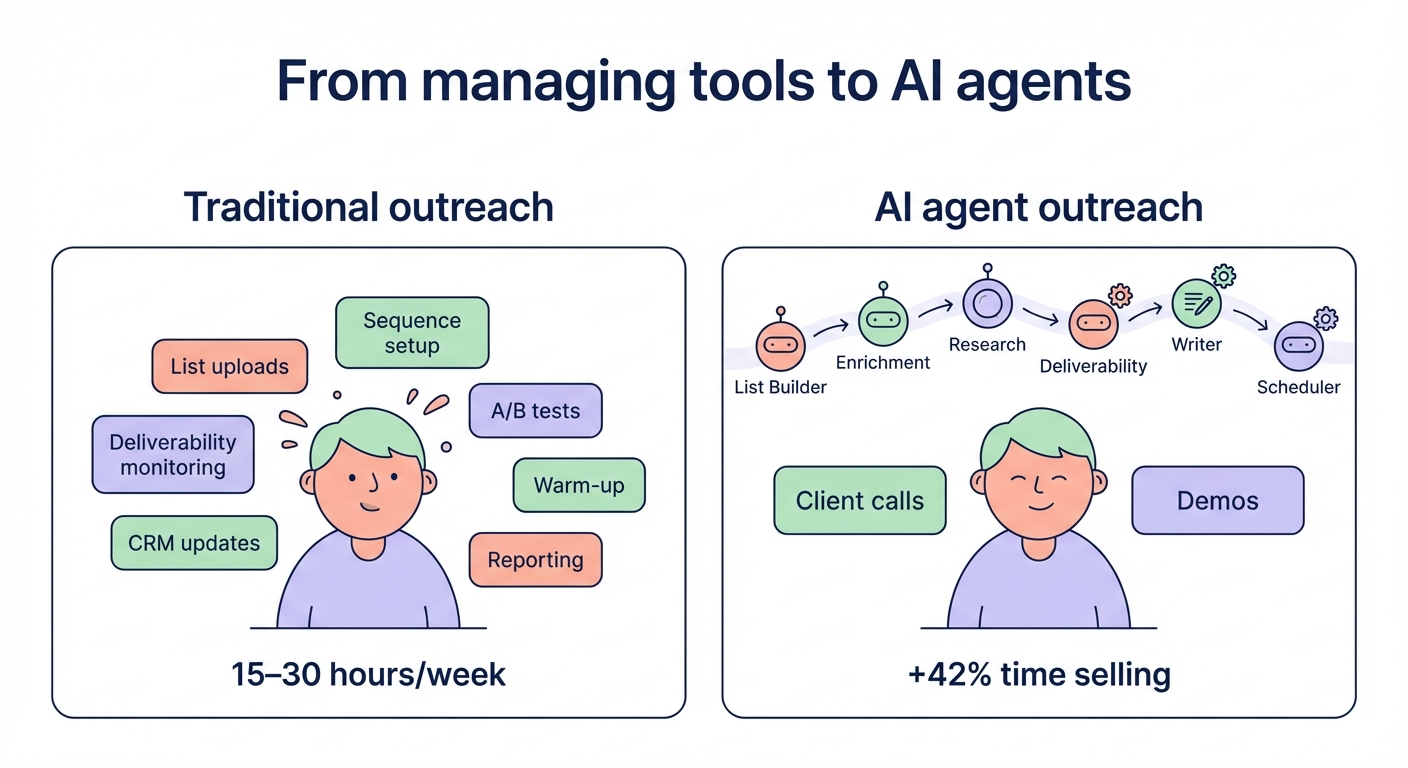
Every tool we’ve discussed requires humans to do most of these steps manually. They provide databases and sending infrastructure, but you’re still the one making decisions, doing research, writing copy, and clicking buttons.
The AI agent approach
Instead of giving humans better tools to click buttons faster, AI agents handle the entire workflow.
Sera’s platform uses six specialized AI agents working together. A List Building Agent creates ultra-targeted lead lists based on your ideal customer profile, analyzing firmographics and behavioral signals across 300M+ companies. An Enrichment Engine adds rich data – tech stack, revenue, recent news, hiring patterns – so every prospect record is complete. A Research Analyst finds timing signals and relevance cues by scanning company websites, LinkedIn, and press releases to identify the right moment to reach out.
A Decision Maker Identifier confirms you’re contacting the person who can actually say yes, not a junior employee who’ll forward your email into oblivion. A Deliverability Guard protects your sender reputation with domain warming, address validation, and send-volume optimization, maintaining 99% inbox placement. An Outreach Writer crafts human-sounding, multilingual emails that reference specific company details and industry challenges – not generic templates with a {FirstName} token.
The entire system learns from every interaction. When a particular approach generates replies in manufacturing but falls flat in SaaS, the agents adjust automatically. When a prospect in Germany responds better to formal tone while UK prospects prefer casual, the Writer adapts.
You don’t upload CSVs or set up sequences. You tell the system your target market and offer, and it handles the rest. Replies appear in your dashboard or CRM. Meeting requests get routed to your calendar. You show up to talk to qualified prospects, not to manage campaigns.
A UK SaaS company using this approach reported a 25% reduction in sales cycle length, 30% increase in qualified meetings booked, and 42% more time spent on actual selling activities. They weren’t clicking through dashboards anymore. They were closing deals.
Making your decision
If you’re set on buying a traditional cold email platform, here’s the short version.
Choose Lemlist if: You need advanced multichannel capabilities (email + LinkedIn + calls), visual branching sequences, and strong personalization features. Budget $69-99/month per user plus warm-up costs. Be prepared to manage campaigns actively.
Choose Instantly if: You want flat-fee pricing with unlimited mailboxes, built-in warm-up, and a clean interface. Good for agencies or teams running high-volume campaigns. Still requires significant hands-on management.
Choose Woodpecker if: You need strong deliverability features included (warm-up, inbox rotation, monitoring) and agency-friendly workspace management. Pricing scales with volume.
Choose Saleshandy if: Budget is tight and you need access to a large database with unlimited email accounts at $25/month. Expect to handle more configuration yourself.
Ask yourself this first: in 2026, should your sales team be operating software, or should software be operating on behalf of your sales team?
Companies that adopt AI-powered automation report 80% more leads and 77% higher conversion rates. UK businesses see an average return of £5.44 for every £1 spent on marketing and sales automation. The gap between teams clicking through dashboards and teams letting AI handle the execution is widening every quarter.
The tools we’ve discussed all help you send cold emails more efficiently. None of them solve the underlying problem of spending days doing work that AI agents can handle in hours – with better research, deeper personalization, and higher inbox placement.
Stop managing campaigns, start closing deals
Your competitors are already moving beyond button-clicking tools. By 2025, over 80% of UK sales interactions will be influenced by AI automation, according to industry forecasts.
You can keep comparing feature lists and pricing tiers. Or you can hand the entire outreach process to AI agents that research prospects, write personalized messages, protect your deliverability, and fill your calendar with qualified meetings – while you focus on the only thing that actually generates revenue: having conversations with buyers.
See how Sera’s AI-powered platform handles prospecting, outreach, and scheduling across 100+ languages, leaving you free to close deals instead of managing campaigns.