


Your last cold email tool promised inbox placement but delivered spam folders. Now your sales pipeline is thin, your team is frustrated, and you’re evaluating alternatives that sound exactly like the last platform you tried.
Both Smartlead and Instantly claim to solve deliverability for outbound campaigns. They offer similar features on paper – unlimited mailboxes, automated warm-up, sequence builders. But when you’re choosing between them in 2026, the differences in how they handle inbox placement, volume management, and reliability determine whether your outreach generates meetings or gets ignored.
How deliverability actually works (and why most tools fail)
Email deliverability isn’t about hitting “send” on 10,000 messages per day. It’s about sender reputation, authentication protocols, engagement signals, and avoiding the algorithmic tripwires that Gmail and Outlook use to filter spam.
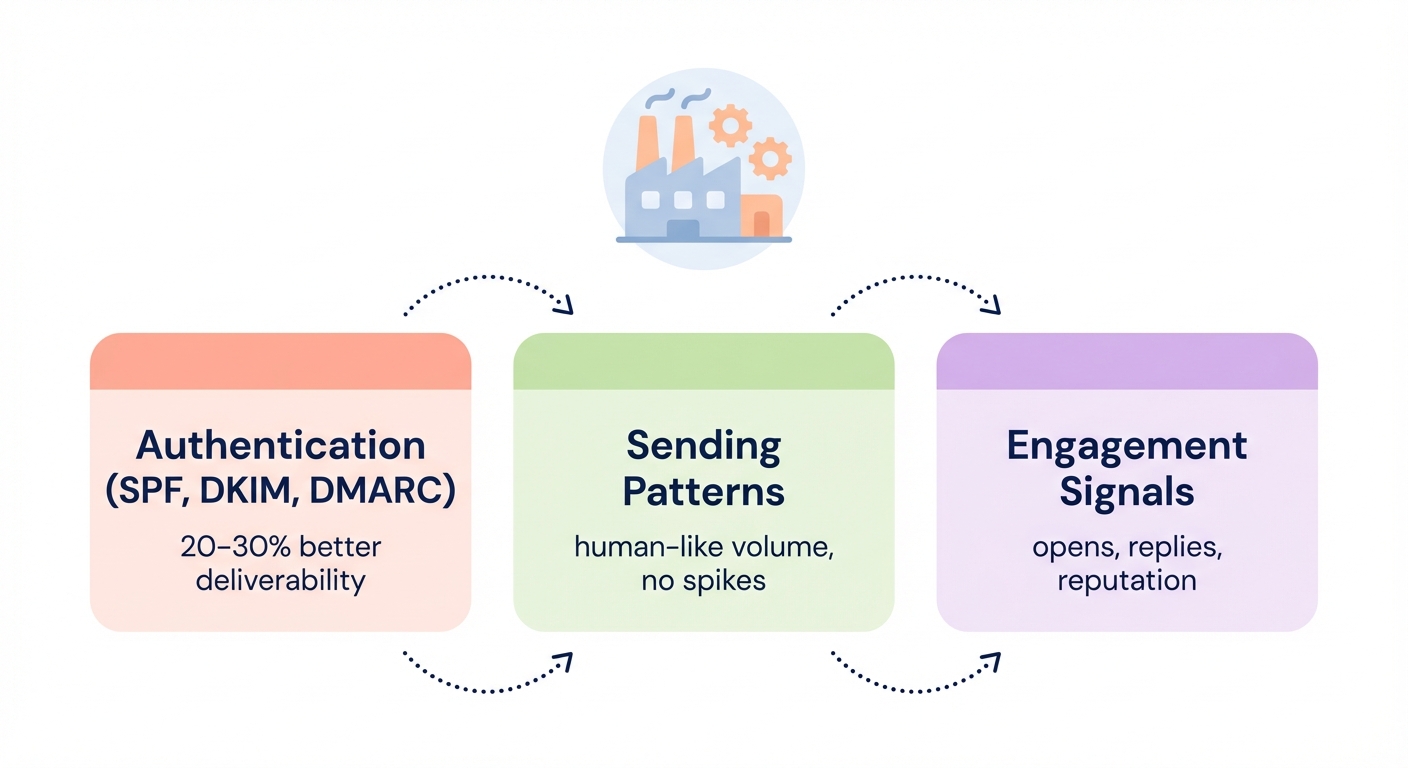
Proper authentication protocols can improve deliverability by 20-30%, but authentication alone won’t save you if your sending patterns look robotic or your content triggers spam filters. The fundamental problem with most cold email tools is they prioritize volume over reputation. They let you send thousands of emails because it looks impressive, but Gmail’s algorithms are built to detect exactly that behavior.
Most manufacturing companies we work with have already burned through one or two “deliverability-focused” platforms before they realize the issue isn’t the tool – it’s the approach.
Smartlead’s approach: variable volume and ESP matching
Smartlead takes a different approach to deliverability that mimics human sending behavior more closely than most competitors.
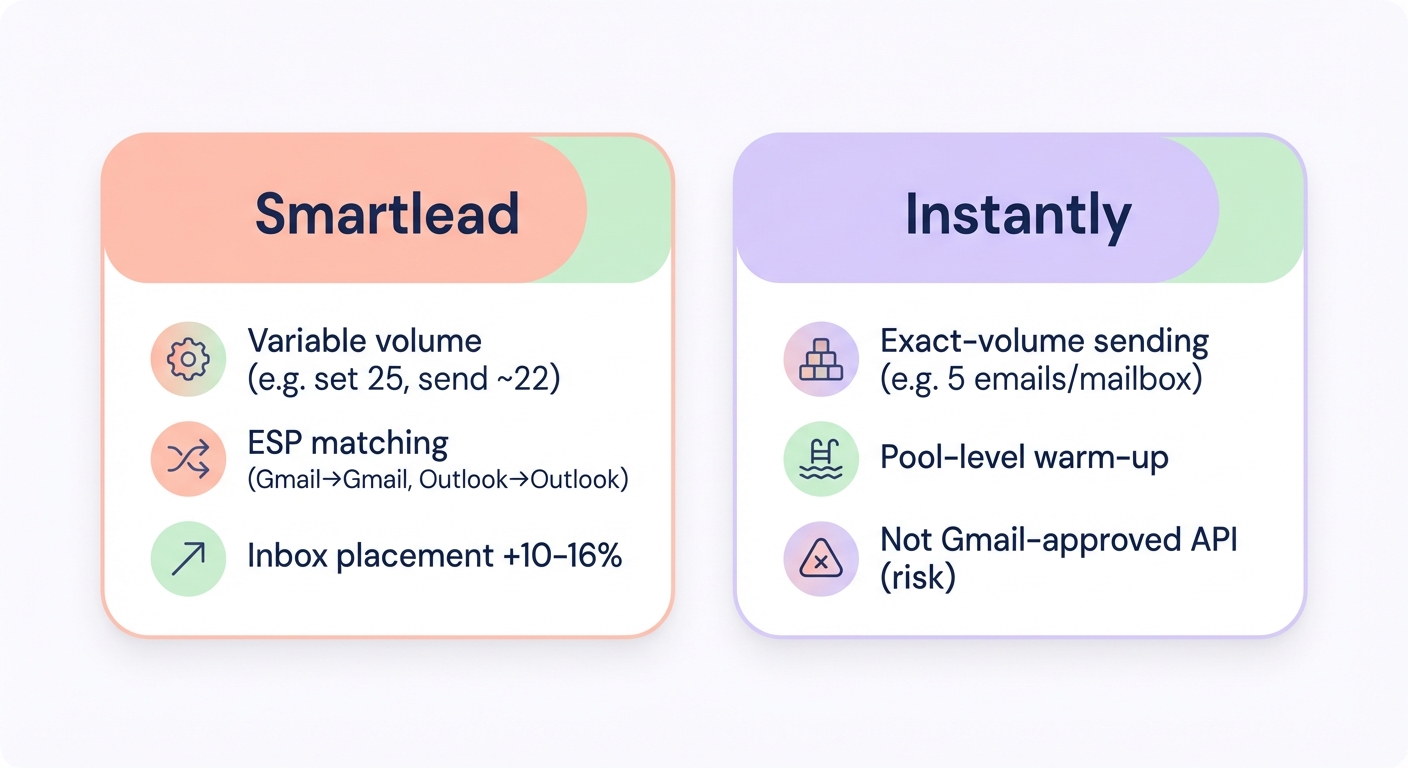
When you set Smartlead to send 25 emails per day, it actually sends 22 – a variable volume that makes detection harder for spam algorithms. According to user reports, this randomization decreases the likelihood of being flagged compared to Instantly’s exact-volume sending. The platform also includes ESP matching, routing your Gmail-sent emails to Gmail recipients and Outlook emails to Outlook recipients. User reports suggest this improves inbox placement by 10-16% because providers trust same-platform senders more than cross-platform ones.
Smartlead’s inbox rotation feature strategically varies which email accounts handle your outreach, spreading reputation risk across multiple addresses rather than burning through single accounts one at a time. The warm-up system runs continuously across unlimited mailboxes, included in the base plan, and includes a “spam rescue” tab that monitors your spam rates and prevents you from crossing critical thresholds.
Smartlead’s Warm-Up Rating sits at 4.2 out of 5, and the AI engine adjusts daily volume automatically when it detects spam triggers. The platform emulates human-like sending behavior with custom identifier tags to build trust with email service providers.
One manufacturing company improved inbox placement from 76% to 94% after implementing proper authentication and engagement-focused strategies. The key wasn’t just the tool – it was combining technical setup with smart sending patterns.
Instantly’s approach: pool-level warm-up and gradual ramps
Instantly positions itself as user-friendly with unlimited mailboxes that warm up gradually and ensure emails get opened and replied to.
The platform uses pool-level warm-up signals, meaning your email accounts benefit from collective reputation rather than individual warm-up cycles. When one mailbox in your pool gets good engagement, it lifts the others. Instantly provides built-in deliverability monitoring and will flag issues before they crater your sender reputation. The interface is more intuitive than Smartlead’s, with a shorter learning curve for teams new to cold email automation.
However, there’s a significant caveat: Instantly is not a Gmail-approved API, and users have reported deliverability issues that required troubleshooting. When your outbound engine depends on inbox placement, that risk matters.
Instantly sends exact volumes when you set daily limits, which can create detectable patterns. If you schedule 50 emails per day across 10 mailboxes, the platform sends exactly that – 5 emails per mailbox, on schedule. Gmail’s algorithms are sophisticated enough to spot those patterns.
The platform does include features like Smart-Adjust that boosts reputation when reply rates drop, but the lack of native ESP matching and variable volume puts more responsibility on you to manually configure sending patterns.
Pricing: what you actually get for the monthly fee
Smartlead starts at $39 per month with unlimited sender accounts included in a single subscription. You’re not paying per mailbox or per user – one price covers the full warm-up infrastructure, inbox rotation, and ESP matching features. For high-volume teams and agencies, this pricing structure makes more sense than per-seat models. You can spin up 20 mailboxes for a new campaign without calculating incremental costs.
Instantly’s pricing varies based on the number of mailboxes and sending volume, but exact pricing depends on your configuration. The platform offers unlimited mailboxes on higher tiers, but you’ll want to verify what “unlimited” actually means in practice versus the throttling and reputation management Instantly builds in.
The real cost isn’t the monthly subscription – it’s what happens when deliverability drops and your pipeline dries up. A tool that saves $20 per month but puts 30% of your emails in spam is a bad deal.
Integration and setup: where both platforms fall short
Both Smartlead and Instantly require technical setup to work properly. You’ll need to configure SPF, DKIM, and DMARC records, warm up new domains gradually, and monitor bounce rates.
Smartlead has limited integrations despite supporting webhooks and API, which means you’ll spend more time connecting it to your CRM and other tools. Setup time matters when you’re trying to get campaigns live quickly.
Instantly offers more native integrations but still requires proper domain authentication and gradual warm-up to avoid reputation damage. Neither platform is plug-and-play.
The bigger issue is both platforms still require you to manage campaigns manually. You’re building lists, writing sequences, monitoring deliverability, adjusting send times, and troubleshooting spam issues. That’s the work of a full-time SDR.
Support and reliability: who answers when things break
Smartlead users consistently praise the platform’s responsive support team. When deliverability issues arise or integrations fail, fast and effective customer service can mean the difference between a minor hiccup and a burned domain. Reddit users report a preference for Smartlead, noting it’s “better for warmup, everything else in between.”
Instantly provides support but response times and effectiveness vary based on user reports. For a tool managing your primary outbound channel, support quality matters.
Both platforms have active user communities where you can troubleshoot issues, but relying on Reddit threads to fix your email deliverability isn’t a sustainable strategy when you’re trying to hit quarterly targets.
The real question: do you need a tool or a solution?
Here’s what the Smartlead vs Instantly comparison misses entirely: you’re not choosing between two cold email tools. You’re choosing whether to keep managing campaigns manually or to move to an AI-driven approach that handles the entire outbound process.
Smartlead is better than Instantly for deliverability-focused teams that want ESP matching, variable sending volumes, and unlimited mailbox warm-up included in the base price. Reddit users prefer Smartlead for warm-up and overall performance.
Instantly is better for teams that prioritize ease of use and don’t want to spend time configuring advanced deliverability features, though the lack of Gmail API approval and exact-volume sending are legitimate concerns.
But both platforms still require you to build and verify lead lists manually, research prospects and write personalized sequences, monitor deliverability across dozens of mailboxes, adjust sending patterns when engagement drops, troubleshoot spam issues and authentication failures, and integrate with your CRM and other tools.
That’s not automation. That’s just software that requires constant supervision.
The alternative in 2026 is an AI-powered outreach platform like Sera that handles list building, enrichment, research, decision-maker identification, deliverability monitoring, and personalized outreach automatically. Six specialized AI agents work together while you supervise through a simple chat interface and dashboard.
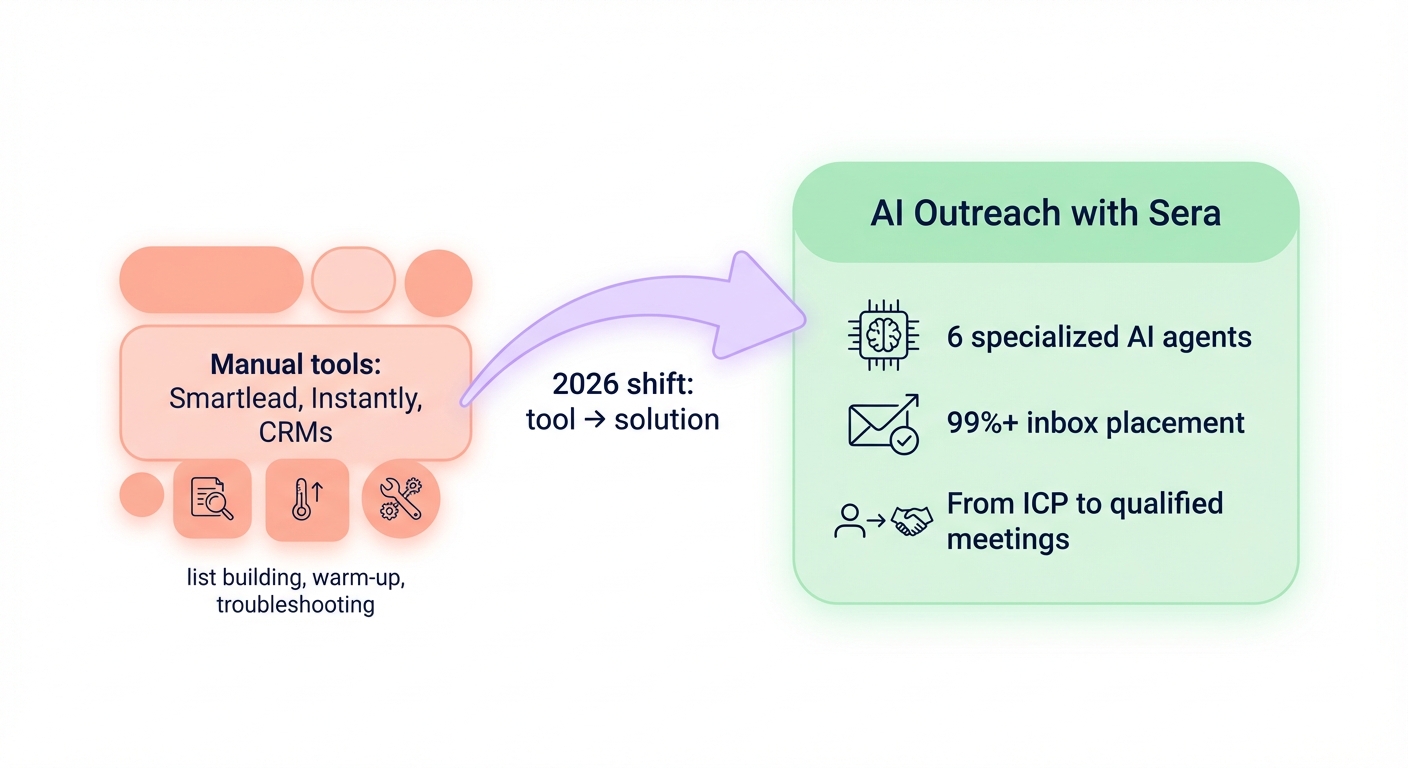
Instead of managing mailboxes and warm-up schedules, you define your ideal customer profile and let the system handle the technical execution. Instead of wondering why your deliverability dropped, you get automatic domain warm-up, address validation, and engagement-based pacing that keeps inbox placement above 99%. Instead of spending 40 hours per week on outbound tasks, you spend your time on qualified conversations with decision-makers who actually responded because the message was relevant and well-timed.
If you’re choosing between Smartlead and Instantly, pick Smartlead for better deliverability fundamentals and responsive support. But if you’re ready to stop managing cold email infrastructure entirely, book a free consultation with Sera to see how AI-driven outreach delivers qualified meetings without the manual work.