


Does your sales team spend 15 hours a week digging through industrial directories? For B2B manufacturers, manual research is a silent profit killer. AI agents eliminate this administrative bottleneck, freeing your best closers to focus on factory floor discussions and high-value deals.
The high cost of manual research in manufacturing
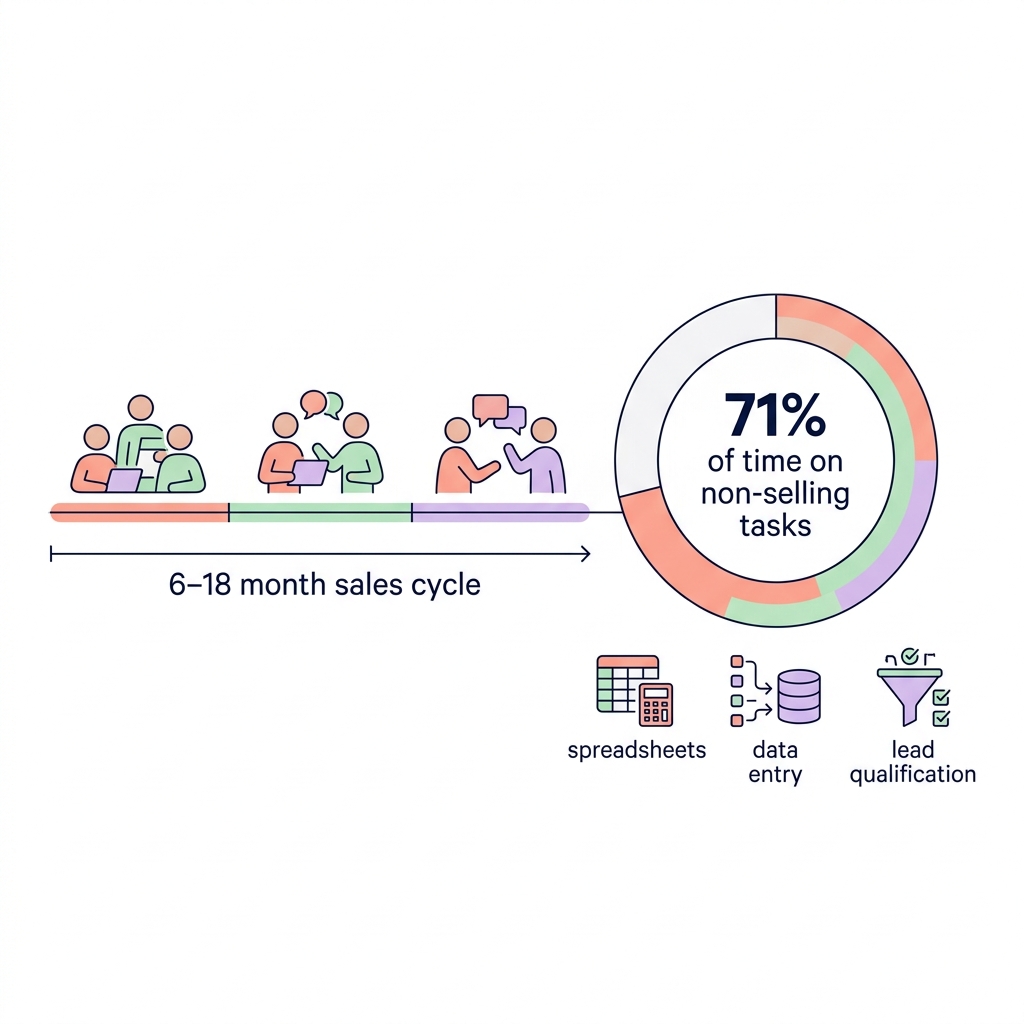
In the industrial sector, sales cycles often stretch between 6 and 18 months. This long duration is frequently compounded by administrative heavy lifting. Recent data shows that sales representatives spend roughly 71% of their time on non-selling tasks such as manual data entry and lead qualification. When your most experienced reps are buried in spreadsheets, your pipeline moves at a glacial pace.
Traditional prospecting methods often rely on static industrial lists that become outdated the moment they are downloaded. For manufacturing executives, this results in generic outreach that fails to resonate with skeptical buyers. These prospects prioritize operational efficiency and technical expertise over a standard sales pitch. Without real-time insights, your team risks appearing out of touch with the specific engineering challenges your customers face.
How AI agents handle the heavy lifting
An AI agent is not a simple database; it is a coordinated system designed to perform the work of a high-performing research analyst. Instead of a human spending hours verifying whether a plant has the necessary ISO certifications or production capacity, a coordinated system of specialized AI agents works in the background to handle the discovery process.
These agents transform the prospecting workflow by automating several critical steps:
- Building targeted lists: Agents scan millions of data points to build a B2B prospect list that matches your ideal customer profile, focusing on specific criteria like facility square footage or equipment investments.
- Enriching company data: They automatically pull firmographic and technographic details, such as the specific ERP or CAD software a prospect currently uses, ensuring every lead is a technical fit.
- Confirming decision-makers: In manufacturing, buying groups often involve 6 to 10 stakeholders. AI agents identify the correct individuals, from plant managers to procurement directors, so you never waste time on the wrong contact.
Identifying technical buying signals
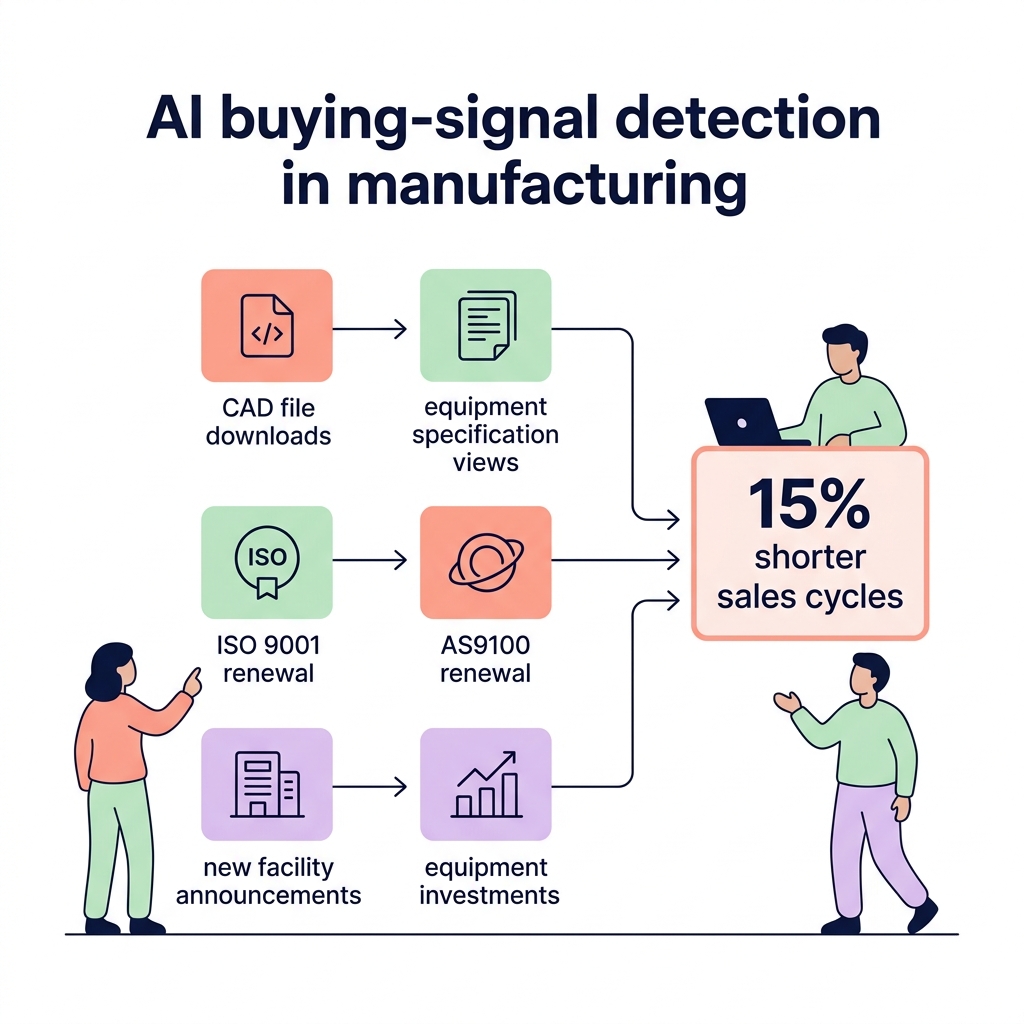
The true advantage of an AI agent lies in its ability to detect “timing.” In the industrial world, reaching out at the exact moment a company is ready to upgrade is the difference between a ignored email and a major contract. AI-driven systems monitor digital footprints to automate prospect scoring based on specific buying signals.
These signals often include technical engagement, such as a prospect downloading specific CAD files or viewing equipment specifications on your site. Agents also track compliance updates, identifying companies that have recently renewed certifications like ISO 9001 or AS9100. Furthermore, they monitor for expansion news, such as new facility announcements or significant equipment investments. By focusing on these high-intent triggers, manufacturers can see 15% shorter sales cycles and significantly higher conversion rates.
Improving outreach relevance
Industrial buyers are generally less active on social media and more focused on finding practical solutions to production bottlenecks. AI agents use the data they collect to help craft personalized outreach sequences that mention a prospect’s specific machinery or recent production milestones. This level of detail moves your messages out of the “spam” category and establishes you as a valuable technical resource.
When an email references a prospect’s specific plant location or a recent compliance challenge they are facing, reply rates can triple compared to generic cold blasts. For companies looking to expand internationally, these agents can even communicate in over 100 languages, ensuring that your technical value proposition is translated with the correct industry nuance. This localized, data-driven approach builds the credibility needed to secure meetings with protective procurement departments.
Integrating AI into your existing workflow
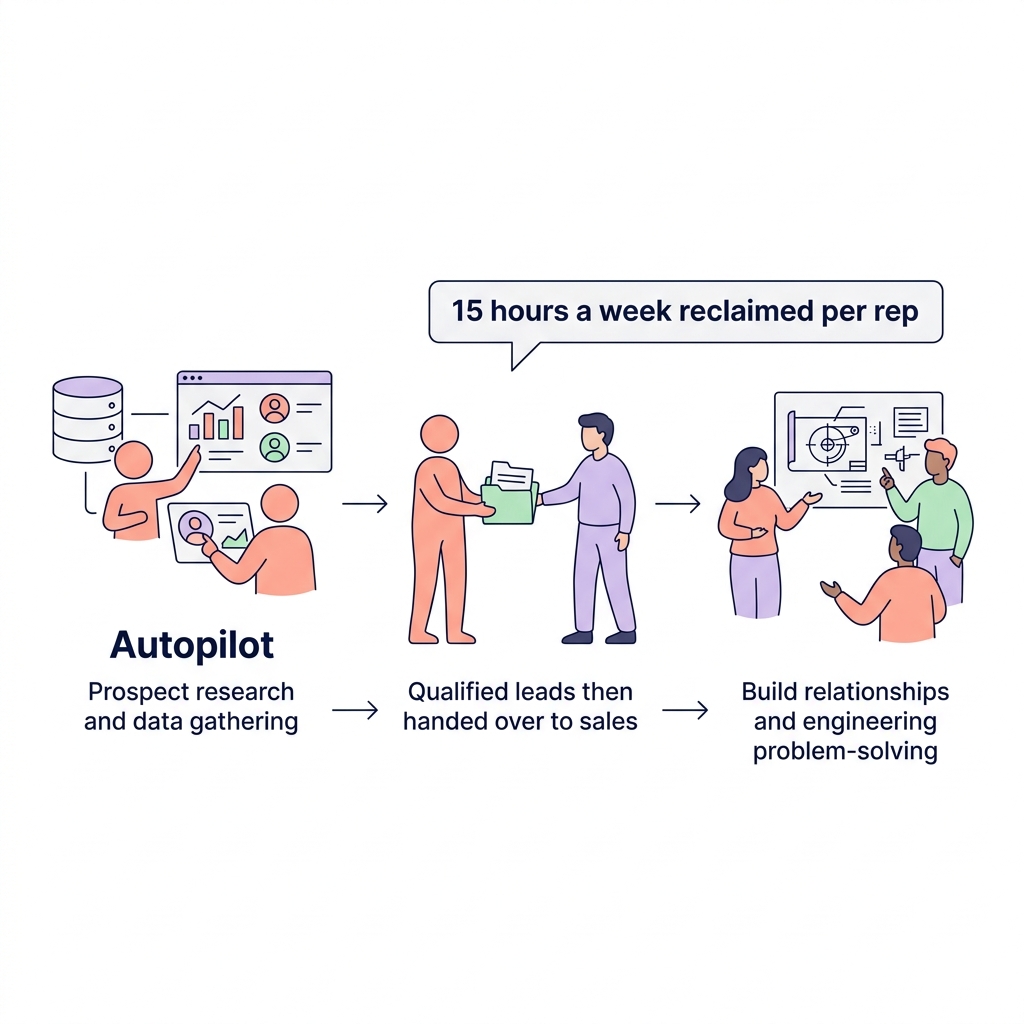
You do not need to overhaul your entire sales operation to see these results. Modern AI agents are built to integrate directly with your CRM, whether you rely on Salesforce, Zoho, or Microsoft Dynamics. This creates a seamless loop where the AI finds and qualifies a lead, enriches the contact record with technical specifications, and then hands it off to your sales team only when the prospect is ready for a professional conversation.
This “Autopilot” approach allows your team to focus on the human elements of manufacturing – building long-term relationships and solving complex engineering problems. Automating your prospect research eliminates the administrative bottleneck that slows down industrial growth. By letting AI handle the data gathering, you reclaim 15 hours a week for every rep, allowing them to focus on high-value activities that drive revenue.
To see how AI-driven research can transform your manufacturing pipeline and fill your calendar with qualified meetings, explore the Sera Autopilot today.