

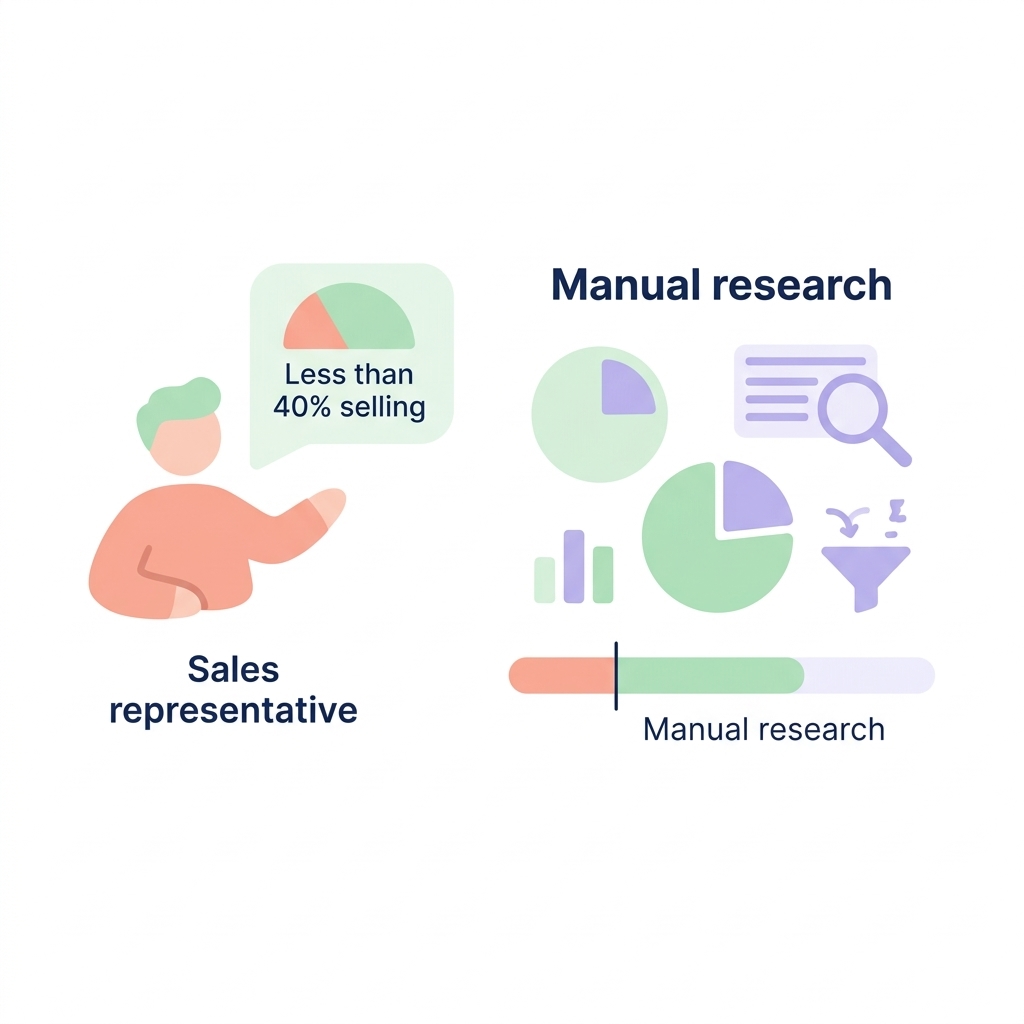
Are your sales reps spending more time on manual research than actually closing deals? Most B2B teams spend less than 40% of their day selling. AI agents solve this by automating the prospecting journey through intelligent, human-supervised workflows.
What are AI agents in B2B sales?
In the past, sales automation meant simple, rule-based tools. You would set a trigger, and a static action would follow without any room for nuance. Today, the industry has shifted toward agentic workflows. Unlike basic tools, AI agents for B2B sales are autonomous software entities that can reason, adapt, and make decisions independently.
These agents don’t just follow a rigid script; they solve problems. For instance, an agent can identify a specific buying trigger – like a manufacturing plant expansion – and independently decide which technical case study is most relevant to send to the plant manager. For GTM teams, this means moving away from mass “spray and pray” tactics. Instead, you can focus on automated lead generation that feels personal because the software has actually done the necessary homework on each prospect.
A coordinated system of six specialized agents
Rather than using one “catch-all” bot, the most effective sales systems use specialized agents working in a tight sequence. This mimics a high-performing sales team where different experts handle research, data, and writing. At Sera, we utilize six distinct agents to handle the heavy lifting:
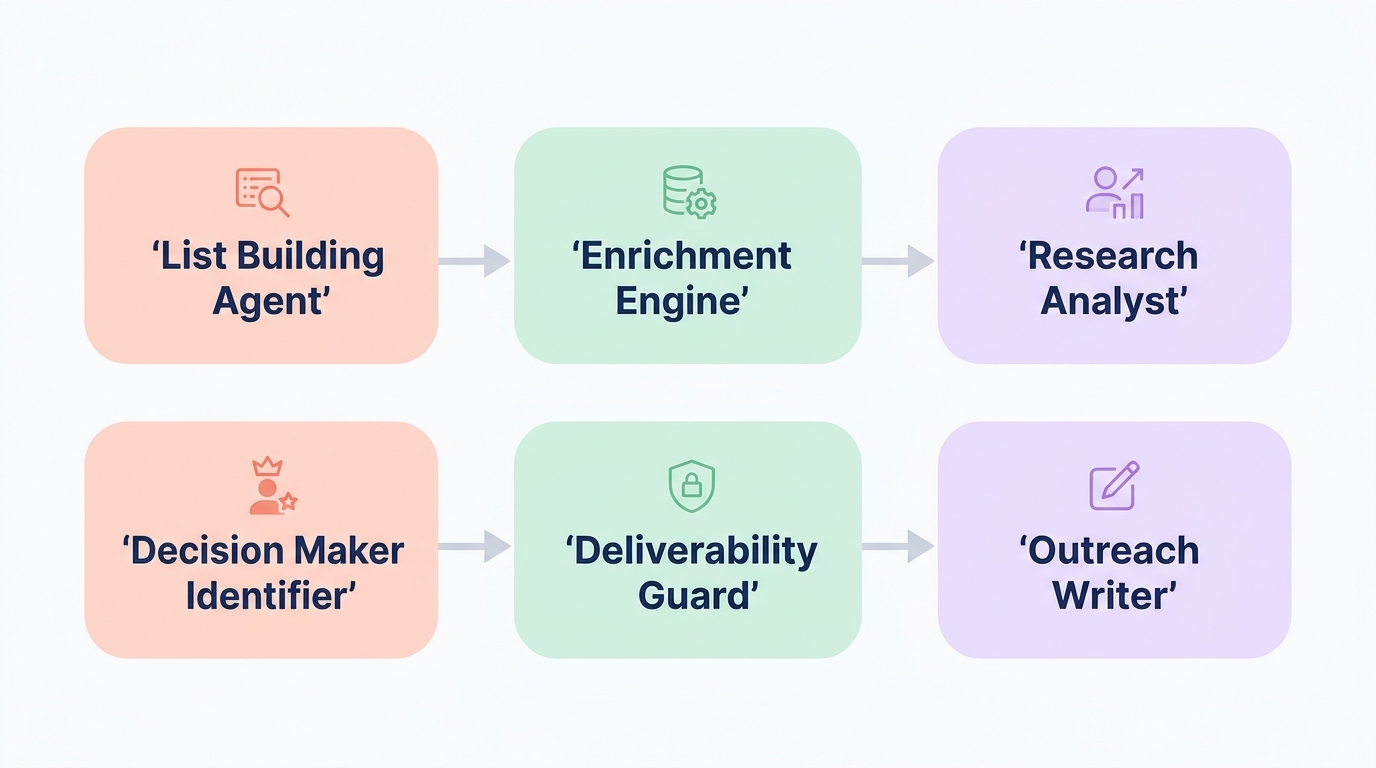
- List Building Agent: This agent scans databases of over 1 billion professionals to find companies that exactly match your Ideal Customer Profile.
- Enrichment Engine: It adds deep firmographic data, such as company size and revenue, and technographics, like the specific software systems a prospect currently uses.
- Research Analyst: By scanning news and LinkedIn, this agent finds “buying signals,” such as recent funding rounds or facility expansions, to ensure your timing is perfect.
- Decision Maker Identifier: This ensures you are reaching the individual with the authority to approve a new vendor, preventing wasted effort on the wrong leads.
- Deliverability Guard: To ensure your outreach actually reaches its destination, this agent protects your sender reputation and keeps your messages out of the spam folder.
- Outreach Writer: This agent crafts human-sounding messages in over 100 languages, adapting the tone to match the cultural nuances and industry standards of your prospect.
The importance of human supervision
While automation is powerful, complete autonomy carries risks. Fully autonomous AI can sometimes “hallucinate” or produce awkward phrasing that harms your long-term brand reputation. This is why a human-in-the-loop approach is essential for high-value B2B deals.
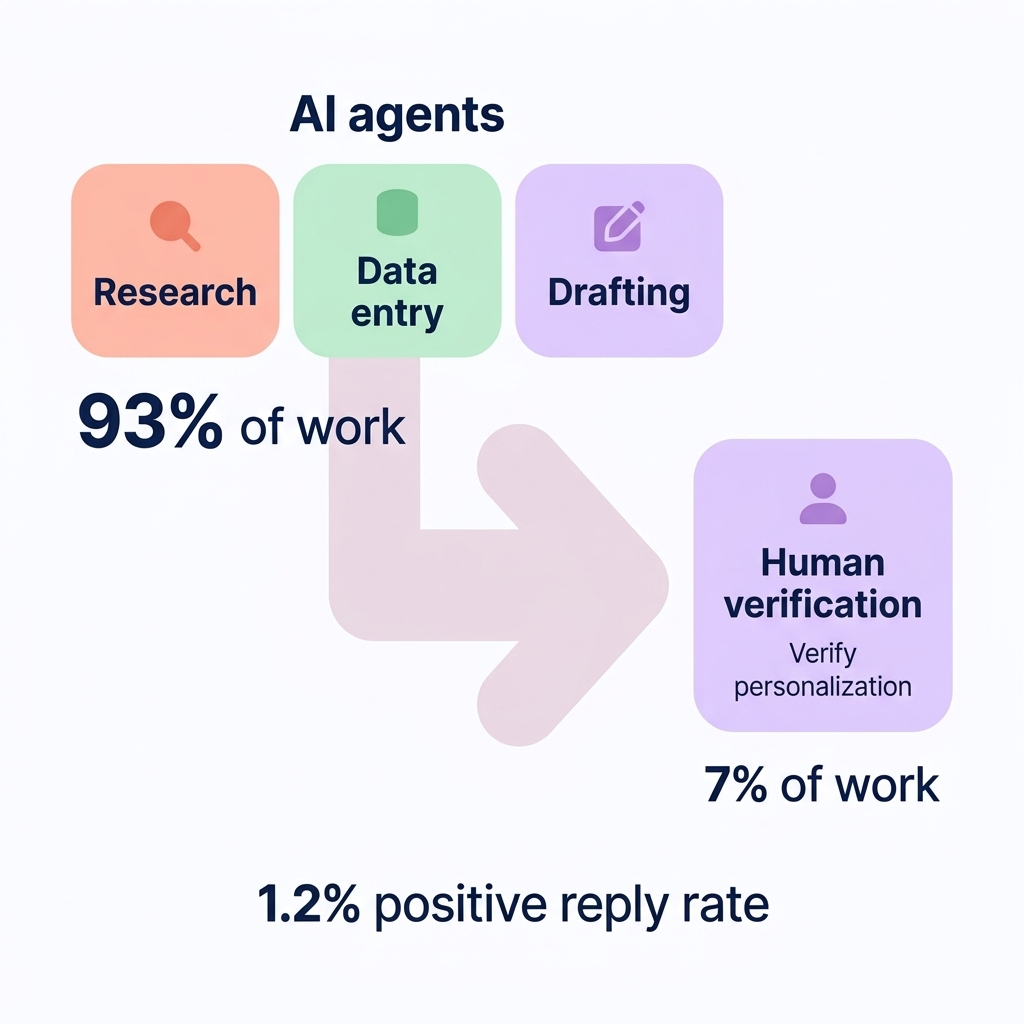
In a supervised model, AI agents handle roughly 93% of the work – the tedious data entry, research, and initial drafting. Human supervisors then perform the final 7% of the work by verifying the data and ensuring the personalization is accurate. This hybrid model is a key reason why many teams see a 1.2% positive reply rate, which is significantly higher than traditional cold outreach. By utilizing AI in personalized sales outreach, you preserve the “human touch” while benefiting from machine-level speed.
Measurable impact on your revenue
The primary goal of AI agents isn’t just to increase email volume. It is to book more meetings with higher-quality leads and move them through the funnel faster. Research and real-world benchmarks show that these systems provide clear financial gains for B2B teams:
- Higher Conversion: Companies using AI-driven lead scoring have seen lead-to-deal conversion rates boost by as much as 51%.
- Shorter Sales Cycles: By identifying high-intent buyers earlier in their journey, many UK firms have reported a 25% reduction in their average sales cycle length.
- Increased Productivity: Sales teams see an average 14.2% boost in productivity by reclaiming hours previously spent on manual prospecting.
- Scalability: AI SDRs can process thousands of interactions daily, a volume that would traditionally require dozens of human hires to achieve.
Scaling your GTM strategy
For many manufacturers and service providers, the biggest hurdle is integrating CRM data with AI. AI agents work best when they can “read” your previous interactions in platforms like Salesforce or HubSpot. This prevents embarrassing mistakes, such as contacting an existing client with a cold sales pitch.
When looking at B2B sales use cases, AI agents are particularly effective for market expansion. You can enter new European markets using native-level outreach in dozens of languages without hiring a local team immediately. This creates a “GTM validation loop,” where you can quickly test how different industries respond to your value proposition and turn hypotheses into booked conversations.
By automating the repetitive parts of prospecting, your team can focus on the true art of the deal: building relationships and negotiating complex agreements. AI agents are no longer a future concept; they are a practical way to transform your sales process into a predictable revenue engine.
Book a demo with Sera to see how our AI agents can fill your calendar with qualified meetings.