


Are your sales reps spending more time searching for contacts than closing deals? In an era where 95% of the industrial buyer journey happens anonymously, reaching decision-makers requires more than just one-off emails. Here is how to coordinate your outreach to generate high-quality leads consistently.
The advantage of multichannel coordination
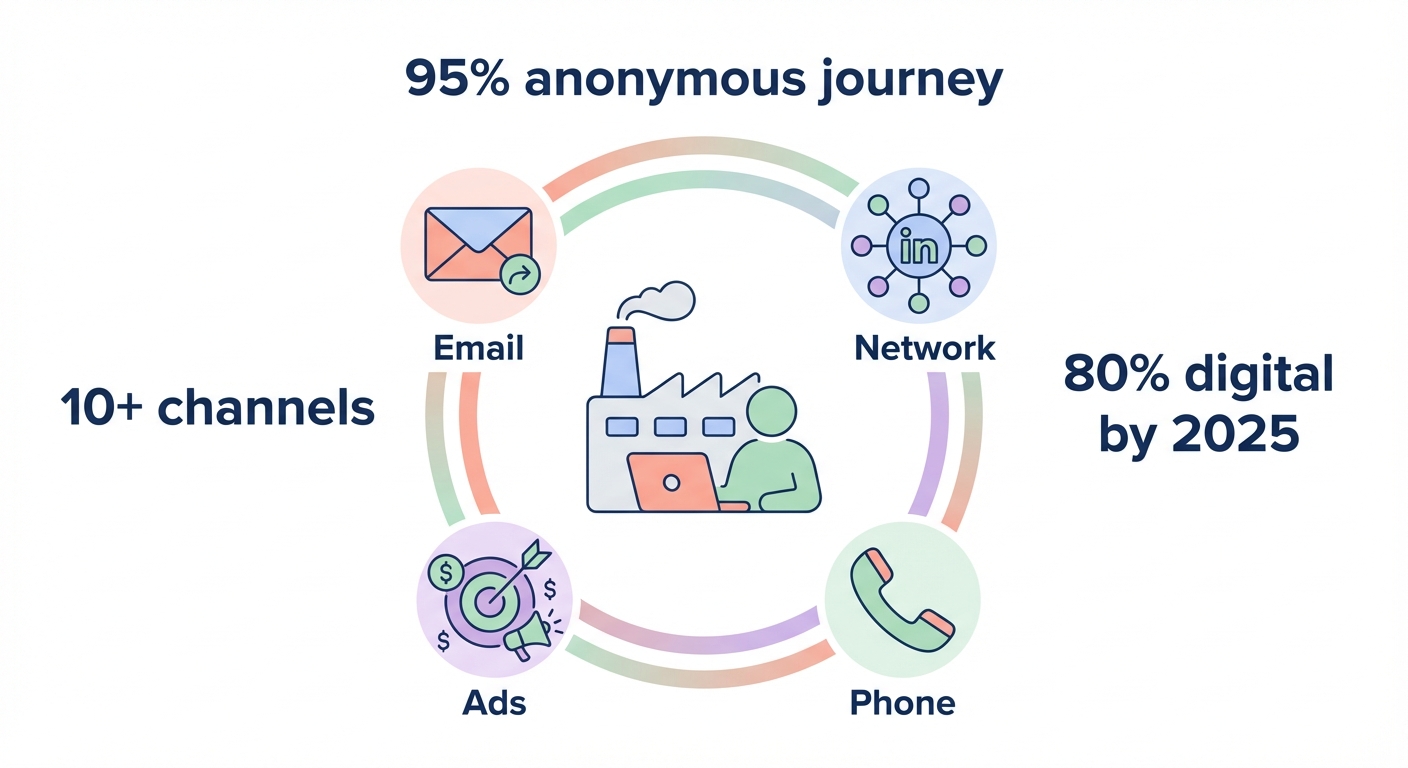
In the traditional industrial sector, the buyer’s journey has shifted significantly. B2B customers now use ten or more channels to interact with suppliers, which is double the number of channels used just a few years ago. If your team relies solely on a single method of contact, you are likely missing a vast portion of the potential conversation.
Research suggests that 80% of B2B sales interactions will occur through digital channels by 2025. By coordinating email, LinkedIn, and phone touches, you move beyond simply reaching out to a prospect; you establish a meaningful presence. This “surround sound” effect is particularly effective at overcoming the skepticism common in industrial sales prospecting, where buyers often research suppliers extensively before making direct contact.
Four essential channels for manufacturing outreach
To generate more qualified leads, your strategy should focus on four core pillars that work in tandem to build trust and authority.
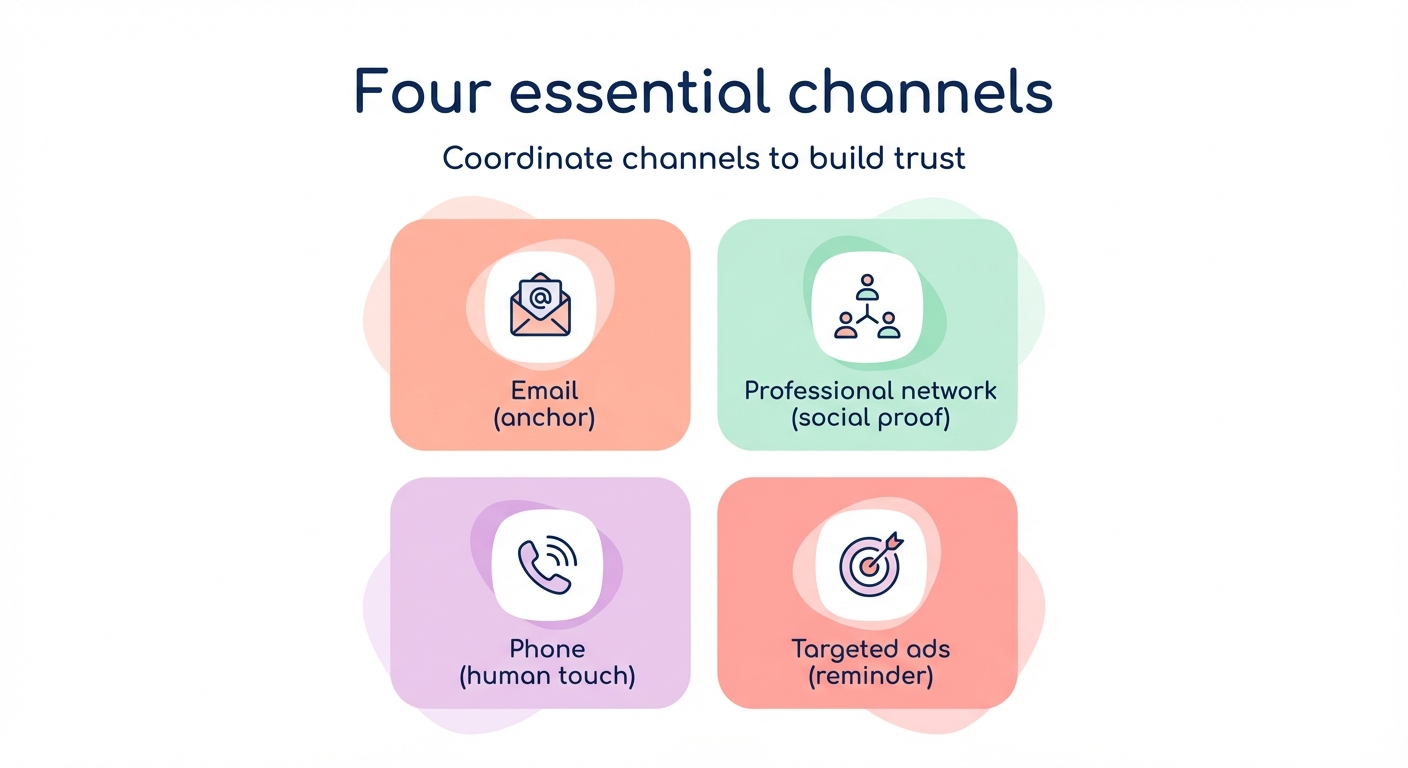
- Email acts as your anchor. This channel is best used for initial outreach and delivering technical value, such as ROI calculators or spec sheets. To ensure your messages actually reach the recipient, your technical email deliverability setup – including SPF, DKIM, and DMARC – must be flawless.
- LinkedIn provides social proof. Rather than leading with a hard pitch, use this platform to engage with a prospect’s professional content or share industry-specific insights. For manufacturing, demonstrating that you understand complex operational challenges helps you stand out from generic competitors.
- The phone offers a human touch. Personal calls should be reserved for high-value prospects or used to follow up on specific engagement triggers. For example, a call is highly effective after a lead has opened a technical data sheet multiple times.
- Targeted ads serve as a persistent reminder. You can use LinkedIn or Google Ads to retarget individuals who visited your trade show booth or downloaded a white paper. This keeps your brand top-of-mind without requiring an active “ask” from your sales team.
A sample 12-touchpoint outreach cadence
Effective outreach requires persistence and a high level of organization. Studies show that 80% of sales require between five and twelve follow-ups, yet the vast majority of sales representatives stop after only two attempts. For a typical manufacturing outreach campaign, you should aim for a structured cadence of 8–12 touchpoints over a four-week period.
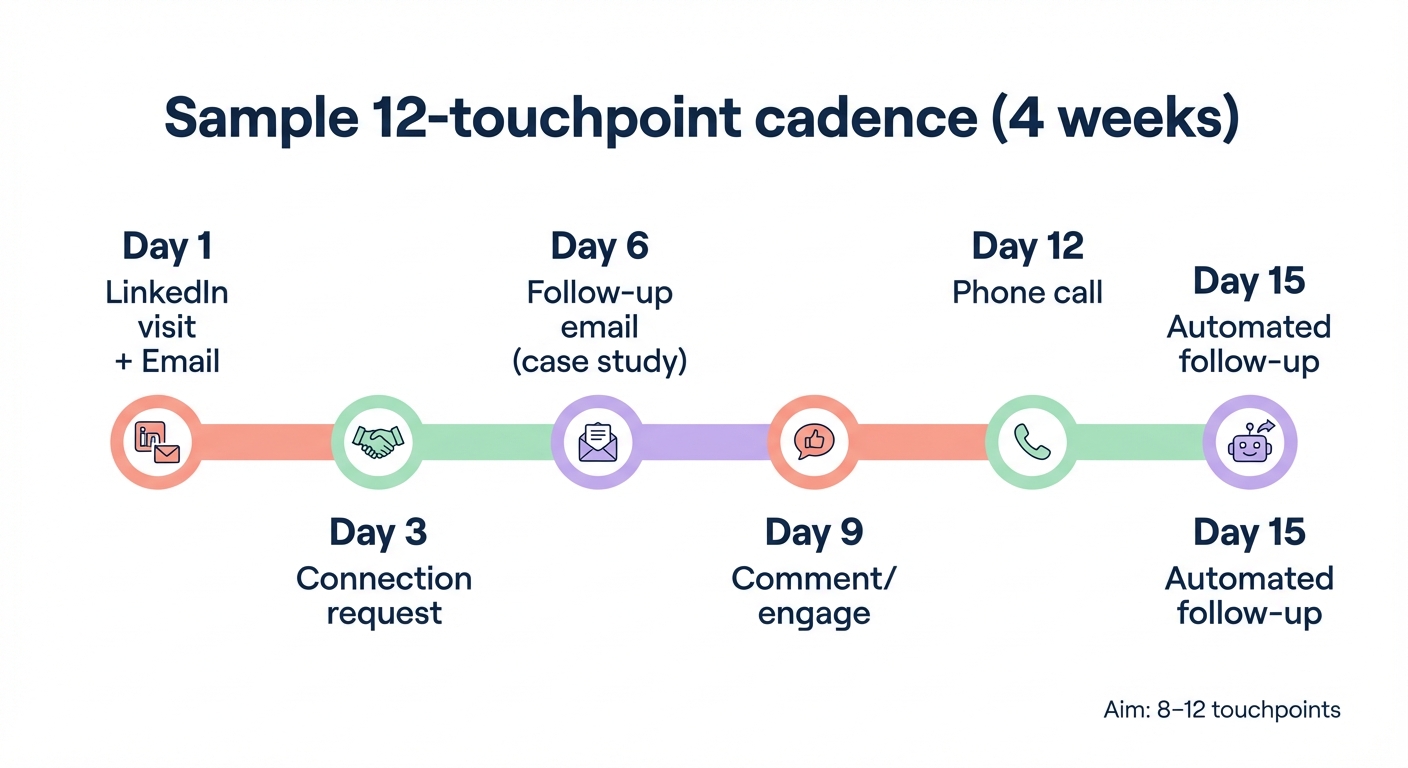
- Day 1: Start with a LinkedIn profile visit followed by a personalized sales email that references a specific facility or recent industry news.
- Day 3: Send a LinkedIn connection request with a short, professional note that focuses on mutual industry interests rather than sales.
- Day 6: Send a follow-up email sharing a relevant case study, such as how you reduced defect rates for a similar Tier 1 supplier.
- Day 9: Engage on LinkedIn by commenting on a recent industry trend or a post the prospect shared.
- Day 12: Place a brief phone call to check if they had any questions regarding the case study you provided.
- Day 15: Use an automated follow-up email with a soft call to action, like suggesting a brief fifteen-minute introductory chat.
Overcoming the technical barrier
Coordinating multiple channels manually is often too demanding for lean manufacturing teams. Much of the struggle stems from siloed data. A critical first step is integrating LinkedIn activity with your CRM, which allows you to track every interaction in one place. This visibility ensures your sales team only spends their time calling pre-qualified leads who have already shown interest.
Furthermore, AI-driven multi-channel automation can take over the heavy lifting involved in research and sequencing. This technology ensures your outreach remains human-sounding and highly targeted, avoiding the generic “batch-and-blast” methods that often result in your domain being flagged as spam.
Scaling precision with Sera’s AI Autopilot
Traditional manufacturing companies often lack the massive sales development teams needed to run these complex sequences manually. This is where Sera’s AI Autopilot transforms the process. Sera acts as a virtual outreach team, utilizing six coordinated AI agents to find and engage your ideal clients.
The system includes a List Building Agent to source verified decision-makers and a Research Analyst that scans the web for specific buying signals. Our Outreach Writer then crafts natural, multilingual messages that reference actual research, ensuring your outreach feels like a one-to-one conversation. By focusing on low-volume, high-precision outreach, Sera maintains a 99% email deliverability rate and generates a steady flow of meetings while your team focuses on closing deals.
To see how AI-driven multichannel outreach can fill your pipeline and save your team hours of manual research, book a free consultation with Sera.