

Are you still paying for a sales database that requires your team to spend 20 hours a week just to keep it running? In 2026, Apollo.io remains a massive data source, but for manufacturing executives, the real cost is the manual labor required to make it work.
Apollo.io 2026 pricing plans and seat costs
Apollo’s pricing structure for 2026 is built on a per-user model, meaning your costs scale directly with the size of your sales team. If you are currently evaluating the trade-offs between Apollo.io vs Lusha, you will notice Apollo positions itself as an all-in-one cockpit for both data and outreach.
The costs depend largely on the level of automation and data access your team needs. While the entry points seem accessible, the total investment often grows once you add multiple seats and account for the “use-it-or-lose-it” credit system at the end of each billing cycle.
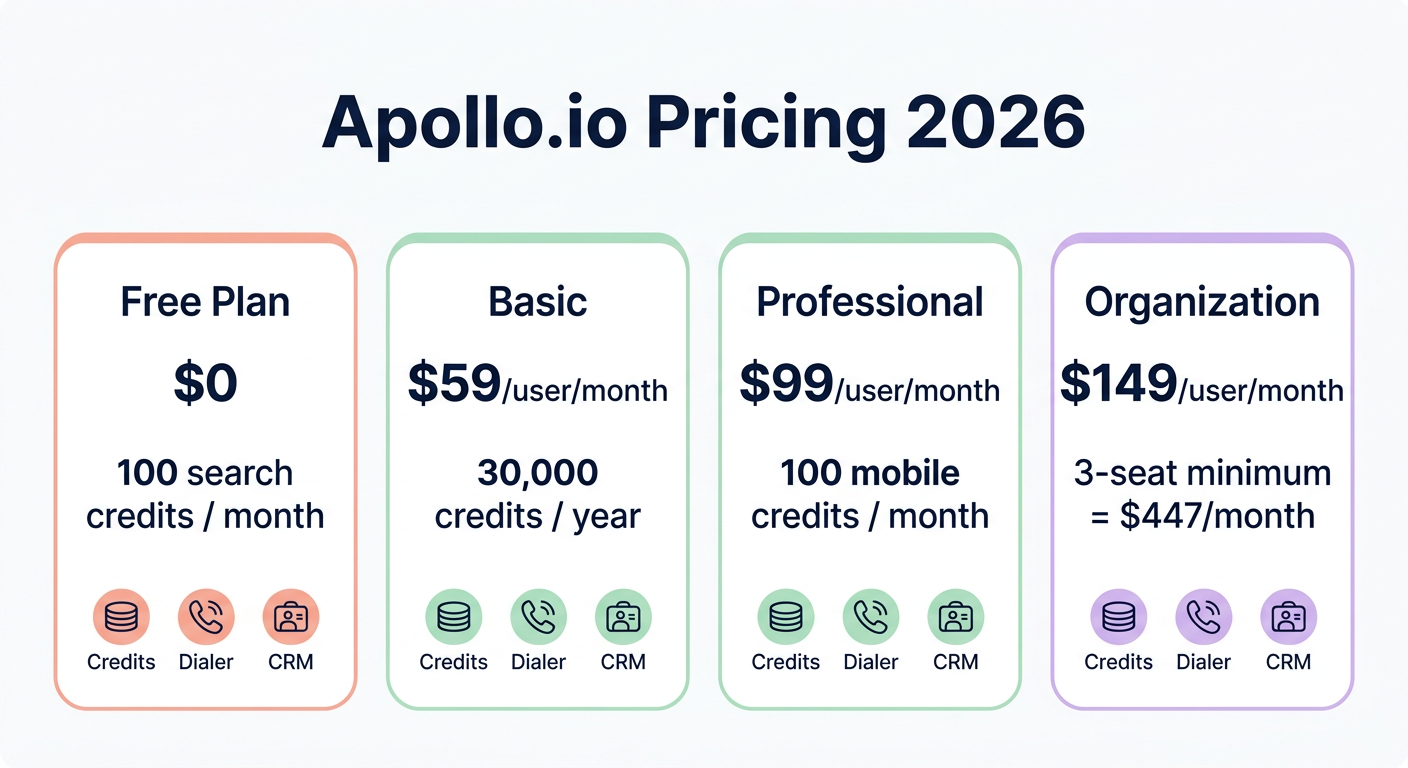
- Free Plan ($0): Includes 100 search credits per month for basic testing without the automation needed for industrial-scale outreach.
- Basic Plan ($59/user/month): Provides roughly 30,000 credits annually and unlimited email sequences for small teams focused on volume.
- Professional Plan ($99/user/month): Adds A/B testing, a US-based dialer, and AI-driven call recording insights for more active sales departments.
- Organization Plan ($149/user/month): Requires a minimum of three seats ($447/month minimum) and includes international dialing and advanced CRM integrations.
Feature limits and the credit system
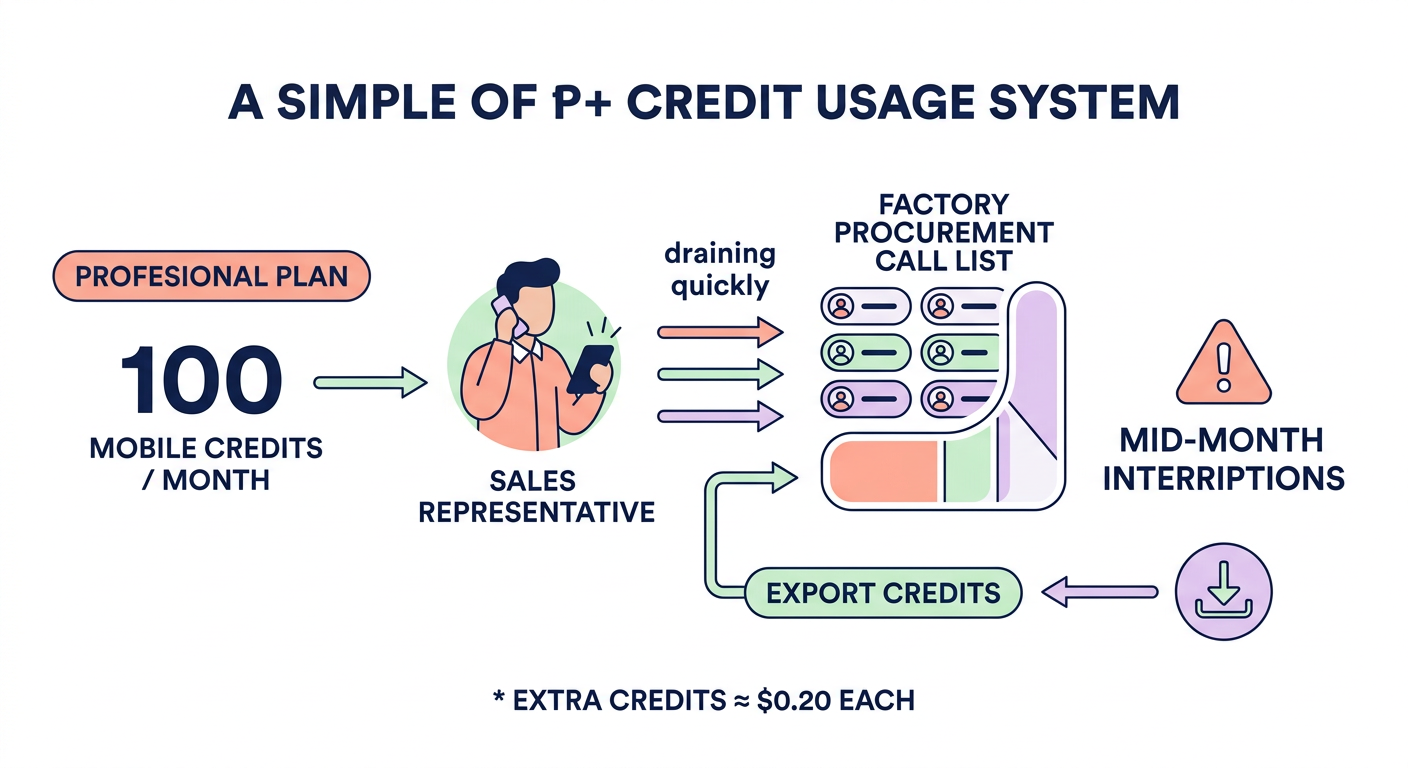
Understanding feature limits is critical to avoiding mid-month service interruptions. In 2026, Apollo uses a tiered credit system that distinguishes between export credits and mobile credits. Export credits allow you to move data to your CRM, while mobile credits are required to access direct phone lines. On the Professional plan, you typically receive 100 mobile credits per month. If your sales team spends their days calling procurement officers at large plants, these credits disappear quickly. Extra credits typically cost around $0.20 each and often require a minimum purchase.
Beyond data access, there are functional limits to consider regarding email health. Although Apollo claims to offer unlimited email sequences, they enforce fair use limits to prevent platform abuse. Sending high volumes of generic emails often leads to domain flagging and poor deliverability. For manufacturers who value their reputation, this volume-over-value approach can be a significant hidden risk that damages your ability to reach new accounts.
The “SDR tax” for manufacturing sales teams
For a manufacturing firm, the most expensive part of using a tool like Apollo is the manual labor required to operate it. Research shows that sales teams using manual databases often spend 15 to 30 hours per week building lists, cleaning data, and updating CRMs. This “SDR tax” diverts your best people away from actually talking to prospects and closing deals.
When you are selling high-value equipment or technical services, generic AI writing tools often fail to resonate with engineers and decision-makers. You end up paying for a product that still requires a full-time human operator to verify if a contact is still at the company, research specific buying signals like new plant openings, and protect email deliverability. If your average deal size is over €10k, spending your team’s time clicking buttons in a database is likely costing you more in lost opportunities than the software itself.
Shifting from software tools to AI Autopilots
By 2026, the market has moved beyond manual data tools. Many industrial leaders are choosing to put their outreach on autopilot instead of managing a complex stack of data providers and email warm-up tools. While Apollo provides a database, it does not provide the finished outcome of a booked meeting without significant human intervention.
Modern solutions like Sera’s AI Autopilot handle the entire process. Sera uses six specialized AI agents, including a List Building Agent and a Research Analyst, to manage the heavy lifting. Instead of your team spending hours inside a database, the AI identifies decision-makers, confirms their authority, and writes personalized, multilingual outreach. This allows your team to focus on the use cases where they provide the most value: closing technical sales and building long-term relationships.
Evaluating the total value
If you need a simple, low-cost database for occasional lookups, Apollo’s Basic or Professional plans are functional. However, if your goal is to enter new markets or scale your efficiency without adding more headcount, the manual labor required by these platforms may hold you back. In a world where nearly half of all email traffic is spam, the winners in 2026 are not those who send the most emails, but those who send the most precise, well-researched ones.
Before committing to a long-term contract, consider if your team should be managing software or managing relationships. If you want to scale your pricing efficiency and ensure your messages actually land in the inbox, an AI-driven outreach service can protect your domain and fill your calendar while your team focuses on high-value closing tasks.
Book a free 30-minute strategy consultation to see how Sera’s AI agents can automate your outreach