

Are you still paying for a database that your team has to manually sift through for hours every week? In 2026, simply owning a list of contacts isn’t enough to hit your revenue targets. You need a way to turn data into booked meetings without adding headcount.
ZoomInfo pricing and financial terms in 2026
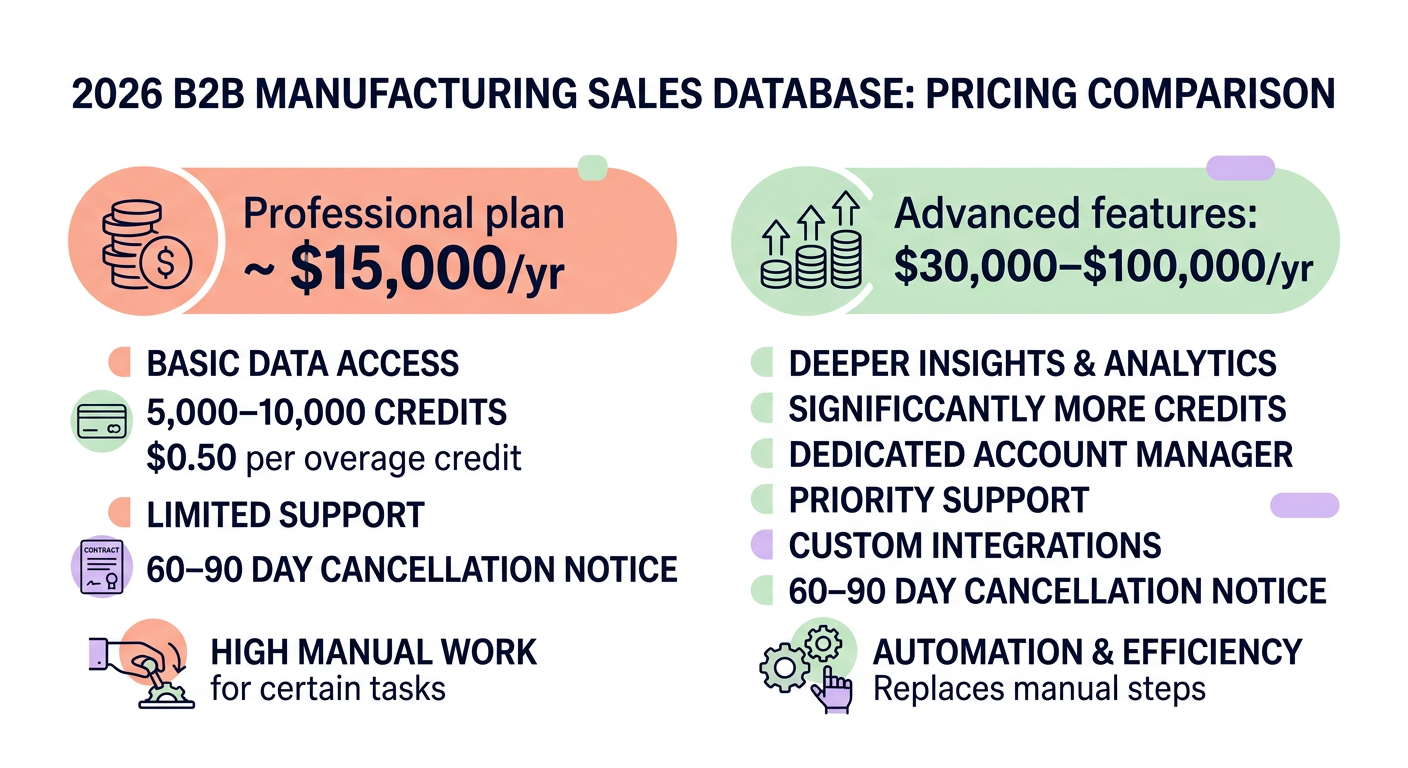
ZoomInfo remains the enterprise-grade warehouse of the sales world, but that status comes with a significant price tag. For most manufacturing teams, quote-based pricing for the Professional plan starts at approximately $15,000 per year for a three-seat minimum. If your firm requires advanced features like real-time intent signals or parent-subsidiary mapping for complex industrial accounts, those costs can easily scale to $30,000 or even $100,000 annually.
Beyond the initial subscription, the platform operates on a credit-based model that can punish high-volume prospecting. Most plans provide between 5,000 and 10,000 credits, with overages costing as much as $0.50 per credit. Because these credits rarely roll over, teams face a “use it or lose it” pressure. Furthermore, the mandatory annual contracts often require a 60 to 90-day notice period for cancellation, making it difficult to pivot strategies quickly. There is also a hidden “SDR Tax” to consider; you still need to pay a human operator to write sequences and manage email deliverability to ensure messages actually reach the inbox.
Data quality: North American depth vs. global gaps
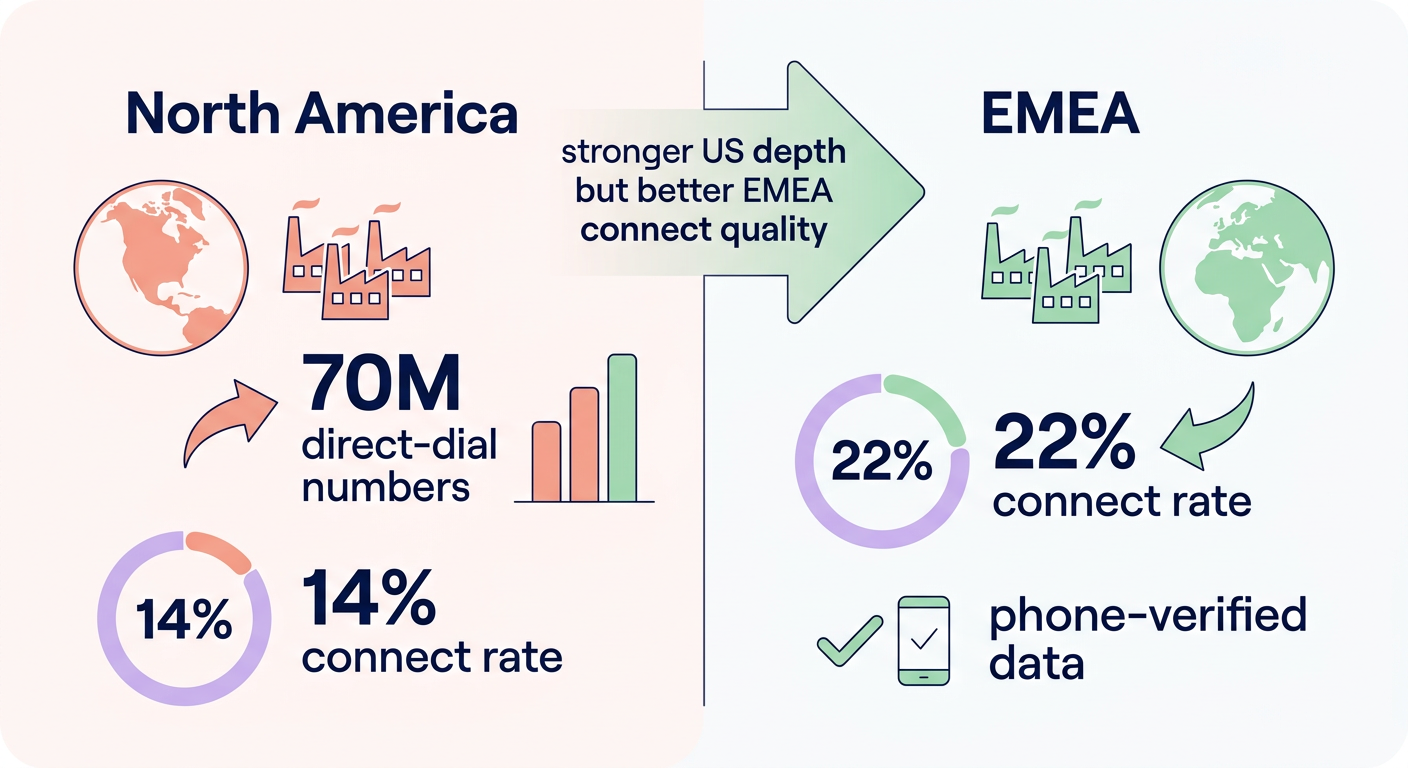
The strongest asset ZoomInfo offers in 2026 is its North American database. With over 70 million direct-dial numbers and a reported 14% call connect rate, it is a powerhouse for US-based industrial sales. Their WebSights signals are particularly useful for spotting when a large company is researching new plant equipment or industrial services.
The landscape shifts significantly if your manufacturing firm exports to Europe or Asia. Research suggests that Cognism often outperforms ZoomInfo in EMEA markets with its phone-verified Diamond Data, which boasts a 22% connect rate. In the manufacturing sector, where procurement heads may stay in roles for decades, titles are often stable, but mobile numbers and direct emails change frequently as companies modernize their IT stacks. This makes real-time verification a necessity rather than a luxury.
Why a database is no longer enough in 2026
The biggest shift in 2026 is not the data itself, but the difficulty of executing outreach. Stricter inbox defenses from major providers mean that if you buy a list and blast out generic emails, your domain will likely be blacklisted within weeks. Many firms find that they are paying for high-quality data only to have their outreach blocked by automated spam filters.
If you have a dedicated RevOps team to manage complex sequences, Apollo.io offers a more affordable all-in-one stack for about $99 per month per user. However, for many manufacturing executives, the goal is not to manage more software or hire more people to click buttons in a CRM. The objective is to secure high-value meetings. This has led to a rise in AI-driven outreach solutions that handle the orchestration that legacy databases leave to humans.
Why manufacturers are switching to AI autopilots
Modern industrial sales cycles often last between 6 and 18 months, requiring a level of personalization that mass-volume tools cannot provide. Sera’s AI Autopilot addresses this by replacing the manual labor of list building and prospecting with six specialized agents that work in sync. Instead of just providing a list, the system finds verified leads, expands each contact with technographics, and scans press data for buying signals.
This autonomous approach confirms the right decision-maker is being contacted before the writer agent crafts a personalized message. Because manufacturing is a global industry, Sera provides multilingual emails in over 100 languages, ensuring your outreach feels authentic to local buyers. A dedicated deliverability guard then manages the pacing to maintain a 99% inbox placement rate. This allows your technical staff to focus on closing deals rather than managing software.
The verdict: investment vs. outcome
ZoomInfo is a viable investment if you already have a large sales team and a dedicated operations manager to oversee credits and manual workflows. It remains a top-tier data warehouse for the North American market. However, if you want to eliminate manual clicking and the cost of hiring new SDRs, an autonomous solution is often superior.
Instead of paying for a database and a junior salesperson to operate it, many manufacturers are now using Sera to automate 93% of the prospecting lifecycle. By focusing on low-volume, high-precision outreach, you protect your company’s reputation and ensure your engineers only spend time on calls with verified decision-makers.
Stop managing databases and start booking high-value manufacturing contracts. Book a free 30-minute strategy call with Sera today to see how our AI agents can fill your calendar.